
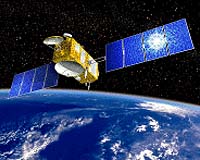
At the conclusion of the first international ocean satellite meeting in Hobart last week, scientists reviewed objectives and opportunities for the joint NASA/French Space Agency satellite to be launched in June next year. The meeting was sponsored locally by the CSIRO Wealth from Oceans Research Flagship, the Bureau of Meteorology and the Royal Australian Navy.
Called Jason 2, it will join its predecessor in mapping the world's oceans with application in monitoring climate variabilty and change through sea level variations, and contributing to Australia's ocean forecasting capabilities.
The key instrument on the satellite, an altimeter, measures the height of the ocean and can be used to quantify water resources held in lakes and river systems.
The head of NASA's oceanography program, Dr Eric Lindstrom, said today Tasmanian scientists and engineers would contribute to the mission in two ways:
+ Through a system of 'ground-truthing' with moored and laser instruments near Burnie in the State's north-west
+ Developing a research program associated with the satellite's extremely accurate sea level measurements.
Burnie, Corsica in the Mediterranean and California are the three sites from which NASA calibrates satellite ocean-observing instruments.
Dr Lindstrom said it was appropriate that Tasmania should be the venue for the ocean-surface topography meeting.
"The State has a significant science base in which satellite altimetry already plays an important part in measuring and monitoring the oceans around Australia.
"We look forward to Australian scientists continuing their role in our science programs and in on-ground verification of the satellites accuracy," Dr Lindstom said.
The satellite circles 1,300 kilometres above the earth and can measure changes in ocean height to within an accuracy of 2 cm.
The meeting attracted 180 scientists, including 30 Australian researchers.
