
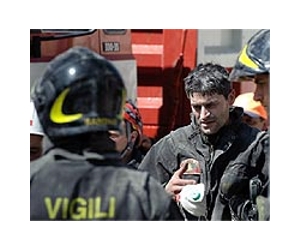
Residents of L'Aquila marked Tuesday the anniversary of the earthquake which leveled the Italian city with children releasing balloons bearing messages to the 308 people killed in the disaster.
The multi-coloured balloons lifted off into the bright spring sky as the father of 10-year-old Riccardo, who lost his best friend in the tragedy, said he was confident the medieval walled city would "recover its old beauty and energy."
But like many other displaced residents of the capital of Italy's central Abruzzo region, Giuseppe told AFP he was "still concerned about the reconstruction" of the city, most of which still remains an off-limits "red zone" because of the dangerous state of the buildings and the rubble-strewn streets.
Thousands of displaced residents would prefer to move back to their homes instead of accepting new housing far from the city centre, which campaigners say was built at three times the projected cost.
"This money could have been used differently," said Eugenio Carlomagno, a co-founder of a pressure group called L'Aquila, A City Centre to Save.
"With that sort of money they could have housed 45,000 people, not only 14,000," he said.
Of some 120,000 people affected by the earthquake in and around L'Aquila, more than 52,000 have yet to return home or move into new housing.
Many are living in hotels along the Adriatic seacoast or in barracks at public expense.
Residents of the new housing estates complain that they have no supporting transport links, no public services — or even shops.
Reconstruction efforts are also clouded by scandal, with the head of civil protection service himself implicated in a wide-ranging investigation into the awarding of contracts in the quake zone.
Guido Bertolaso — initially lionised for his response to the disaster — said Tuesday that L'Aquila could be rebuilt in seven or eight years if reconstruction work continued "nonstop," the ANSA news agency reported.
"In this difficult and dramatic year, we have done all we can to ease the hardships of the people of L'Aquila," he said, adding: "That's why we concentrated right away on building lodging to allow everyone to live in dignity."
He added: "In the space of seven or eight years, all can be completed and restored to the city, even better than before."
Conservative Italian Prime Minister Silvio Berlusconi, who made frequent trips to the disaster zone in the weeks following the earthquake, was conspicuous by his absence from Tuesday's observances.
"Berlusconi did not come because he would have been booed," said Father Nunzio Spinelli of L'Aquila's Collemaggio basilica. "That is the real reason for his absence," he told ANSA.
Some displaced residents have taken to spending Sundays loading wheelbarrows with rubble in the "red zone" in a bid to shame officials over the slow pace of reconstruction.
Berlusconi and President Giorgio Napolitano both sent messages to a council meeting late Monday at which displaced residents laid out their grievances.
Some 25,000 people later took part in a torchlight procession in the early hours of Tuesday — timed to coincide exactly with the anniversary of the quake, which struck at 3:32 am on April 6, 2009.
Many wept in L'Aquila's central square as the severely damaged cathedral tolled its bell 308 times in honour of the dead and their names were read out.
"A year has passed, but we haven't yet found the strength to live with it," said the father of Matteo Vannucci, a student victim.
"It's the first time I've come back to the centre and it's shocking. All the little streets are closed, and one can imagine how bad it is further in," said another displaced resident.
After the march, residents attended a mass at the romanesque Collemaggio basilica, a landmark of L'Aquila whose cupola, transept vaults and triumphal arches collapsed in the quake.
Though still shrouded in scaffolding inside and out, the basilica has reopened to the public.
Share This Article With Planet Earth
