
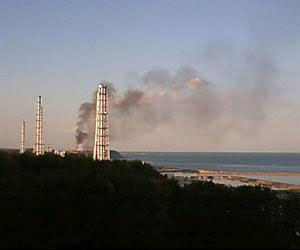
The main lesson of Chernobyl and Fukushima is that authorities must tell the truth, Russian President Dmitry Medvedev said Monday ahead of the 25th anniversary of the world's worst nuclear disaster.
Medvedev made the plea for transparency in nuclear emergencies at a meeting in the Kremlin with rescue workers who were charged with cleaning up Chernobyl and have long complained of being unaware of the risks they were encountering.
"I think that our modern states must see the main lesson of what happened at Chernobyl and the most recent Japanese tragedy as the necessity to tell people the truth," Medvedev told the meeting ahead of the Chernobyl anniversary on Tuesday.
"The world is so fragile and we are so connected that any attempts to hide the truth, to gloss over a situation, to make it more optimistic, will end with tragedy and cost the lives of people."
"This is a tough and important lesson of what happened."
Moscow stayed silent on the Chernobyl disaster for three days, with the official news agency TASS only reporting an accident there on April 28 after the Forsmark nuclear plant in Sweden reported unusually high radiation.
The operator of Fukushima, Tokyo Electrical Power Co. (TEPCO), has also come under fire over its information policy and has been accused of not disclosing full and clear information, especially in the early days of the disaster last month.
Medvedev slammed the unwillingness of the then Soviet Union to admit the extent of the Chernobyl disaster, recalling how the first report in Communist Party mouthpiece Pravda was a small article in tiny letters in the back.
"The state did not immediately have the courage to acknowledge the consequences of what happened. I remember, like many other people, how everything looked very strange," he said.
Six of the liquidators — as the rescue workers were called — and 22 staff at the plant in Ukraine, then under Soviet rule, died of radiation exposure in the months after the disaster.
Many surviving liquidators complain of health problems although how many died later as a result of their exposure is hugely controversial, with estimates ranging from dozens to tens of thousands.
Medvedev pinned medals to the chests of 16 of the liquidator veterans and champagne was served in the Kremlin but many of the former rescue workers complained they had been poorly treated by the state since Chernobyl.
"Some widows looked after their husbands for years," liquidator Alexander Shabutkin told the Kremlin chief after receiving his award. Today, "they don't even have enough to feed their children."
Medvedev announced that he would be visiting the Chernobyl nuclear site on Tuesday alongside his Ukrainian counterpart Viktor Yanukovych and would meet with more veterans of the rescue effort.
"You and and your comrades — some of whom unfortunately are not with us — carried out your duties very courageously in exceptionally difficult situations with great danger for your own lives," Medvedev told the liquidators.
"No-one at the time understood the extent of the personal risk. Your capacity to take the most responsible decisions at the hardest times allowed the saving of a large number of human lives."
He said that Russia remained committed to peaceful nuclear energy but added that Fukushima showed that safety standards across the world had to be improved.
"The peaceful atom remains the cleanest form of energy. But standards (of safety) must be increased," he said.
Share This Article With Planet Earth
