
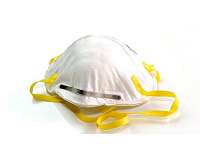
Test results suggest N95 masks can be safely disinfected through heating 50 times before their filtration efficiency begins to decline.
With N95 masks still in short supply in many parts of the country. Doctors, nurses and other professionals on the front lines of the COVID-19 pandemic have been forced to reuse their masks.
N95 masks feature a fine webbing of "meltblown" polypropylene fibers. The porous material is breathable but capable of capturing 95 percent of particles. Electrostatically charged fibers help wrangle those particles that slip through the pores.
Recommendations from the U.S. Center for Disease Control and Prevention suggest heating, ultraviolet radiation and bleach can all be used to disinfect N95 masks.
However, when scientists at Stanford University and 4C Air, a startup company making air filters, tested the different methods, they found heating worked best.
When researchers sprayed ethanol or chlorine bleach solution on N95 masks, they found the respirators' filtration abilities suffered a swift drop off. Steam treatments worked fine as a one-off method, but after five steams, filtration efficiency declined. Masks treated with UV light began to suffer performance declines after 20 disinfecting cycles.
For the heating method, scientists exposed N95 masks to a temperature of 185 degrees Fahrenheit for 20 minutes. The heating method successfully disinfected the test masks 50 times before scientists measured a decline in filtration efficiency.
Scientists acknowledged that their tests results — published Tuesday in the journal ACS Nano — aren't the final word on the matter. The are other factors to consider, such as fit.
"Frequently donning and removing N95 masks could affect fit, which also impacts performance," researchers wrote in a news release.
Last month, the Pentagon awarded the Battelle Memorial Institute $415 million for the decontamination of used N95 respirator systems. Battelle deploys a concentrated, vapor phase hydrogen peroxide to decontaminate masks for reuse up 20 times.
The latest research suggest there are more promising disinfectant methods than those deployed by Battelle.
"Treatments involving liquids and vapors require caution, as steam, alcohol, and household bleach all may lead to degradation of the filtration efficiency, leaving the user vulnerable to the viral aerosols," scientists wrote in their paper.
3M inks $126M deal with DoD to increase N95 mask production in October
Washington DC (UPI) May 06, 2020 –
3M has signed a $126 million deal with the Pentagon to increase its production of N95 masks to 26 million per month beginning in October 2020.
The increase is intended to resupply the Strategic National Stockpile in response to increased national demand caused by the COVID-19 pandemic, but also to "continue to ensure a sustainable supply chain of N95 respirators," the Department of Defense said Wednesday in a statement.
Under the deal, 3M will increase N95 respirator production by at least 312 million per year within the next 12 months, the Pentagon said.
In order to increase capacity, 3M will expand its facility in Aberdeen, S.D., as well as expanding production of the masks to Wisconsin.
In late April, 3M received $76 million from the Department of Defense to make N95 masks.
At that time the company was contracted to provide 78 million units within six months, with an additional 13 million units per month by June.
N95 respirator masks, considered the safest for use in medical settings, have been in short supply since the beginning of the coronavirus pandemic, leading to criminal charges for price gouging, revised public health recommendations to include washable fabric masks and contracts for decontamination services so N95 masks can be sanitized and reused to address the immediate shortage.
Also on Wednesday, 3M announced Ford is shipping 10,000 powered air-purifying respirators, or PAPRs — which the two companies collaborated to develop — to protect healthcare workers fighting the COVID-19 pandemic.
According to 3M, since the COVID-19 outbreak began, the company has doubled its global output of filtering facepiece respirators, such as N95s, to more than 1.1 billion per year, or 100 million per month — with 35 million N95s being produced in the United States.
The company said that 90 percent of N95s it currently produces go directly to health care workers.
At the end of January, 3M, which currently employs 96,000 employees worldwide, announced it was laying off 1,500 workers globally in an effort to restructure the company.
