
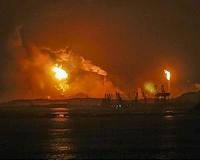
More fires are expected to ignite at a flooded chemical plant northeast of Houston, its operators said Thursday, after a series of overnight explosions sent a plume of toxic smoke spewing from the site.
Richard Rennard, a senior executive with French group Arkema, encouraged anyone who has been exposed to the smoke, which irritates the eyes and lungs, to seek medical advice.
However Rennard, who is Arkema's president of acrylic monomers, also stressed: "It's not a chemical release that's happening. I want to be clear about that. What we have is a fire."
The fire was triggered inside a container after the organic peroxides it contained could no longer be refrigerated due to flooding caused by storm Harvey that cut off electricity and flooded emergency generators.
The chemical plant makes compounds with many commercial uses, including plastics, pharmaceuticals and construction materials — compounds that can combust if not cooled to the proper temperatures.
"We're anticipating the remaining eight containers that have not yet started to have product degrade in them, for that to start to happen," Rennard told reporters, cautioning it was unclear when the containers would burn.
"We fully expect that the other eight containers will do the same thing."
The company has said the organic peroxides could cause eye, skin or respiratory irritation as well as nausea, drowsiness or dizziness, and urged residents within the 1.5-mile evacuation area to turn off their air conditioners to avoid possible smoke exposure.
"The smoke is noxious. Toxicity is a relative thing," Rennard said, declining to elaborate.
Bob Royall, assistant chief of emergency operations for the Harris County fire marshal, cited the sheriff as saying the smoke from the organic chemicals was similar to a camp fire, but refused to further press the comparison.
Federal Emergency Management Agency Administrator Brock Long earlier said the plume of fumes from the plant was "incredibly dangerous."
Bewildered Harvey victims look for salvation
Lake Charles, United States (AFP) Aug 31, 2017 – Linda Dupre was on a prayer call to Houston consoling hurricane victims when she spotted water seeping under her own back door in Lake Charles, Louisiana.
At first, she suspected her washing machine was leaking, but then it hit her: the flood had reached her home, and it was time to escape.
It's been a tough few days for the 54-year-old Dupre.
On Friday last week, the day Harvey first made landfall as a massive hurricane in Texas, she lost her job at a local plant. By late Wednesday, her home was under water.
"I'm praying for other people, but now I need prayer," she said, weeping.
Dupre was one of hundreds of storm evacuees huddling Thursday at the civic center in Lake Charles, a city just over the Texas-Louisiana border, many of them reduced to tears by the shock and sheer exhaustion of the past few days.
With civilian and state rescuers still heading out to launch boats into rising waters in eastern Texas, the number of people sheltering at the center was expected to rise well beyond the 1,200 already packed inside.
People lay on cots and blankets on a gymnasium floor, comforting children or trying to catch a few minutes of sleep, receiving food, medicine and supplies like soap and toothpaste, or sifting through donated clothes.
Jamie Neff, one of a throng of overnight arrivals from Orange, a town on the Texas-Louisiana border, watched one neighbor struggling to keep her toddler above the deep water as the flood surged through her community.
"It's stuff you don't want to see, but it's stuff that's happening and it's just horrific," said the 40-year-old, who broke into tears as she recalled her narrow escape from a home she was sure has now been ruined.
"It's just a horrible feeling to watch your family and friends lose everything — and yourself," she said.
– 'Totally lost' –
Neff drove through water higher than her pickup truck's headlights as she left Orange. She expressed gratitude that she and her fiance were spared by a storm that is believed to have killed at least 33 people.
Now, she is relying on guidance from federal emergency management teams, because "we are totally lost right now."
Stress and exhaustion were taking an increasing toll on both evacuees and first responders in Lake Charles after days of emergency rescues.
"This is the time when it just really begins to get too much," volunteer coordinator Bruce Baker of the Carey Baptist Association told AFP.
He said 60 people per hour arrived at the shelter late Wednesday, including 13 in the back of a rental trailer.
"It was heartbreaking," he said.
As victims used cell phones to try to locate loved ones, a steady stream of residents drove up to donate what they could: blankets, water, food, cleaning supplies, toiletries.
The "Cajun Navy," a loose organization of civilian rescuers, were marshaling their resources in a nearby parking lot, preparing to drive their boats to rescue points in Louisiana, which like Texas has been pummelled by Harvey.
Like Neff, Nathaniel Owens was forced to flee Orange, leaving everything behind.
"Orange is a disaster. All of Orange is gone," Owens said.
"We're all so stressed out," he said, holding a plastic bag of donated linens as he headed to his car. "Our car is our house now."
For Dupre, her faith has helped her remain level-headed and reassured.
"I believe everything happens for a reason, and that God's going to see us through," she said.
"God got this."
Toll in Texas mounts as Harvey menaces further east
Storm-battered Houston began limping towards recovery Thursday as Harvey's floodwaters started receding there, though the historic storm was still wreaking havoc further east.
While clouds parted at last in America's fourth-largest city, rural areas of Texas were drenched as Harvey headed eastwards, with the city of Port Arthur especially hard hit.
Authorities in Louisiana scrambled to s … read more
