
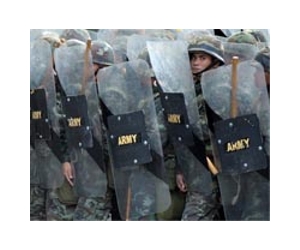
The Thai government extended a state of emergency in 19 of its 76 provinces, including the capital Bangkok, because of fears of renewed violence.
But the emergency measure, imposed during anti-government riots in the central financial district of Bangkok earlier this year, was lifted in five provinces.
The government of Prime Minister Abhisit Vejjajiva continues to keep a tight security presence on many streets.
The emergency decree bans public meetings of more than five people and police also have the right to detain people for 30 days without giving a reason or charging them.
Vejjajiva has said order needs to be maintained in the wake of the riots that began as peaceful demonstrations on March 14.
By the time security forces and police had cleared central Bangkok streets in mid May, after weeks of standoffs, around 90 people had died and more than 2,000 had been injured.
Leaders of the protesters, called Red Shirts, demanded the government resign and call elections immediately.
Several meetings between the leaders and Vejjajiva looked like securing peaceful resolution. Vejjajiva, at one time, offered to step down and dissolve parliament by the end of the year and have elections in early 2011.
But negotiations faltered and eventually security forces moved in on the protesters whose blockades had closed off streets.
In the aftermath, around 400 people have been arrested and the government has been busy closing down hundreds of Web sites.
Also, a Thai court approved an arrest warrant for the self-exiled former Prime Minister Thaksin Shinawatra on terrorism charges relating to the protests.
Many of the protesters were rural poor from the north and supporters of Thaksin, who was ousted from power by a military coup in September 2006 but returned to Thailand when his political allies won power in 2007.
His wife, Pojaman, was sentenced in 2008 to three years in jail for tax fraud and, soon after, Thaksin, 60, received a 2-year prison sentence. He fled rather than surrendering to authorities, leaving an estimated $2 billion in frozen assets.
Despite the government getting a grip on national security, it has a shaky hold on parliamentary power.
Vejjajiva promised an investigation into the security force's crackdown but he also had to defeat a no-confidence vote in parliament based on his government's handling of the riots.
During an intense debate in parliament on the issue, carried live on a television station, Vejjajiva blamed "terrorists" among the Red Shirts. The prime minister claimed there was a militia group among the rioters that attacked the military first, which in turn led to more clashes.
Opposition parties, including the Puea Thai Party, said the army's use of live ammunition and armored personnel carriers was excessive and resulted in civilian deaths and injuries.
The government has insisted all along that its use of the military was a last resort after failed attempts to negotiate a peaceful resolution to the crisis.
More than 25 buildings were set on fire, including some office blocks, banks and Central World, one of Southeast Asia's biggest shopping centers.
Share This Article With Planet Earth
