
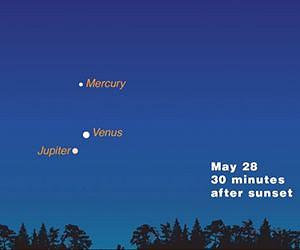
The two brightest planets, Venus and Jupiter, will help you find a fainter one, Mercury, as all three shine together in the western twilight about half an hour after sunset this Saturday and for a few days after, according to the editors of StarDate magazine.
Although they are quite low in the western sky as darkness begins to fall, Venus and Jupiter are so bright that, with a clear horizon, you won't have any trouble spotting them. In fact, they really do shine so brightly that you might mistake them for one or two approaching airplanes with their landing lights turned on.
That brilliant display will help you find a planet that is easy to overlook: Mercury. The little world sweeps up and past Venus and Jupiter in hurry, but its proximity to them will make it stand out.
Mercury is the closest planet to the Sun, so it seldom wanders far from the Sun in our sky. Because of that, it's seldom in view for more than an hour or so after nightfall or before dawn.
The three planets cluster closest together on the 25th and 26th, with Venus and Jupiter standing side by side on the 27th. After that, Venus and Mercury will continue to climb higher into the evening sky, while Jupiter drops inexorably toward the Sun.
Venus will reign as the "Evening Star" for the rest of the year.
+ The animation also may be accessed and shared via YouTube.
