
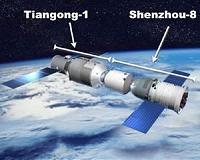
The mission of China's first space laboratory, Tiangong 1, is not finished yet. Originally advertised with an operational lifespan of two years, Tiangong 1 passed its expected use-by date in September of last year.
It's still in orbit, and it's still apparently healthy. But China isn't just keeping it aloft for engineering tests on its ageing components. It seems that Tiangong 1 is now entering a new phase of operations, and is now being more openly promoted as a scientific research platform.
Tiangong 1 was launched in September 2011, and supported two crews of astronauts who flew to the laboratory aboard Shenzhou spacecraft. Tiangong 1 also performed docking experiments with an uncrewed Shenzhou before any astronauts arrived. It's like a small space station on the inside, with living facilities including sleeping berths and a toilet.
This analyst has previously written about the extended mission of Tiangong, noting that the laboratory was flying for much longer than we had originally expected. Some sort of explanation for this was required, and China's recent announcements of an extended Tiangong scientific program provide the answers.
"At present, (Tiangong is) in stable and normal condition with all systems operating normally and consumable resources meeting needs of follow-up tasks". That's an official statement from the China Manned Space Engineering Web site. Decoding this into plain language, China is saying that Tiangong still works and has a lot of fuel in its tanks.
This suggests that Tiangong can stay operational for a considerable period, enough to contemplate a new range of research tasks. This analyst now suspects that we could see an extended mission that lasts for months longer, or even longer than a year.
What can Tiangong do? The main attraction seems to be Tiangong's two Earth observation cameras, which are located in the junction between the pressurized crew module and Tiangong's service module. These are multispectral cameras that can see in the infrared as well as visible light.
China notes that Tiangong has observed flooding in China and bush fires in Australia with these cameras. Basically, most of the standard civilian applications of satellite remote sensing are being touted as useful for the data that Tiangong has collected so far, and will collect in the future.
Tiangong also has "space environment detectors" on board. This involves measuring particles and fields around the spacecraft. Space weather is a serious issue for satellites and life on Earth itself. Major outbursts from the Sun can shut down radio communications and even electricity grids! Again, the stage is set for some highly practical research.
Although China is promoting the use of scientific data from its instruments, we can be certain that engineering tests on Tiangong are also continuing. There are no astronauts aboard, but some of the in-cabin systems are probably being checked. China could also be monitoring the state of the cabin atmosphere for pollutants.
How long can Tiangong stay in orbit? There's no way for an outsider to calculate this. We don't have any real data on how much fuel is on board. Nor do we know exactly how China plans to manage Tiangong's altitude and orbital boosts. The emphasis on Earth observation could see Tiangong flying in a relatively low orbit, which allows more detailed images of the ground at the expense of higher atmospheric drag. But clearly Tiangong's mission is far from over. Although Tiangong's main achievements have been connected to human spaceflight, it is proving to be highly useful as an uncrewed vehicle.
