
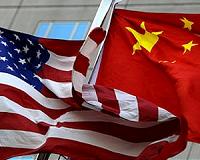
US Secretary of State Rex Tillerson on Friday used his first meeting with Chinese counterpart Wang Yi to urge Beijing to help rein in North Korea after its series of nuclear and ballistic missile tests.
Their talks, the highest level Sino-US encounter since President Donald Trump was elected, had appeared unlikely after he infuriated Beijing by calling into question Washington's long-standing "One China" policy.
Trump however reaffirmed the position in a conciliatory phone call to Chinese President Xi Jinping, mending fences enough for Wang to come to Bonn for a G20 foreign ministers meeting.
"Secretary Tillerson and Minister Wang noted the recent call between leaders and discussed efforts to advance bilateral cooperation while addressing differences in a constructive manner," Mark Toner, acting US State Department spokesman, said.
"Secretary Tillerson also highlighted the increasing threat posed by North Korea's nuclear and missile programs and urged China to use all available tools to moderate North Korea's destabilising behaviour," Toner said.
China is North Korea's last major ally and has shown itself reluctant to put too much pressure on Pyongyang.
In the meantime, reclusive North Korea has made huge strides in both its missile and nuclear weapons programme to the point where it could acquire the capability to hit the US mainland.
Washington has led international efforts to get Pyongyang to reverse course, including imposing sanctions, but all to no avail as its regional allies take fright at North Korea's ambitions.
On Thursday, Tillerson pledged that Washington would use the full range of its arsenal, including nuclear weapons, to defend Japan and South Korea against North Korea, which conducted another ballistic missile test on Sunday.
"The United States remains steadfast in its defence commitments to its allies, the Republic of Korea and Japan, including the commitment to provide extended deterrence, backed by the full range of its nuclear and conventional defence capabilities," Tillerson said in a joint statement with their foreign ministers.
Washington's recent decision to install a sophisticated THAAD anti-missile system in South Korea especially angered China which condemned the move as a potential threat to its own security.
– Global trade, protectionism –
Toner said Tillerson and Yang "also discussed the need to create a level playing field for trade and investment."
On the campaign trail, Trump regularly attacked China for stealing American jobs and running a massive, unfairly won trade surplus with the United States which he would reverse by whatever means necessary.
Chinese President Xi pointedly made a signature address to the Davos World Economic Forum in January to defend free trade and globalisation which he said were menaced by growing protectionist sentiment.
When the Chinese foreign ministry announced Wang's trip would go ahead, it said Beijing hoped the G20 gathering would "send positive signals on supporting multilateralism, enhancing global governance and creating an innovative, interconnected, open and inclusive world economy."
Several of Trump's cabinet, including Tillerson, have also warned Beijing against throwing its weight about in the South China Sea, insisting the US would intervene if necessary to preserve international rights of navigation.
Although Washington severed ties with Taiwan in 1979, it has retained close links with Taipei, particularly in defence, and Beijing watches closely for any sign of US backsliding.
Taiwan has been ruled separately since Mao Zedong's communists ousted China's Nationalists who fled to the island in 1949.
China urges nuclear talks resumption with NKorea
Munich, Germany (AFP) Feb 17, 2017 –
China on Friday urged a resumption of six-party talks with North Korea on Pyongyang's nuclear programme, saying a "negative cycle" of nuclear missile tests followed by sanctions must end.
"Today, what we see is nuclear test, sanction, nuclear test and then sanction again," said Chinese Foreign Minister Wang Yi.
"This negative cycle should not continue. Because the ultimate end result could be something that no one can bear. It's a situation where everyone loses," he said.
Wang stressed that UN Security Council resolutions — including sanctions — against Pyongyang should be fully implemented, but added: "We cannot give up on seeking a resumption of talks."
"On this point, the United States and North Korea … must quickly come to a political decision," he said.
"We hope and call on all parties to stop taking any action that would provoke tensions."
The North quit the now-stalled negotiations aimed at curbing its nuclear weapons programme in 2009, and soon afterwards carried out its second atomic test. The talks are hosted by China, and include South Korea, the United States, Russia, and Japan.
Beijing, the North's main diplomatic protector and economic benefactor, wants to revive negotiations, although Washington, Seoul and Tokyo all insist Pyongyang must first take some tangible steps towards denuclearisation.
Earlier Friday, US Secretary of State Rex Tillerson used his first meeting with Wang to urge Beijing to help rein in North Korea after its series of nuclear and ballistic missile tests.
North Korea's latest missile was launched Sunday near the western city of Kusong and flew east about 500 kilometres (310 miles) before falling into the Sea of Japan (East Sea), South Korea's defence ministry has said.
