
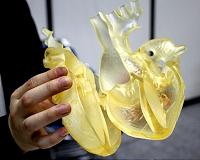
Toying with the human heart may be a sin, but it's serious business for Japanese professionals who make life-sized organ models. At Yokohama-based JUMBO Co., Ltd., which specializes in replicating human organs down to the last vein and ventricle for research at Japan`s top medical schools, there is no substitute for detail.
The 68-year-old Yokohama-based company was a conspicuous exhibitor at the MEDTEC Japan expo held from April 20 to 22 in Odaiba, where staff displayed samples ranging from life-sized models of human intestines to monkey heads.
"Heart models sell ok, but bones are actually more popular, followed by knees and intestines," says Makoto Hamada, head of JUMBO's 3D business division. She points to a remarkably detailed replica scale model of a human knee joint, complete with simulated tendons, ligaments, and cartilage.
The popularity of bone and joint kits is likely directly tied to Japan's rapidly aging society, she adds, since calcium depletion naturally accompanies the aging process. And while Japan is remains a leader in average life expectancy, higher fat consumption in recent decades has also triggered higher rates of obesity, heart disease and diabetes.
Three-dimensional models help to illustrate the effects of poor diet on the human body for medical students and nurses, as well as health care professionals and insurance agents who tutor corporate employees on how to stay fit. Ms. Hamada adds that zoos are also big customers due to the need for animal research tools.
JUMBO markets a typical knee model for about YEN 120,000, while a human heart may sell for YEN 170,000. The designs can be taken from a variety of data sources, including MRI and CT-scan images.
The company is one example of how advances in 3D printing have forged changes to otherwise orthodox business models at some domestic companies. Formerly a diverse data research, printing, and marketing concern, JUMBO added custom manufacturing of everything from anatomical parts to machine components from 2013.
The company has also embraced drone and satellite imaging capabilities, which have allowed for the manufacture and marketing of detailed terrestrial maps for use in infrastructure development, natural disaster prevention and tourism. The company makes use of camera images taken by aerial drones, electronic topographical maps from Japan's Geospatial Information Authority, and satellite images provided by Japan Aerospace Exploration Agency (JAXA)'s PRISM sensor.
"Clients are naturally particular about accuracy for 3D imaged products given the size, scale, and cost of projects that could be involved," says Ms. Hamada.
"On the medical applications side, of course, it's best to provide a realistic, yet practical look and feel for a given body part. Professionals often want to see what healthy and unhealthy versions of a particular organ or limb look like in order to make proper diagnoses."
