
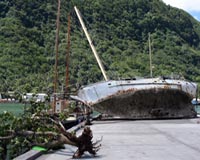
Makeshift crosses dot the shattered landscape of the Samoan tsunami's "Ground Zero", a village of tropical homes and beachside resorts which has been literally wiped off the map.
Upturned cars, toppled concrete pillars and mounds of debris mark the site of Lalomanu, home to hundreds of people just 24 hours earlier. Now, not even a single building remains.
Tony Hill, head of the joint-agency aid operation, said the village was "just Ground Zero" of the disaster which has left at least 148 people dead in the Samoan islands and Tonga.
"For Samoa this is just real devastation, I have never seen anything like this before," he said.
"I have been overseas where there have been major incidents but this is a major for me."
As Hill spoke, rescuers pulled a tourist's backpack containing family photographs from wreckage where bodies were found earlier. Red Cross volunteer coordinator Lapa Tofilau said the village had yielded dozens of corpses.
"We're still pulling out bodies now but we have already taken out 30-40 people today alone," he told AFP.
"We cannot account for the bodies that families have taken themselves to the hopsital or just buried. We are trying everything we can to find missing bodies."
Police and Australian army rescuers combed the hillside for victims and formed a grid to search every inch of the wrecked village, as New Zealand's airforce patrolled seas looking for corpses washed away by the waves.
Lalomanu's pristine white sands, normally scattered with sun-loungers and basking tourists, were strewn with personal effects and furniture, with a red velvet armchair lying beside a felled power pole.
Dozens of police fanned out in formation along the beach, using sticks to probe the detritus for bodies buried beneath. Light rain fell from ominous, overcast skies.
Similar scenes were visible elsewhere in the Samoan archipelago whose coast was shaken by a massive 8.0 magnitude earthquake then swamped by deadly tsunamis on Tuesday.
In nearby Poutasi, villagers made the heartbreaking discovery of the bodies of a woman and her baby granddaughter dumped in a bush by the giant waves.
Clean-up work, involving cranes and gangs of workmen, paused as a solemn religious procession passed to honour the two victims.
One villager told how her aunt was swept against a beached fishing trawler, fracturing her skull, as she tried to outrun the sudden five-foot (1.5 metres) waves.
"No, no, no time. No bells, no siren. In one minute, right when they saw the wave, it was here," resident Lonnie Mai told AFP.
In other areas, a fishing boat was flung into a village hall and a car was seen in the second floor of a building, as large swathes of countryside lay flooded. Debris was scattered over miles (kilometres) of once-idyllic beach.
Residents, many of whom slept under the stars for fear of returning to their homes, told how they had just seconds to flee the deadly waves.
"I don't know how to describe it, it was like a mountain coming out of the sea," Meleisea Sa, a Poutasi village chief, told AFP.
"The last thing that I saw was how my house came down. We lost everything. I can still hear the fierce sound of the waves and the sea coming up."
Share This Article With Planet Earth
