
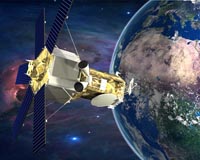
DigitalGlobe reports that the company's newest high-accuracy, high-resolution commercial imaging satellite – WorldView-4, was successfully launched by a United Launch Alliance Atlas V rocket on Nov. 11 at 10:30am PST. Lockheed Martin Commercial Launch Services procured the Atlas V for this mission. The WorldView-4 satellite was built by Lockheed Martin, and its imaging payload was developed by Harris Corp.
The Lockheed Martin-built WorldView-4 satellite will more than double DigitalGlobe's capacity to collect the world's highest-resolution 30 centimeter commercial satellite imagery and will accelerate the growth of DigitalGlobe's 80-petabyte, 16-year time-lapse image library.
The fifth active satellite in DigitalGlobe's industry-leading constellation, WorldView-4 will enhance global transparency and security, power location-enabled applications and services, support the response to global humanitarian crises, and much more.
"WorldView-4 dramatically extends DigitalGlobe's position as the industry leader in earth imagery, and insight into our changing planet," said Jeffrey R. Tarr, Chief Executive Officer of DigitalGlobe.
"The importance of today's success to our customers and shareowners is evidenced by the unprecedented pre-launch demand for this new capacity. This expansion of the DigitalGlobe constellation will accelerate our efforts to build out the digital globe and enable our customers to derive new insights and make critical decisions with confidence."
Build it; Launch it
"Lockheed Martin is proud of today's launch and our longstanding partnership with DigitalGlobe," said Rick Ambrose, Executive Vice President of Lockheed Martin Space Systems Company.
"From the world's first high-resolution commercial imaging satellite, IKONOS, to the state-of-the-art WorldView-4, Lockheed Martin and DigitalGlobe have an unparalleled legacy of innovation in remote sensing."
"Congratulations to the entire mission team. ULA is honored to celebrate the successful launch of the WorldView-4 satellite for DigitalGlobe and Lockheed Martin," said Gary Wentz, ULA vice president of Human and Commercial Services.
"This [morning's] Atlas V launch delivered the WorldView-4 satellite into near sun-synchronous orbit during a flawless flight. ULA is proud to have launched the entire constellation of DigitalGobe's satellites and served in an essential role to get this revolutionary capability to orbit."
This mission was launched aboard an Atlas V 401 configuration vehicle, which includes a 4-meter-diameter large payload fairing. The Atlas booster for this mission was powered by the RD AMROSS RD-180 engine and the Centaur upper stage was powered by the Aerojet Rocketdyne RL10C engine.
Today's launch marks ULA's ninth launch in 2016 and the 112th successful launch since the company was formed in December 2006," said Wentz. "Thank you to the men and women at the 30th Space Wing who worked tirelessly to combat and contain the fires that delayed a launch attempt in mid-September."
On Sept. 15, wildfires spread through Vandenberg Air Force Base's South Base. The wildfires delayed the Sept. 16 launch attempt. ULA, the Western Range and DigitialGlobe worked together to achieve today's launch success.
Cubesats are go
Including today's seven successful CubeSat deployments, ULA has launched 62 CubeSats. Sponsored by the NRO, today's CubeSat payloads are unclassified technology demonstrations known collectively as Enterprise. The CubeSats rode in the Aft Bulkhead Carrier, developed by the NRO and ULA, on the Centaur upper stage.
ULA has established a very low-cost approach to both design and launch of CubeSats to enable the ability to accommodate our commitment to education and innovation. This fall ULA announced the winner of its first-ever CubeSat competition this fall.
Dubbed CubeCorps, the program encourages hands-on science, technology, engineering and math (STEM) experience to motivate, educate and develop the next generation of rocket scientists and space entrepreneurs.
ULA's next launch is the GOES-R satellite for NASA. The launch is scheduled for Nov. 19 from Space Launch Complex-41 at Cape Canaveral Air Force Station, Florida.
