
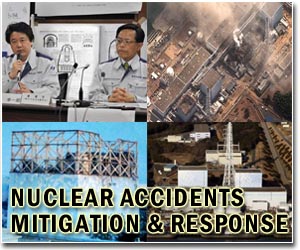
The UN atomic agency said Monday it was hoping to send in early October a team of experts to assist in making safe "properly" the area around Japan's crippled Fukushima nuclear plant.
"Japan does not have that much experience in decontamination," International Atomic Energy Agency (IAEA) director general Yukiya Amano, himself Japanese, told reporters at the UN body's Vienna headquarters.
"They have had small accidents but they have never had an accident this big, so we can provide assistance. Even though they have some ideas, we can provide confidence and credibility," he said.
"For many countries, for the engineers, what is going on in the reactor is the main issue of interest. But for the local people the most important is what happens with their house or rice field. We need to decontaminate."
He added that people had started to spray water on their houses and dig up fields in an effort to decontaminate them.
"These things need to be done properly. Otherwise the amount of debris becomes huge. I hope that we can give some advice," Amano said.
He said that the mission aimed at finding out what Japanese authorities had done so far in the clean-up and what they plan to do, and that other countries were interested in learning from Japan's experiences.
Six months after Japan's massive March 11 earthquake and tsunami sparked the world's worst nuclear accident since Chernobyl, emergency crews are struggling to stop radiation seeping out.
Tens of thousands of people remain evacuated from homes, farms and businesses in a 20-kilometre (12-mile) radius around the plant and in pockets beyond.
Many activists and scientists have said the evacuation zone is not wide enough and does not account for unpredictable spread of fallout. The government has warned some areas near the plant may be uninhabitable for years.
