
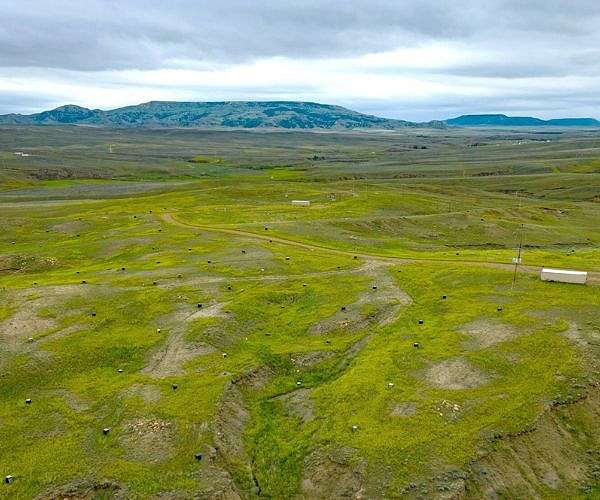
Uranium Energy Corp (NYSE American: UEC) reports that the Company's plan to accelerate the steps required for a resumption of operations has been completed, enabling a faster restart at the Christensen Ranch in-situ recovery ("ISR") Project in Wyoming.
Amir Adnani, President and CEO stated: "With demand increasing for uranium supply from stable geopolitical jurisdictions and U.S. national security objectives, we foresee an increasingly urgent need for domestic uranium supply. The fundamental drivers of supply and demand, including pending legislation to ban Russian uranium imports to the United States, are translating into rising uranium prices that have accelerated UEC's production readiness program. In that regard, we have been working towards restarting production to fulfill the need for domestic uranium and are pleased to provide an update on activities related to resuming operations at the Company's Christensen Ranch ISR uranium operations in Johnson County, Wyoming."
Background: UEC acquired Uranium One Americas, Inc. ("U1A") from Russia's State Atomic Energy Corporation, Rosatom, in December 2021. The repatriation of the assets to U.S. ownership has been a transformative acquisition for UEC, positioning the Company as the largest, fully permitted, low-cost ISR project resource base of any U.S. based producer.
The U1A U.S. portfolio was assembled starting in 2007 with the acquisition of Energy Metals Corp. and subsequently Cogema Resources Inc. The portfolio is anchored by the Irigaray Central Processing Plant ("CPP") and includes over 20 uranium projects, 100,000 acres of land and 4 fully permitted ISR projects. These assets include Christensen Ranch ISR Operations that, combined with early Irigaray production, produced over six million lbs. of uranium before being placed on standby in 2018 in care and maintenance. During this period, key production infrastructure, including its wellfields and the satellite ion exchange plant, have been maintained, and now upgraded and refurbished to facilitate a fast restart. Uranium recovered from Christensen Ranch will be processed at UEC's Irigaray CPP.
The Irigaray CPP is the centerpiece of the Company's Wyoming ISR Hub and Spoke operations. The Irigaray CPP was originally constructed by Westinghouse Electric Corporation and was later expanded by U1A in 2010, adding two resin elution circuits and additional precipitation capacity. The Irigaray CPP is one of the largest uranium CPPs in the U.S., licensed for 2.5 million lbs. of uranium production per year with pending plans to increase the licensed capacity to 4 million lbs. per year.
The first Company project ("Spoke") to feed the Irigaray CPP Hub will be the Christensen Ranch Project. The Company has been working steadily at Christensen Ranch since the beginning of this year to move out of care and maintenance and advance towards resuming production.
The orebody at Christensen Ranch ISR Project is divided into tracts of injection and recovery wells. These tracts of wells are called "Mine Units" for production management. Each Mine Unit is then subdivided into groups of injection and recovery wells that are operated individually; these groups are called "Modules", also known as "header-houses", where each well is connected to a manifold that connects to pipelines that carry the recovery solutions to the satellite IX plant.
Each Mine Unit typically contains 600 to 800 injection and recovery wells, depending upon the orebody configuration, with each Module having an average of 90 to 100 injection and recovery wells. This configuration allows great flexibility in operations, allowing operation of all Modules in a Mine Unit, or just one Module, as well as individual wells in each Module, and as many Modules in the various Mine Units as desired. All wells are controlled electronically and can be started and stopped in the Module buildings and at the satellite plant operations control room.
UEC has also conducted a series of operational tests in the Mine Units at Christensen Ranch. Two Modules located in Mine Units 8 and 10 have had testing completed to establish operating parameters for each Mine Unit. UEC has operated these Modules by circulating recovered mining solutions to test injection and recovery systems while adding oxygen ("O2") and carbon dioxide ("CO2") to the injection stream at varying rates during the testing. The tests evaluated:
