
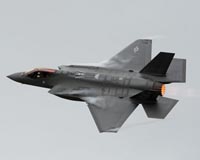
An airstrike in Iraq this week was the first combat employment of the F-35A Lightning II fighter aircraft by the U.S. Air Force.
Two F-35s struck an entrenched Islamic State tunnel network and weapons cache at Wadi Ashai, Iraq, on Tuesday, the Air Force announced in a statement on Tuesday. The planes were recently deployed from Hill AFB, Utah, and joined the Combined Forces Air Component team of the U.S. Central Command area of operations on April 15.
The plane's capabilities include enhancing other battlefield assets, the Air Force said.
"The F-35A has sensors everywhere, it has advanced radar and it is gathering and fusing all this information from the battlespace in real time," said Lt. Col. Yosef Morris, an F-35 pilot. "Now it has the ability to take that information and share it with other F-35s or even other fourth generation aircraft in the same package that can also see the integrated picture."
In the F-35's first use in combat by the United States, the U.S. Marine Corps used an F-35B for a ground clearance operation on Sept. 27, 2018, in support of Operation Freedom's Sentinel in Afghanistan.
The U.S. Navy declared their F-35C ready for combat in March.
Readiness of the aircraft, however, has been compromised by logistics issues in the parts chain.
A General Accounting Office report, released last week, noted that the plane is unable to fly as often as required because of spare parts shortages and logistical problems in moving parts around the world.
In the time period GOA analyzed — May to November of 2018 — F-35s were unable to fly 30 percent of the time because of shortages and mismatched parts. It added that the Defense Department has an order backlog of about 4,300 parts.
Northrup Grumman to integrate countermeasures system on aircraft for U.S., allies
Washington DC (UPI) May 01, 2019 –
Northrup Grumman Systems Corp. was awarded a contract to integrate the U.S. Navy's Large Aircraft Infrared Countermeasures onto aircraft of the U.S. military and two allies.
The Department of Defense announced the contract, to be completed by June 2021 and not to exceed $132.2 million, on Tuesday.
The contract calls for obtaining the equipment, analysis and technical support required to integrate the Navy's LAIRCM system onto aircraft for the Army and Navy, as well as those of Britain and Norway.
LAIRCM is an active countermeasure to defeat threat missile guidance systems by directing a high-intensity laser beam at an incoming missile. It has heat-seeking capabilities, automatically countering an incoming missile system by honing in on its infrared light emission.
Under the contract, Northrop Grumman will provide advanced threat warning sensors, replaceable control indicator units, signal processors, infrared missile warning sensors, Guardian Laser Transmitter Assemblies [GLTAs], multi-role electro-optical end-to-end test sets, GLTA shipping containers, high capacity cards, signal processor replacements smart connector assemblies and other hardware.
The Navy is responsible for 79 percent of the contract cost, with the Army responsible for 15 percent and the foreign governments, through the Defense Department's Foreign Military Sales agency, with the rest.
Most of the work will be performed at Northrup Grumman facilities in Rolling Meadows, Ill., and Goleta, Calif.
The Naval Air Systems Command in Patuxent River, Md., is the contracting agent.
