
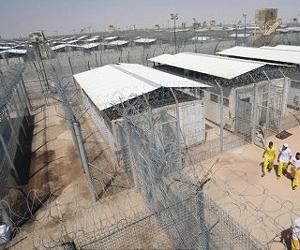
The US army handed control of Camp Cropper prison to Iraqi authorities on Thursday, effectively ending one of the most controversial chapters of the seven-year-long American military occupation.
Cropper, west of Baghdad and now holding 1,600 detainees, opened immediately after the US-led invasion in March 2003 and was built to handle senior members of Saddam Hussein's toppled Baathist regime.
The dictator himself was its most famous inmate between his capture after the invasion and his eventual execution in December 2006.
An official transfer of authority ceremony involving US and Iraqi military officers saw the facility renamed Karkh prison.
"This is the first day of a new era," said US deputy commanding general for detainee operations, Jerry Cannon.
It is "a modern, functional and well-built facility that will last for years to come," he added.
Iraqi Justice Minister Dara Nureddine Dara was among around 100 officials at the event.
"We must ensure we make this prison a model for all others in Iraq," he said. "The days of mistreatment and abuse of prisoners are gone. We will investigate and discharge anyone found to have committed a wrongful act."
More than 100,000 detainees have passed through US custody in Iraq, where Camp Bucca near the southern city of Basra was closed in September 2009 and Camp Taji north of Baghdad shut earlier this year.
Among the last of Saddam's inner circle to leave Camp Cropper was former deputy prime minister Tareq Aziz, who was transferred to Khadimiyah prison in Baghdad on Tuesday night.
Saddam's former secretary Abed Hmoud, the former interior minister Mohammed Zumam, and former oil minister Amir Mohammed Rashid, were among 25 other prisoners moved together with Aziz.
Cropper was originally a tented site but it was upgraded after the Abu Ghraib prison scandal in 2004 where photographs showed naked and hooded Iraqi prisoners being beaten and humiliated by their US guards.
The furore over what happened at Abu Ghraib, already a notorious torture and execution centre during the Saddam era, is still regarded as the nadir of the US occupation. The prison was returned to Iraqi control last February.
General Ray Odierno, the commander of US forces in Iraq, told reporters on Tuesday that the handover of Camp Cropper had been planned for one year and a system of training and safeguards had been put in place.
He also said Cropper proved that the American military had cleaned up its act. "Abu Ghraib is a lesson that we were not prepared to handle large masses of detainees when we came into this operation in 2003," Odierno said.
"We made some real errors in thinking it was going to be like Desert Storm and we would just hold prisoners of war for a period of time.
"We did not properly anticipate a counter-insurgency which would require us to handle a large number of detainees… in fact we were not trained and prepared to do it. And we ended up having significant issues," he added.
Despite Thursday's handover around 200 high value detainees will stay under US control at Camp Cropper, Odierno and the Iraqi government have said.
Share This Article With Planet Earth
