
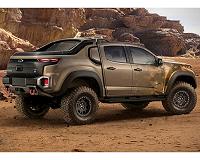
The U.S. Army is to field test a vehicle from General Motors that does not produce smoke, noise, odor or have a thermal signature.
The demonstrator vehicle is called the ZH2 — basically a modified Chevy Colorado — fitted with a hydrogen fuel cell and electric drive, which is still in the science and technology stage.
The ZH2 was spotlighted Thursday at the 2017 Washington Auto Show in the District of Columbia by the Army's Tank Automotive Research, Development and Engineering Center, or TARDEC.
The Army said electricity from stacked hydrogen fuel cells powers the vehicle. They do so through an electro-chemical reaction instead of an explosive combustion process.
Hydrogen, a component of water, can come from the grid or from renewable power sources such as wind or solar, the Army said. Another way to extract hydrogen is taking it from existing fuels like gasoline, propane, and natural gas.
The Army and GM are comparing the costs and benefits to each approach but haven't decided yet on which approach to follow.
The vehicle's fuel-cell stacks are composed of layers of plates and membranes coated with platinum, which convert hydrogen and air into usable electricity.
The hydrogen fuel cell, in addition to powering the vehicle, can also produce two gallons per hour of potable water for soldiers and can generate 25 kilowatts of continuous power — or 50 kW of peak power. The power generation is available through outlets in the trunk when the vehicle is stationary.
U.S. Marines upgrading armored vehicles
Barstow, Calif. (UPI) Jan 30, 2017 -The U.S. Marine Corps is upgrading the Mine Resistant Ambush Protected All-Terrain Vehicle used by the Corps and the Air Force.
The modernization, which also involves refurbishment and up-armoring, is being conducted on the latest version of the MRAP in use by the two services and is being conducted at Production Plant Barstow, Marine Depot Maintenance Command, on the Yermo Annex of Marine Corps Logistics Base in Barstow, Calif.
"Currently we're working on a split line between Air Force and Marine Corps M-ATVs at a rate of about 16 to 20 a month," said Kenny Phillips, production superintendent for the M-ATV line at the production plant.
"It takes us about three to four weeks for each vehicle and the total repair cycle time for all the vehicles is 120 days."
Phillips said the cost for modernizing and refurbishing each vehicle is $385,000. The cost of a new vehicle from Oshkosh would be about $400,000 to $1 million depending on the model.
According to Daniel Contreras, who is working on the project said the heavy metal armor upgrade involves the original armor plating covered by a much heavier and wider second layer of steel, which is then overlaid with dense foam.
The foam acts as a crumple zone and absorbs a lot of the impact of an explosion of a mine.
