
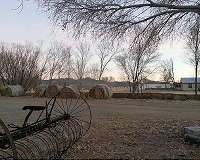
US farmers find themselves in the crosshairs of a trade war with China and others launched by President Donald Trump, who was elected with the support of many in rural America.
On Friday, Trump announced long-threatened trade tariffs on tens of billions of dollars worth of Chinese goods, sparking an immediate retaliation from Beijing on an equivalent of US products including agricultural goods, notably soy.
"For American farmers, this isn't theoretical anymore, it's downright scary," the Farmers for Free Trade lobbying group said of the prospects for escalating tariffs.
"It's no longer a negotiating tactic, it's a tax on their livelihoods."
China is the largest buyer of soy beans, buying $12 billion in 2017, about 30 percent of the US harvest.
"We were already in a depressed market. These trade uncertainties add a lot of stress to this situation," said Jamie Beyer, a farmer in Wheaton, Minnesota who grows soybean, corn, sugar beets, wheat and alfalfa.
"We feel these tariffs are very damaging to our agricultural economy."
Farmers are the most at risk in this trade battle, as their incomes already were falling, declining by around 50 percent since 2013, and this year expected to reach the lowest level since 2006.
– Easy target –
The sector already was shaken up by the difficult negotiations on the North American Free Trade Agreement (NAFTA) with Canada and Mexico, two major importers of agricultural products.
On her family farm in Oklahoma, Hope Pjesky raises cattle and grows winter wheat, and says she is "very nervous" about recent developments.
"Unfortunately, agriculture seems to be the industry that they hit back on when there is retaliation. I just wish there were a better way to go about addressing that issue," she said.
That is according to plan, since US trading partners have singled out American products from states strongly supportive of Trump, in hopes of increasing the pressure on him to reconsider.
But Pjesky noted that "there are a lot of people who voted for him that still have faith that it is just going to end up well."
It is difficult to quantify the precise cost of Chinese sanctions, but Missouri corn and soybean farmer Blake Hurst said he already is seeing an impact on prices.
The weather remains the main factor influencing the price of corn, wheat, soybeans and cotton, but the threat of renewed tensions between Beijing and Washington hit the market hard this week and the soybean price fell by more than six percent.
"It will affect our profitability" and cut the number of acres cultivated, he said.
– Trump support –
Roger Johnson, who leads the country's second largest agricultural union, the National Farmers Union, said the group supports the White House goal of reducing the US trade deficit.
"But our organization grows increasingly concerned that this administration does not have a plan to ensure family farmers and ranchers aren't thrown under the bus for the sake of these goals," he said.
Even so, few blame Trump directly.
Hurst said many in Missouri are still willing to give him the benefit of the doubt.
But, he cautioned, "if we don't see any success, then patience will wear thin."
US soybean prices tumble amid trade fight with Beijing
Chicago (AFP) June 15, 2018 –
Soybean prices tumbled this week in Chicago, along with other key agricultural commodities, amid rising trade tensions culminating in Friday's announcements of new US and Chinese tariffs.
A bushel of soy for July delivery fell to $9.22 on Friday from $9.69 a week earlier after having earlier dropped to $9.03, the lowest level in a year.
Soybeans are a key US export to China, an economic tie that makes the back-and-forth between the US and China a source of anxiety throughout the American farm belt.
"The market realizes that the US has carried through what they threatened to do," said Bill Nelson, senior economist at Doane Advisory Services, a research firm.
US President Donald Trump announced tariffs of 25 percent targeting $50 billion in Chinese imports.
China responded swiftly, saying it would imposed "equal" tariffs on US products.
The Chinese government did not specify which goods will be targeted, but Beijing has previously threatened to impose a 25 percent tariff on American soybean imports.
The US move "is raising concerns that the Chinese will retaliate against soybeans," said Dewey Strickler of Ag Watch Market Advisors.
Since US and China trade tensions began heating up in April, Nelson has seen no shift in Chinese demand for US soybeans.
"We have to wait to see in the next few days if there are cancellations or diverting of ships," he said.
Prices of other key farm commodities wheat and corn also fell this week in the wake of trade uncertainties.
