
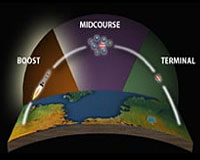
The US missile defense system worked better than expected last year while on alert during North Korea's test launch of a long-range missile, a Boeing executive said Monday. "We're ready to defend the nation. I see nothing to suggest otherwise," said Scott Fancher, Boeing program manager for the ground-based missile defense system.
The North Korean Taepodong-2 missile failed shortly after the July 4-5 launch and no US interceptor missile was launched as a result.
But the missile defense system's elaborate network of early warning satellites, radars and command centers was operational and on alert for much longer than ever before, Fancher told reporters here.
"Quite frankly the system is much more robust than we'd hoped for. It's performance exceeded our expectations," he said.
He said the long time on alert uncovered some problems that would not otherwise have manifested themselves.
He said, for instance, that computer buffers filled up over time as they retained health and status information of the system.
"In real time we adjusted our maintenance procedures and we were able to clear those buffers, preventing any problems from occurring," he said.
Although the missile defense system is still in development, it shifts during a crisis like the one with North Korea from testing by contractors to operations with military crews.
"I'm confident, if called upon, we can transfer the system to the warfighters within the time constraints we've been given and they can defend the nation with the system. And we're ready to support if they do so," Fancher said.
The Missile Defense Agency is investing in redundant systems so that by the end of next year the system can be on alert at the same time that testing is being conducted, he said.
The missile defense system currently has eight interceptor missiles in silos at Fort Greely, Alaska and two more at Vandenberg Air Force Base in California.
Two intercept tests are planned for later this year, Fancher said.
Source: Agence France-Presse
