
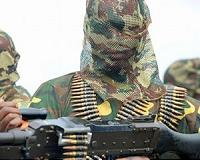
The United States offered Niger two military surveillance planes Wednesday as attacks by suspected Boko Haram extremists continued in the country's south-east region bordering Nigeria.
Two Niger soldiers were killed and several injured Wednesday in a foiled suicide attack by suspected Boko Haram fighters, Defence Minister Mahamadou Karidjo said.
Karidjo spoke as he took possession of two Cessna C-208 planes equipped with intelligence and reconnaissance systems, as well as around 30 military vehicles and ambulances. A US official said the aid was worth around 32 million euros.
The aircraft "will enable Niger's armed forces to identify local threats and better secure the border," said US Ambassador Eunice Reddick.
Wednesday's attack took place in the Diffa region, said private radio station Anfani, the scene of several such incidents since February, including one in June in which 38 people were killed.
"It's not tanks we need but intelligence to fight them," said Karidjo.
Niger is under threat from jihadist fighters along its northern borders with Mali and Libya, and from Boko Haram extremists along its southeast border with Nigeria.
In October it struck a military cooperation deal with the United States that provides for US training to Niger troops as part of a joint fight against terrorism.
Washington has a military base in Niger used by its drones to supply intelligence to French troops who launched an anti-Islamist operation in Mali in January 2013.
Niger, a vast arid country whose primary source of foreign income is uranium, has joined a regional military alliance alongside Cameroon, Chad and Nigeria, to fight Nigeria-based Boko Haram.
Sudan govt accepts invitation to talks with rebels
Khartoum (AFP) Oct 21, 2015 –
The Sudanese government said Wednesday it has accepted an invitation from the African Union to attend peace talks with the rebel Sudan People's Liberation Movement-North in Addis Ababa next month.
The SPLM-N has been battling Khartoum's forces in the southern Blue Nile and South Kordofan states since 2011, and did not immediately say whether they would attend.
"The Sudanese government received an invitation to a new round of negotiations about the two areas with the SPLM-N on November 2 in the Ethiopian capital Addis Ababa, and the invitation was to both sides," said Hussein Kershoum, a member of the government's delegation for negotiations.
Kershoum said the government was prepared to attend.
A round of talks last year ended without result.
The latest invitation comes as Khartoum redoubles its efforts to persuade the SPLM-N and rebels from the western Darfur region to join a national dialogue, aimed at resolving the insurgencies on the country's peripheries and mending an ailing economy.
Three main Darfur rebel groups and the SPLM-N, which form part of the Sudan Revolutionary Front (SRF), have declined to attend and called for a meeting outside the country to set conditions for dialogue.
In a bid to encourage them to attend, President Omar al-Bashir — wanted by the International Criminal Court over war crimes charges related to the conflict in Darfur — declared a two-month ceasefire in Darfur, Blue Nile and South Kordofan last month.
The SPLM-N has already said Khartoum has carried out air strikes since then.
Fighting in Darfur, South Kordofan and Blue Nile usually halts during the rainy season between June and November.
But spokesmen from the Justice and Equality Movement and the Sudan Liberation Army-Minnawi — two Darfur-based members of the SRF — said Wednesday the alliance had declared a six-month cessation of hostilities, but the SPLM-N has not confirmed this.
"At the time of writing we have not received confirmation of that," SPLM-N spokesman Arnu Lodi told AFP Tuesday.
Mostly black rebels in Darfur mounted an insurgency against Bashir's Arab-dominated government in 2003, complaining that their region had been marginalised.
In response, Bashir unleashed a brutal counter-insurgency using troops and allied militia.
The United Nations says 2.5 million people have fled the fighting and some 300,000 have been killed, although Khartoum puts the death toll at 10,000.
Former insurgents in South Kordofan and Blue Nile states rebelled in 2011, also complaining of marginalisation.
European Union ambassadors in Sudan made a rare visit to Blue Nile state on Wednesday, where humanitarian access has been limited because of the conflict.
"There is an urgent need for more development and humanitarian assistance to the Blue Nile," the EU head of delegation Tomas Ulicny said.
