
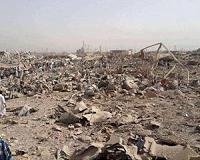
Four civilians, including possibly a child, were "likely" killed in a US air strike against an Islamic State group checkpoint in Iraq in March, an investigation released Friday found.
It marks only the second such acknowledgement since the start of a coalition air campaign in Iraq and Syria. In November 2014, the US military admitted accidentally killing two children during a strike in Syria.
The US military, which for more than a year has led the coalition bombing IS extremists' positions in the two countries, investigated the Iraq incident after a woman said her car had been destroyed with five civilians in it.
"The preponderance of the evidence gathered during the investigation indicates that the air (strike) likely resulted in the deaths of four non-combatants," the US military's Central Command said in a statement.
"One of the non-combatants may have been a child."
Officials say a US A-10 air-to-ground combat plane targeted the checkpoint on March 13, near an IS-held area of Hatra in northern Iraq.
"However, before coalition air forces could complete the air strike, two vehicles arrived at the checkpoint and parked within the target area," the investigation states.
Simply because the drivers of the cars were talking to people at the checkpoint for about 40 minutes while other vehicles drove through, the US pilot and supervisors decided the drivers were "ISIL and therefore lawful targets."
The A-10 air crew did not realize four "additional personnel" had been in the vehicles.
– Number too low? –
According to the report, it was not possible to definitively prove the gender or age of the victim who might have been a child.
Colonel Pat Ryder said that 26 other similar cases or allegations are under various stages of review.
Still, the coalition can boast a "97-percent-plus assessed accuracy" in the approximately 8,200 strikes carried out so far in the campaign, he added.
"We are hitting exactly what we are aiming at," Ryder said.
But air campaign critics claim coalition strikes are killing many more civilians than the United States has ever acknowledged.
Airwars, a London-based group of independent journalists, published a report in August saying "many hundreds" of civilians had been killed.
The true number of deaths was likely "somewhere in between" the US tally and the Airwars claim, said Sahr Muhammedally, a senior program manager at the Center for Civilians in Conflict advocacy group.
She has interviewed Syrians along the border and, while she heard some allegations of civilian deaths, "most Syrians are just telling us these (air strikes) tend to be pretty precise compared to when the regime just dropped barrel bombs."
Muhammedally credited CENTCOM for making its investigations public, but said it was moving too slowly in doing so.
Lieutenant General CQ Brown of US Air Forces Central Command said he regretted the unintentional loss of lives.
"Our goal is to defeat Daesh (the IS group), a terrorist organization that continuously wraps itself around the population, and we do everything we can to prevent unintended deaths or injuries to non-combatants," he said.
IS claims deadly Iraq mosque attack
Baghdad (AFP) Nov 21, 2015 –
The Islamic State jihadist group has claimed an attack at a Shiite mosque south of the Iraqi capital that officials said killed at least six people.
IS, in a statement, said a suicide bomber named as Abu Hussein al-Ansari carried out the attack inside the mosque, while security and medical officials said it took place nearby after Friday prayers, also wounding at least 19 people.
The IS only mentioned the suicide bombing, but officials said it was preceded by a roadside bomb, and that the attack took place after security forces arrived at the scene.
IS frequently carries out attacks against civilians from Iraq's Shiite Muslim majority, whom it considers to be heretics.
The Friday attack came a week after a series of bombings claimed by IS targeted Shiites in Baghdad, killing at least 19 people.
IS overran large areas north and west of Baghdad in June 2014, sweeping security forces aside, and though Iraqi forces have since pushed the jihadists back, the group still holds much of western Iraq.
Bombings in Baghdad have become less frequent since the IS offensive last year, apparently because the jihadists have been occupied with fighting elsewhere.
