
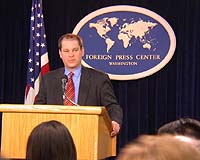
The United States on Monday admitted implicitly that it did not interdict a shipment of North Korean weapons to Ethiopia despite UN sanctions on Pyongyang for its nuclear test.
State Department spokesman Sean McCormack refused to comment directly on a New York Times report that the United States allowed Ethiopia to purchase the arms from North Korea in January, when Addis Ababa was supporting Somali government troops in a battle against Islamist militias, and three months after the UN sanctions were adopted.
He did say, however, that the US government had reasons not to intercept certain suspect ships, as it was empowered to do, by the Proliferation Security Initiative, or PSI.
"In terms of activities within PSI, you are always doing a cost-benefit analysis as to whether or not it is to the benefit of the overall effort to launch particular operations, to intercept, board, ask for boarding rights to any particular shipment," he said.
"Those are requests that are not cost-free. There is a certain amount of political capital that you have in making those kinds of requests and you want to husband that in such way that you really do target those shipments that are of the highest threats to American security or to international security," McCormack said.
"We have encouraged the Ethiopian government to take a look at with whom they are doing business to ensure that any transaction that it has complies fully with (UN Security Council) resolutions," he told reporters.
PSI is a US initiative, which several seagoing countries have signed onto and 60 others have promised cooperation.
The exact contents and value of the January shipment were unknown, although the Times said US intelligence agencies assumed that it was probably made up of tank parts and other military equipment.
The sanctions called for a halt of sales to and transfer from North Korea of battle tanks, armored combat vehicles, large-caliber artillery systems, combat aircraft, attack helicopters, warships, missiles or missile systems.
Source: Agence France-Presse
