
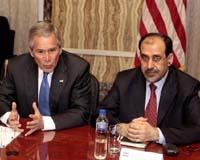
The United States will revisit its plan to surge more than 20,000 US troops into Iraq if Iraqi leaders fail to deliver on their political commitments, Defense Secretary Robert Gates said Thursday. "If the Iraqis fail to keep their commitments, I think we would have to do that," Gates said at a hearing of the House Armed Services Committee. Lawmakers expressed deep skepticism that Iraqi Prime Minister Nuri Al-Maliki would live up to commitments to end political and sectarian interference with military operations in Baghdad and to provide more Iraqi troops for the effort.
"The president and his national security team have had the same concerns, as we have debated and examined our options in Iraq going forward," Gates said in his opening statement.
"And yet, our commanders on the ground and the president's intended nominee as the new commander in Baghdad believe this is a sound plan, in no small part because General (George) Casey and other senior military officers have worked closely with the Iraqi government in developing it."
Beefing up the 132,000-strong US force in Iraq represents a change of heart for US military commanders, who had argued consistently against sending more troops and questioned whether they could have a lasting impact on the violence in Baghdad.
But General Peter Pace, the chairman of the Joint Chiefs of Staff, said US commanders were behind the new plan and changed their thinking in part because of the Iraqi government's commitment to provide more troops and end interference in operations.
Pace said the first additional US brigade was already moving and two others would be in Iraq within a month.
"I don't think anybody has a definite idea about how long the surge would last," Gates said. "I think for most of us, in our minds, we're thinking of it as a matter of months, not 18 months or two years."
Under the previous Baghdad campaign, called Together Forward, US commanders were often prevented from entering Shiite neighborhoods and on some occasions were forced to hand over people detained in raids, Pace said.
Under the new arrangements commanders will be free to impose the rule of law equally in Sunni, Shia or mixed neighborhoods without political interference, he said.
Source: Agence France-Presse
