
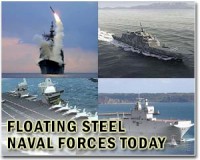
The USS Charleston, a littoral combat ship, has arrived at its San Diego homeport after completing its maiden voyage that began at the shipyard in Alabama.
The Independence-variant entered Naval Base San Diego on Friday after a 1 1/2-month trip from the East Coast. The Charleston was commissioned on March 2 in its namesake city in South Carolina. In 2017, it was christened at the Austal USA shipyard in Mobile, Ala.
In the past month and a half, the ship made port calls to Mayport, Fla.; Little Creek, Va.; Guantanamo Bay, Cuba; and Mazatlan, Mexico as well as a successful transit through the Panama Canal, on its way to San Diego.
"I'm proud to say that the crew did a phenomenal job during Charleston's maiden voyage, working many long hours to execute the voyage safely," Cmdr. Christopher K. Brusca, Charleston's commanding officer, said in a news release Monday. "To get Charleston ready for delivery, we've been away from our families for nine months, but during that time, the crew maintained an infectious positivity throughout every aspect of bringing this ship to the fleet."
The ship falls under control of the Commander, Littoral Combat Ship Squadron One — COMLCSRON ONE — until the future LCS Mine Countermeasures Division is established on the West Coast.
"Charleston is a first-class ship with a first-class crew," said Capt. Matthew McGonigle, commander, COMLCSRON ONE. "With Charleston's arrival, we now have 11 littoral combat ships homeported in San Diego and we couldn't be more proud of the hard work and positivity our LCS crews continue to demonstrate every single day."
The Charleston is the ninth Independence-variant littoral combat ship, which consists of even-numbered hulls, and are manufactured by Austal USA, in Mobile, Ala. Lockheed Martin produces the Freedom variant in Marinette, Wis.
The ship, which is designated LCS-18, is the sixth Navy vessel to carry the name Charleston. It adopted South Carolina's motto — "As I Breathe, I Hope" — and made it its own adding a combative twist — "As We Breathe, We Fight!"
LCSs are designed for operations in the littoral environment, but are fully capable of open ocean operations because of their high-speed, agility and shallow-draft. They can counter and outpace evolving threats independently or within a network of surface combatants, according to the Navy.
Australia WWII ship sunk by Japanese submarine found
Sydney (AFP) April 23, 2019 –
An Australian freighter sunk by a Japanese submarine during World War II has been located "relatively intact" in waters off the country's southeast coast, archeologists said Tuesday.
The SS Iron Crown was hit by a torpedo on June 4, 1942 while carting ore in waters off Australia's southern coastline near the state of Victoria.
The ship sunk within 60 seconds, killing 38 of the 43 crew members aboard.
"Locating the wreck after 77 years of not knowing its final resting place will bring closure for relatives and family of those that were lost at sea, as well as for Australia's maritime community," Peter Harvey, an archeologist with Heritage Victoria, said.
Scientists located the 100 metre (328 foot) ship about 100 kilometres (62 miles) off the Victoria coast.
The ship appears "relatively intact" about 700 meters below the surface on the seafloor, they said.
"We have mapped the site and surrounding seafloor using sonar but have also taken a lot of close up vision of the ship structure using a drop camera," chief scientist Emily Jateff from the Australian Maritime Museum said.
"This will allow us to create a composite image of the whole site to assist in follow up surveys for its conservation and management," she added.
Researchers said they plan to hold a memorial at the site.
The five survivors of the sinking vessel managed to grab life jackets and hold on to floating wreckage until they were rescued, according to the Victoria Heritage Council.
Between June 1942 and 1943, Japan sent 13 submarines to Australia's east coast, the heritage council said, resulting in the sinking of 22 ships with the loss of 194 lives.
