
The Hollywood Valley Girl comedy "Clueless" contains a classic lesson in parking a car. The lead character, Cher, played by Alicia Silverstone, is a vacuous bimbo teenager taking her first driving lessons. Upon being questioned by her instructor about parking, Cher merely states that there's no need for her to learn, because everywhere she goes has valet parking!
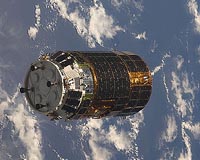
A similar trick is now being played out in the heavens above us. Japan has launched a large cargo spacecraft to the International Space Station. The H-2 Transfer Vehicle, or HTV, is a cylindrical module filled with equipment and supplies for the astronauts.
The maiden flight of HTV has added to the list of vehicles that can carry gear to the station, which includes the US Space Shuttle, the Russian Progress spacecraft, the European ATV spacecraft and soon, the privately-developed US Dragon and Cygnus spacecraft.
The Shuttle, Progress and ATV are sophisticated spacecraft that can fly directly to a docking with the Space Station. The Shuttle is piloted by its crew for this, but the other vehicles are crewless (as opposed to Cher, who was just clueless). Thus, human input for the final approach of these vehicles comes partially from ground controllers, but also from astronauts on board the Space Station itself.
HTV is a different breed of spacecraft. It can fly to a close approach of just metres from the International Space Station. But there it stops. The spacecraft lacks the instrumentation to fly directly into a docking port. Fortunately, like Cher, it has help.
Astronauts on board the space station have their own system of valet parking. The Station's large robot manipulator arm grabs a toggle on the HTV, and pulls it in. The HTV is then connected to a port on one of the station's nodes, just like attaching a new laboratory module to the station.
This is done with the aid of the Common Berthing System, a latching system around the hatch that's simpler and less cumbersome than a normal docking probe. The Common Berthing System is also used to connect the US modules to each other, as well as the Japanese and European laboratories.
The Common Berthing system is also used by the European Multipurpose Logistics Modules, which are cargo containers carried in the Shuttle's cargo bay, and also docked in place with the aid of a robot arm.
Does this mean that HTV lacks sophistication? Not really. It still performs its task of reaching the space station. There's also an advantage of the less independent approach. More cargo can be carried because HTV does not have the added weight of rendezvous and docking systems.
A similar "valet parking" approach that uses the station's robot arm will also be used by the Dragon spacecraft and the Cygnus spacecraft.
Both approaches to sending a spacecraft to the Space Station are useful, and it's interesting to see the diversity of designs that's appeared in these different vehicles.
And no, there's nothing clueless about either of them, as the success of the HTV mission has demonstrated!
Share This Article With Planet Earth
