
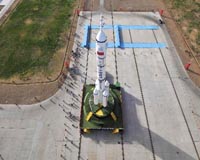
With Tiangong 2 safely in orbit, attention is now shifting to the spacecraft that will soon meet it. The Shenzhou 11 spacecraft is expected to lift off at some point in mid-October, although China has yet to release an official launch date or time. We are also unsure about the crew, although China has stated it will consist of two astronauts.
That's a step back from recent trends of three-person crews for China. The smaller crew will allow logistics to be stretched further on this mission, allowing the crew of Shenzhou 11 to live aboard Tiangong 2 for roughly a month.
What about the Shenzhou spacecraft itself?
Earlier incarnations of Shenzhou were wildly different in terms of their design and appearance. Different experiment packages were attached to the front of the spacecraft.
The cylindrical Orbital Module at the front also featured solar panels in the first models. The Orbital Module itself became an independent spacecraft at the end of the primary mission for these flights, carrying out science experiments.
The internal design of Shenzhou also underwent revisions, as China reconfigured the wiring and other systems. This was natural. China was gradually evolving the design as it gained actual flight experience. These earlier Shenzhou missions never docked with other spacecraft, and carried no docking systems.
Starting with Shenzhou 8, China announced that the Shenzhou spacecraft had now entered its mass-production phase. Shenzhou had settled into its main role as a system for delivering crews to space laboratories and space stations.
The spacecraft now featured an androgynous docking system and no external experiment payloads. A single set of solar panels on the rear Instrument Module was now the norm.
Shenzhou 8 carried no crew, but proved China's docking capabilities when it flew to the Tiangong 1 laboratory. Shenzhou 9 and Shenzhou 10 carried three astronauts each. All three spacecraft were reportedly assembled concurrently.
Engineers have probably tinkered with some features of Shenzhou 11, but overall, we can expect this to be a standard spacecraft. The design is mature and proven. If it isn't broken, don't fix it.
