
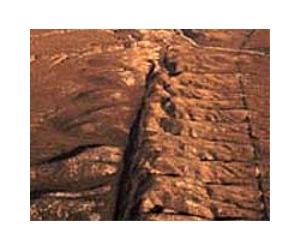
Some U.S. seismologists are increasingly alarmed at the potential of an earthquake occurring along the entire length of California's San Andreas fault.
The San Andreas has long been considered one of the most dangerous faults in the state; however recent research has some experts fearing a future major quake could occur along its entire 340-mile length.
"My concern is that we will get a series of large earthquakes along the San Andreas fault," said Thomas Jordan, director of the Southern California Earthquake Center.
Jordan told the Los Angeles Times the quakes could include a devastating 8.1 shaker and could run "wall to wall" from Monterey to the Salton Sea near the Mexican border.
Jordan based his opinion on research from Arizona State University and the University of California, Irvine that concluded a key section of the San Andreas northwest of Los Angeles was way overdue for a major quake.
The last major quake in the section was in 1857 and was halted at the Cajon Pass north of Los Angeles., a fortunate occurrence that seismologists say can't be counted on in the future.
earlier related report
Haitian quake triggered tsunamis: scientists
Paris (AFP) Oct 10, 2010 –
The magnitude 7.0 earthquake that struck Haiti in January, killing a quarter of a million people, also unleashed a string of tsunamis on the country's western coast, scientists reported on Sunday.
Several waves measuring up to 75 centimetres (two and a half feet) were caused by a combination of earth movement and coastal landslides.
They included banks of sediment on the sea bed, accumulated at river deltas, which were displaced by the shock and unleashed the waves as they moved, the study says.
Waves were reported west, north and south of the epicentre, which was within a few kilometres (miles) of the surface on the Enriquillo-Plaintain Garden fault, on the boundaries of two microplates in the Caribbean.
Such "slide-generated" tsunami are rare, but their risk is underestimated, according to the paper, published online in the journal Nature Geoscience.
"Even modest, predominantly strike-slip earthquakes can cause potentially catastrophic slide-generated tsunami," it says.
A strike-slip earthquake occurs when one side of the fault moves along horizontally and in parallel to the other side of the fault, rather than down or up.
Vertical displacement, especially of the seabed, is best known for creating tsunamis.
The study was led by a team led by Matthew Hornbach of the University of Texas at Austin.
The January 12 quake was in tectonic terms a surprisingly complex affair, according to new research. Two-thirds of the movement was strike-slip, and a third was a thrust, or upward, movement.
The quake inflicted huge damage to the capital, Port-au-Prince, injuring 300,000 people and leaving 1.5 million homeless.
Share This Article With Planet Earth
