
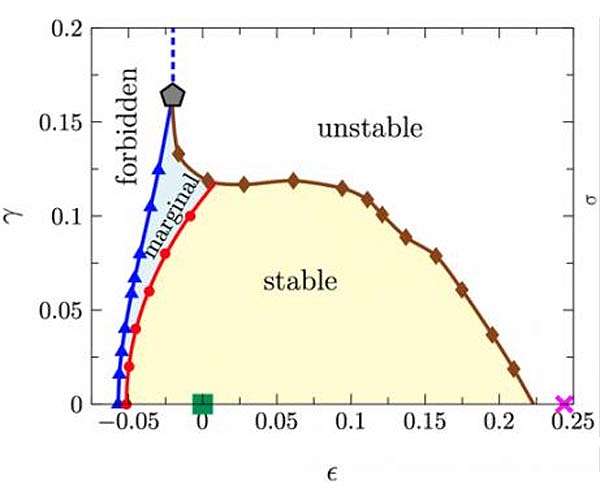
Avalanches occur not only on snowy mountains but also at the microscopic level within disordered materials like glasses, granular substances, and foams. These materials exhibit particle movements similar to avalanches, where their internal structure collapses, becoming unstable without any changes in temperature. Researchers at the University of Konstanz, led by physicist Matthias Fuchs, are investigating this phenomenon, seeking to determine precisely when and how amorphous solids lose their stability and begin to deform.
Building on previous research that explained glass vibrations using a neglected theoretical approach, Fuchs and his colleagues Florian Vogel and Philipp Baumgartel extended their work to analyze the critical point at which an "irregular house of cards" collapses. Their study is based on the "Euclidean random matrix" (ERM) model, which helps describe and predict the stability loss process. Their findings hold promise for developing improved materials, particularly in the fields of granular systems and foams.
Understanding Structural Instability
To visualize how amorphous solids behave, imagine a box filled with building blocks. If neatly arranged, the blocks support each other, creating a stable and ordered solid. In contrast, a disordered solid resembles a haphazard pile of blocks wedged together but still possessing some stability. Unlike the neatly stacked arrangement, this chaotic structure is more susceptible to collapse when disturbed.
In an experiment, if the box is shaken, the organized blocks return to their original positions after minor disturbances, maintaining stability. However, in the disordered system, gaps between the blocks allow for movement, and with enough disturbances, the connections holding the structure together weaken, eventually leading to total collapse. This illustrates the key question: At what threshold does this breakdown occur, and what are the underlying mechanisms within the material?
Probing the Mechanics of Collapse
The researchers at Konstanz are not merely shaking metaphorical building blocks but instead analyzing how molecular structures within disordered solids lose their stability. Instead of external shaking, they generate internal vibrations within the particle system, carefully eliminating gravitational effects and monitoring the spatial spread of rigid regions.
"Our analyses show that the stability of the system is lost when low-frequency vibrations approach zero, leading to the disappearance of sound velocity," explains first author Florian Vogel. "At this point, the material becomes malleable: under applied force, particles do not elastically return to their original position but begin to slide. In this loosened state, clusters of moving particles increase in size."
Crucially, this phenomenon is independent of temperature changes. Unlike the classical transition from solid to liquid by heating, the loss of stability in these materials results solely from the weakening of internal structural connections. This theory applies to molecular solids near absolute zero (-273 degrees Celsius) as well as bulk materials like sand and soil, where thermal effects are negligible.
Testing in Space
The research is set to take an exciting turn with experiments in microgravity. The GraSCha (Granular Sound Characterization) experiment, conducted by the German Aerospace Center (DLR), will test the theory aboard the International Space Station (ISS) in late 2025. By eliminating gravitational influences, the space-based experiment will further refine the understanding of how disordered solids transition from stability to deformation.
Research Report:Self-consistent current response theory of unjamming and vibrational modes in low-temperature amorphous solids
