
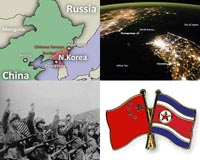
The White House on Friday welcomed news of a sharp drop in Chinese trade with North Korea, saying it would help put pressure on the regime of Kim Jong-Un.
China reported earlier that its imports from North Korea plunged 33 percent last year — and 81.6 percent in December.
President Donald Trump's "administration is pleased that China is sharply reducing its trade with North Korea," the White House said.
"This action supports the United States-led global effort to apply maximum pressure until the North Korean regime ends its illicit programs, changes its behavior, and moves toward denuclearization of the Korean peninsula," it said in a statement.
Trump has leaned heavily on China to use its economic clout to rein in North Korea, but Kim has shown no sign of halting Pyongyang's race to become a nuclear power capable of striking the United States.
In 2017, it conducted tests of intercontinental ballistic missiles capable of hitting the United States as well as its sixth and most powerful nuclear test.
After months of soaring tensions, North Korea agreed this week to send athletes to the Winter Olympics in South Korea, in what was seen as a potential sign of a cooling-off period.
The United States and South Korea reciprocated by calling off military exercises during the Olympics.
On Wednesday, Trump told South Korean President Moon Jae-In the United States was open to holding talks with North Korea "under the right circumstances," according to the White House.
But White House press secretary Sarah Sanders said the two leaders, who spoke by telephone, also "underscored the importance of continuing the maximum pressure campaign against North Korea."
On Thursday, Trump suggested in an interview with The Wall Street Journal that he could have a good relationship with Kim, though he left vague the extent of his dealings with the North Korean leader.
"I probably have a very good relationship with Kim Jong-Un," Trump said.
"I have relationships with people. I think you people are surprised."
A senior US official said Thursday the United States plans to lobby allies at a major meeting next week to stop and inspect suspect ships bound for North Korea.
Japan's Abe seeks Baltic support against North Korea
Vilnius (AFP) Jan 13, 2018 –
Japan's Prime Minister Shinzo Abe on Saturday urged Baltic NATO states to support pressure on North Korea, as he hammered home his hawkish message that Pyongyang's nuclear and missile programmes pose a global threat.
Despite a recent cooling of tensions in the run-up to the Winter Olympics in South Korea, Shinzo Abe has insisted on "maximising pressure" on the North.
"We should work closely together to maintain and strengthen a rule of law-based international order on North Korea, which is now a threat to the global community", Abe told reporters in Lithuania's capital Vilnius.
His Lithuanian counterpart Saulius Skvernelis voiced support as did Latvian Prime Minister Maris Kucinskis with whom Abe met earlier in the day in Latvia's capital Riga.
Briefing reporters, Japanese Foreign Ministry spokesman Norio Maruyama said that although the threat posed by Pyongyang was "unprecedented", the full implementation of UN sanctions would have "a very strong effect on North Korea."
New UN sanctions passed against North Korea last month ban the supply of nearly 75 percent of refined oil products to Pyongyang and cap crude deliveries among other measures.
Abe kicked off his visit in fellow Baltic eurozone state Estonia on Friday, where he also discussed deepening cybersecurity and economic ties.
Japan is keen to raise its profile in the region as China bolsters its ties there.
China is pushing its massive $1 trillion "One Belt, One Road" initiative, which seeks to build rail, maritime and road links from Asia to Europe and Africa in a revival of ancient Silk Road trading routes.
On Sunday Abe will head to Lithuania's second largest city Kaunas to pay tribute to Japanese diplomat Chiune Sugihara, who saved 6,000 European Jews from the Holocaust by issuing visas to allow them to escape war-torn Lithuania.
Abe is the first sitting Japanese leader to visit the Baltic states and will also visit Bulgaria, Serbia and Romania before returning to Tokyo Wednesday.
Trump's 'madman' rhetoric may have scared N. Korea to talks: analysts
US President Donald Trump's notoriously threatening rhetoric towards nuclear-armed North Korea – which has drawn comparisons with Richard Nixon's "madman theory" of diplomacy – may deserve some credit for bringing Pyongyang to talks, analysts have said.
The two Koreas held their first official dialogue in more than two years this week, agreeing the North would send its athletes to next mon … read more
