
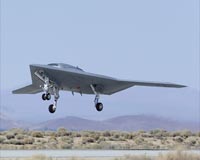
An unmanned aircraft system has for the first time been refueled in flight by Northrop Grumman and the U.S. Navy.
The UAS was the X-47B Unmanned Combat Air System Demonstration, or UCAS-D, aircraft, which in 2013 became the first unmanned aircraft to be autonomously launched from an aircraft carrier and recovered by it.
"AAR [autonomous aerial refueling] testing with the X-47B helps solidify the concept that future unmanned aircraft can perform standard missions like aerial refueling and operate seamlessly with manned aircraft as part of the Carrier Air Wing," said Capt. Beau Duarte, the Navy's Unmanned Carrier Aviation program manager.
During the test, the X-47B maneuvered into position behind a K-707 tanker and successfully engaged the tanker's drogue. It disengaged after refueling, moved a safe distance away and then returned to base, Northrop Grumman said.
"We are very pleased with the outcome of this first round of probe and drogue flights with the X-47B," said Pablo Gonzalez, UCAS-D program manager, Northrop Grumman Aerospace Systems. "The AAR system and X-47B both performed as expected. While we would certainly benefit from additional probe and drogue flight testing, we have reached a tipping point at which AAR is now feasible."
Northrop Grumman's AAR technology uses a hybrid approach that integrates both GPS and infrared imaging to enhance navigational precision and hedge against GPS disruption. Initial testing of the refueling technology began in 2012 using a manned Learjet as a surrogate for the X-47B and helped refine the system's navigation, command and control, and infrared sensor processing components.
Northrop Grumman is the Navy's UCAS-D prime contractor.
