
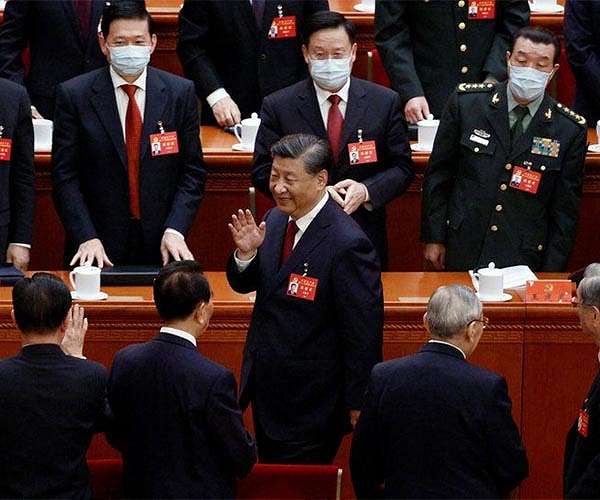
Chinese President Xi Jinping locked in support for a historic third term in power at the Communist Party's Congress on Saturday, but the dramatic removal of his predecessor from the event stole the headlines.
At the end of the week-long gathering in Beijing, China's ruling party approved a sweeping reshuffle that saw a number of top officials — including Premier Li Keqiang — step down, allowing Xi to appoint new allies.
The largely rubber-stamp meeting of around 2,300 party delegates was meticulously choreographed, with Xi determined to avoid any surprises as he enshrined his leadership for the next five years.
However, in an unexpected move that punctured the proceedings at the Great Hall of the People, former leader Hu Jintao was led out of the closing ceremony.
The frail-looking 79-year-old seemed reluctant to leave the front row where he was sitting next to Xi.
State media reported late Saturday that Hu was "not feeling well" when he was removed.
"Xinhuanet reporter Liu Jiawen has learned that Hu Jintao insisted on attending the closing session… despite the fact that he has been taking time to recuperate recently," Xinhua said on Twitter.
"When he was not feeling well during the session, his staff, for his health, accompanied him to a room next to the meeting venue for a rest. Now, he is much better."
– 'Core position' –
Delegates then approved a call obliging all party members to "uphold Comrade Xi Jinping's core position on the Party Central Committee and in the Party as a whole", according to a unanimously passed resolution on changes to the party charter.
Xi is now all but certain to be unveiled as general secretary on Sunday, shortly after the first meeting of the new Central Committee.
This will allow Xi to sail through to a third term as China's president, due to be announced during the government's annual legislative sessions in March.
The Central Committee of around 200 senior party officials was elected shortly before the closing ceremony.
A list of officials in the group revealed that four out of seven members of the party's Standing Committee — the apex of power — would retire.
Among them is Premier Li Keqiang, as well as fellow Politburo Standing Committee members Wang Yang — who was touted as a possible successor to Li — Han Zheng, and Li Zhanshu.
Han and Li Zhanshu were widely expected to step down, having surpassed the informal age limit of 68 for Politburo-level officials — a requirement not extended to 69-year-old Xi.
Wang and Li Keqiang, both 67, could still have continued in the Standing Committee or 25-member Politburo for another five-year term.
Other high-profile Communist Party top brass absent from the new Central Committee include high-ranking diplomat Yang Jiechi and economic tsar Liu He.
– Rubber stamp –
Analysts were closely watching for whether the party charter would be amended to enshrine "Xi Jinping Thought" as a guiding philosophy, a move that would put Xi on a par with Mao Zedong.
That did not take place, though the resolution did call the creed "the Marxism of contemporary China and of the 21st century", adding that it "embodies the best Chinese culture and ethos of this era".
Xi previously abolished the presidential two-term limit in 2018, paving the way for him to rule indefinitely.
The Congress has effectively cemented Xi's position as China's most powerful leader since Mao.
"Xi's power will be akin to that of the dictator of China, and there will be next to no scope for anyone to advise him to attempt course correction," said Steve Tsang, director of the SOAS China Institute at the University of London.
One of the key questions outstanding is if Xi will appoint a potential successor to the Politburo Standing Committee. This could be answered on Sunday when the Standing Committee is unveiled.
Delegates also on Saturday enshrined in the party's constitution opposition to Taiwanese independence. Beijing has always pledged to re-take the self-ruled democratic island, by force if necessary.
Taiwan's Mainland Affairs Council accused China late Saturday of harbouring an "old mindset of invasion and confrontation" and called on Beijing to "resolve differences through peaceful, equitable and realistic means."
How is China's Communist Party changing its constitution?
Beijing (AFP) Oct 22, 2022 –
China's Communist Party on Saturday unanimously approved a series of amendments to its constitution, further strengthening the control of Xi Jinping who now appears set for a historic third term in power.
Here's a guide to what has — and hasn't — changed.
– Xi's 'core position' –
China's Communist Party endorsed Xi's "core position" on the Party Central Committee — a group of about 200 senior officials — as well as his rarefied status "in the Party as a whole".
All party members will have to "acquire a deep understanding" of Xi's unassailable role and work to uphold it, the document says.
While the 69-year-old has long been referred to as the "core" of the party, the resolution uses the designation more often and in more reverent terms than the previous charter.
That may indicate a further consolidation of his untrammelled power at the top of the party and state.
– No 'Xi Jinping Thought' –
Many analysts were waiting to see whether the party would enshrine the term "Xi Jinping Thought" as its guiding doctrine, a move that would have placed Xi on a par with the likes of the country's founding leader Mao Zedong.
The lengthier "Xi Jinping Thought on Socialism with Chinese Characteristics for a New Era" was first woven into the charter in 2017, and argues that the party must take a commanding role in Chinese society while pushing further reform, national security and internal discipline.
The resolution Saturday referred to the ideology by its longer name, indicating that its status had not been significantly elevated.
However, it lauded the creed as "the Marxism of contemporary China and of the 21st century".
It "embodies the best Chinese culture and ethos of this era", the resolution said.
– Taiwan inclusion –
For the first time, the party's charter will say explicitly that it opposes Taiwanese independence, according to the resolution.
The constitution will be changed to include "statements on… resolutely opposing and deterring separatists seeking 'Taiwan independence'".
The existing charter says only that the party will "work continuously to strengthen the unity of all the Chinese people, including compatriots… in Taiwan" as part of efforts to achieve the "reunification of the motherland".
Beijing views self-ruled Taiwan as part of its own territory and has vowed to one day take it — by force if necessary.
Tensions ratcheted up in the summer when US House Speaker Nancy Pelosi visited the island, prompting Beijing to launch huge military drills.
During the congress opening ceremony, Xi reiterated that China would never renounce the option of using force to impose its rule on Taiwan.
