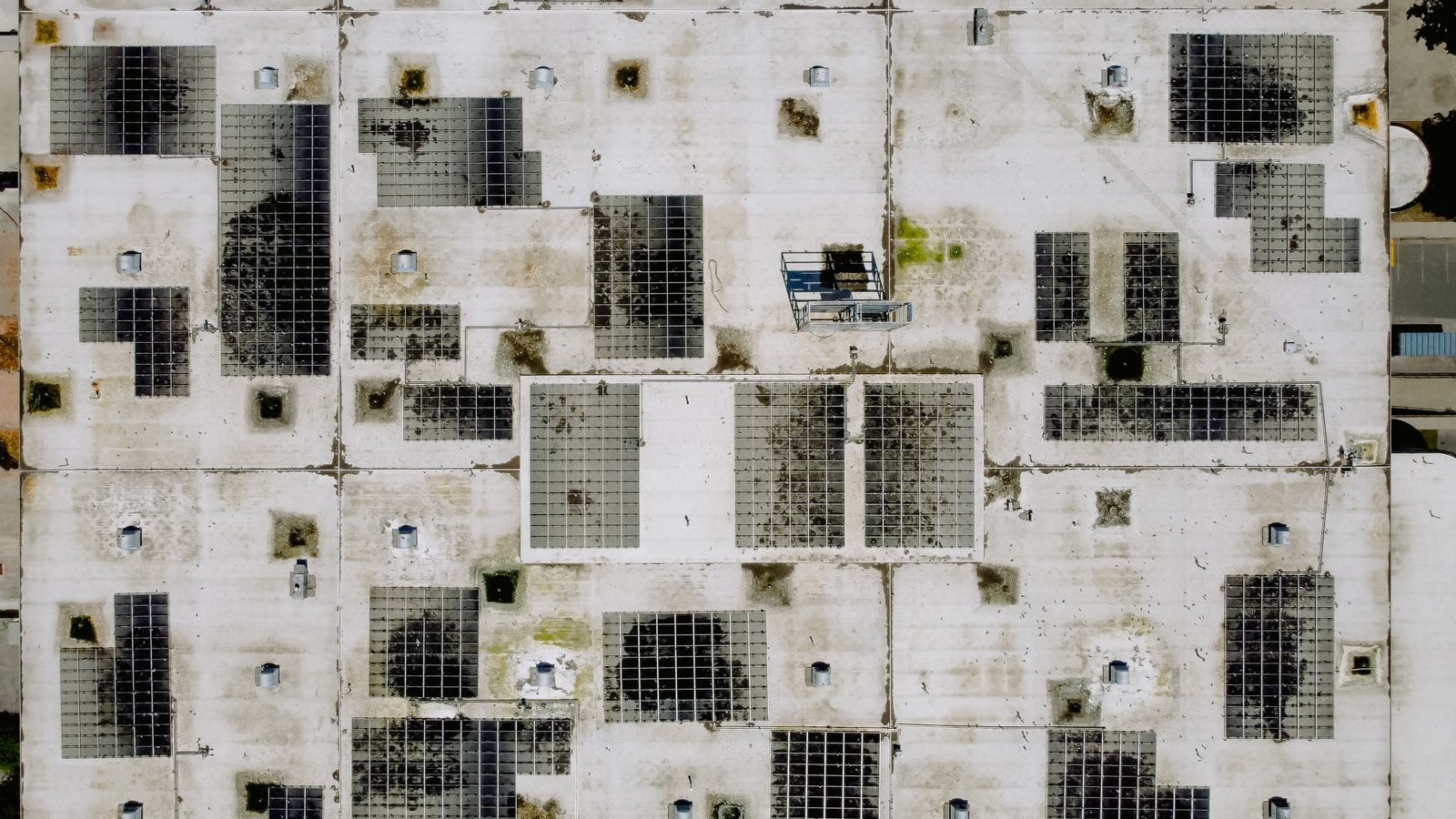
On the roof of the University of Oldenburg’s Energy Lab in northern Germany, photovoltaic modules manufactured in the 1970s are still generating electricity more than four decades after their first use. According to the university’s official history of the system, the 336 modules were first put into operation in 1979 and permanently installed at Oldenburg in 1983.
The most remarkable figure attached to the array is not 79 percent. Recent measurements of 18 historic modules that operated on the roof until 2022 found an average nominal output of 10.4 watts, with the university reporting that they still delivered almost as much energy as when they were installed. The original manufacturer’s data sheet had even listed a slightly lower nominal figure.

A system built before rooftop solar became ordinary
The modules belong to an era when terrestrial photovoltaics was still experimental. They had already been demonstrated in Berlin and used during a field test before arriving at the Oldenburg Energy Lab, a highly energy-efficient research building that began operating in 1982.
The complete array was rated at 3.46 kilowatts, less than the output of many small residential installations today. Each module contained rows of monocrystalline silicon cells sealed between two sheets of glass and held inside an aluminium frame. The cells themselves were about 0.3 millimetres thick.
Those specifications now look modest, but power density was not the experiment’s only purpose. The system was also a test of whether photovoltaic hardware built for use on Earth could survive decades of rain, ultraviolet radiation, temperature changes, and electrical loading. Most of the modules remain in service, and their electricity has been fed into the grid since 2007.
Where the 79 percent figure actually belongs
A separate European installation produced the widely circulated figure of roughly 79 percent. France’s Phébus 1 system was connected in 1992, and panels removed for laboratory testing three decades later were subjected to controlled flash measurements under international standards.
Those tests found that the French modules retained an average 79.5 percent of their initial power after 31 years. That works out to an average decline of about 0.66 percent per year, although the individual panels did not all degrade at the same rate.
Both examples are valuable, but they demonstrate different things. The French result provides a clearly measured retained-output percentage, while the Oldenburg measurements indicate that at least some much older modules are still close to their original nominal performance. Combining the two creates a stronger-sounding story, but an inaccurate one.
A warranty is not an expiration date
Solar-panel warranties usually define a minimum level of performance over a fixed period. They do not predict the day on which a panel will stop generating electricity, and they should not be treated as an estimate of unavoidable physical failure.
Manufacturers have historically needed to make long-term promises before decades of field data existed for each product generation. A 2016 report discussed by Electrek examined more than 11,000 panels and concluded that solar installations could have a useful life of at least 35 years, around 40 percent longer than the 25-year period commonly assumed at the time.
The Oldenburg modules suggest that carefully constructed systems can go considerably further. Their survival does not mean every panel will last for 40 or 50 years, because materials, manufacturing quality, installation conditions, climate, and maintenance all affect the outcome. It does show why a warranty period and a module’s physical lifetime are not the same thing.
What ages inside a solar module
Crystalline silicon can remain electrically useful for an exceptionally long time when it stays dry and mechanically intact. Many failures instead begin in the materials surrounding the cells, including seals, encapsulants, solder connections, backsheets, junction boxes, and external wiring.
Moisture entering through damaged edges can corrode electrical contacts. Repeated heating and cooling can fatigue solder joints, while ultraviolet exposure can alter polymers and reduce the amount of light reaching a cell. Hail, transport damage, poor installation, and manufacturing defects can create additional failure points.
The Oldenburg modules used a substantial glass-and-aluminium construction that has visibly weathered but remained functional. Their continued operation does not mean that every part of an old photovoltaic system lasts equally long, particularly the electronics that convert and manage the electricity.
The US Department of Energy notes that string inverters commonly last between 10 and 15 years and may require replacement during the lifetime of the panels. A solar array can therefore undergo significant maintenance or electronic upgrades while its original modules continue producing power.
Long life changes the economics
A module that remains productive for several additional decades can generate far more lifetime electricity than a financial model based on a short operating period would suggest. Longer service also spreads the energy and material costs of manufacturing across a larger number of delivered kilowatt-hours.
That does not mean the oldest panel should always remain on the most valuable roof. Modern modules can produce far more electricity from the same surface area, so replacing a functioning low-output array may make sense where roof space is limited. The decision depends on the value of the additional generation, the condition of the old system, installation costs, and whether the removed equipment has another safe use.
Oldenburg represents an unusual case because the array has historical and research value as well as electrical value. Its modest capacity matters less than the evidence it provides about the physical endurance of early terrestrial photovoltaic construction.
The second-life question is becoming more important
A functioning panel does not automatically become waste when it leaves its original installation. It may still be useful where available space is less constrained, provided it passes appropriate electrical, insulation, and safety checks.
A 2026 report from the International Energy Agency Photovoltaic Power Systems Programme describes testing and sorting as the most robust pathway for deploying second-life modules. It also warns that repair can be labour-intensive, qualification standards remain inconsistent, and inexpensive new modules make the economics difficult.
That distinction matters. Reuse should not mean moving untested equipment into another market simply because it still produces current. A credible second-life system needs inspection, performance measurement, traceable documentation, and a clear decision about whether each module should be reused, repaired, or recycled.
Efficiency records and lifetime records measure different things
Photovoltaic research has advanced enormously since the Oldenburg modules were built. The National Laboratory of the Rockies maintains a chart of independently confirmed research-cell efficiency records across crystalline silicon, multijunction, thin-film, tandem, and emerging photovoltaic technologies.
Those records measure how effectively a cell converts incoming light under defined test conditions. They do not establish how much electricity a commercial module will deliver after decades outdoors. Peak efficiency, manufacturing yield, stability, repairability, and lifetime energy production are related engineering goals, but they are not interchangeable.
New tandem and emerging-cell designs may eventually put far more generating capacity into the same roof area. Their remaining challenge is to demonstrate that high initial performance can survive years of moisture, heat, ultraviolet exposure, electrical stress, and repeated temperature cycling at commercial scale.
A four-decade benchmark
The Oldenburg modules do not need an imported 79 percent figure to make their case. They were first operated in 1979, installed permanently at the university in 1983, and most are still working. Measurements of selected modules found output remarkably close to the level recorded at the beginning of their service.
On a roof in Lower Saxony, photovoltaic hardware built before modern rooftop solar became an industry is still turning daylight into electricity. Newer cells will beat it easily on efficiency and power density. Matching its demonstrated endurance may take another four decades to prove.