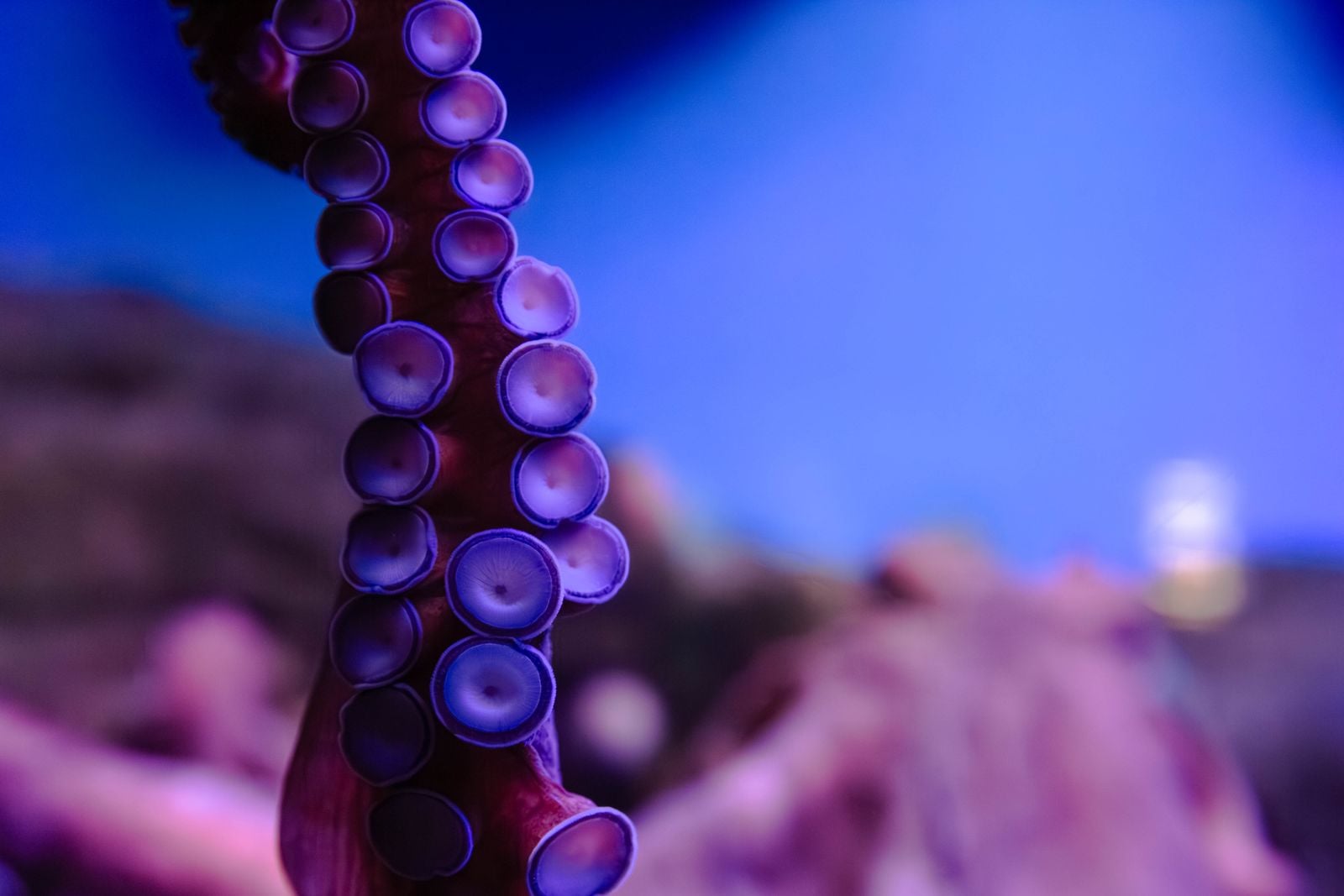
An octopus does not have a brain in the way you do. It has one central brain wrapped around its esophagus, two optic lobes behind its eyes so large they are often counted as brains in their own right, and eight further clusters of neurons — one running the length of each arm. Roughly two-thirds of the animal’s neurons live outside its head, distributed through those arms, which is why a severed octopus limb can still reach for food, recoil from acid, and grip a passing object for up to an hour after being cut from the body, as demonstrated in research on octopus arm autonomy.
The blood pumping through all of this is blue.
Nine brains, or one brain and eight assistants
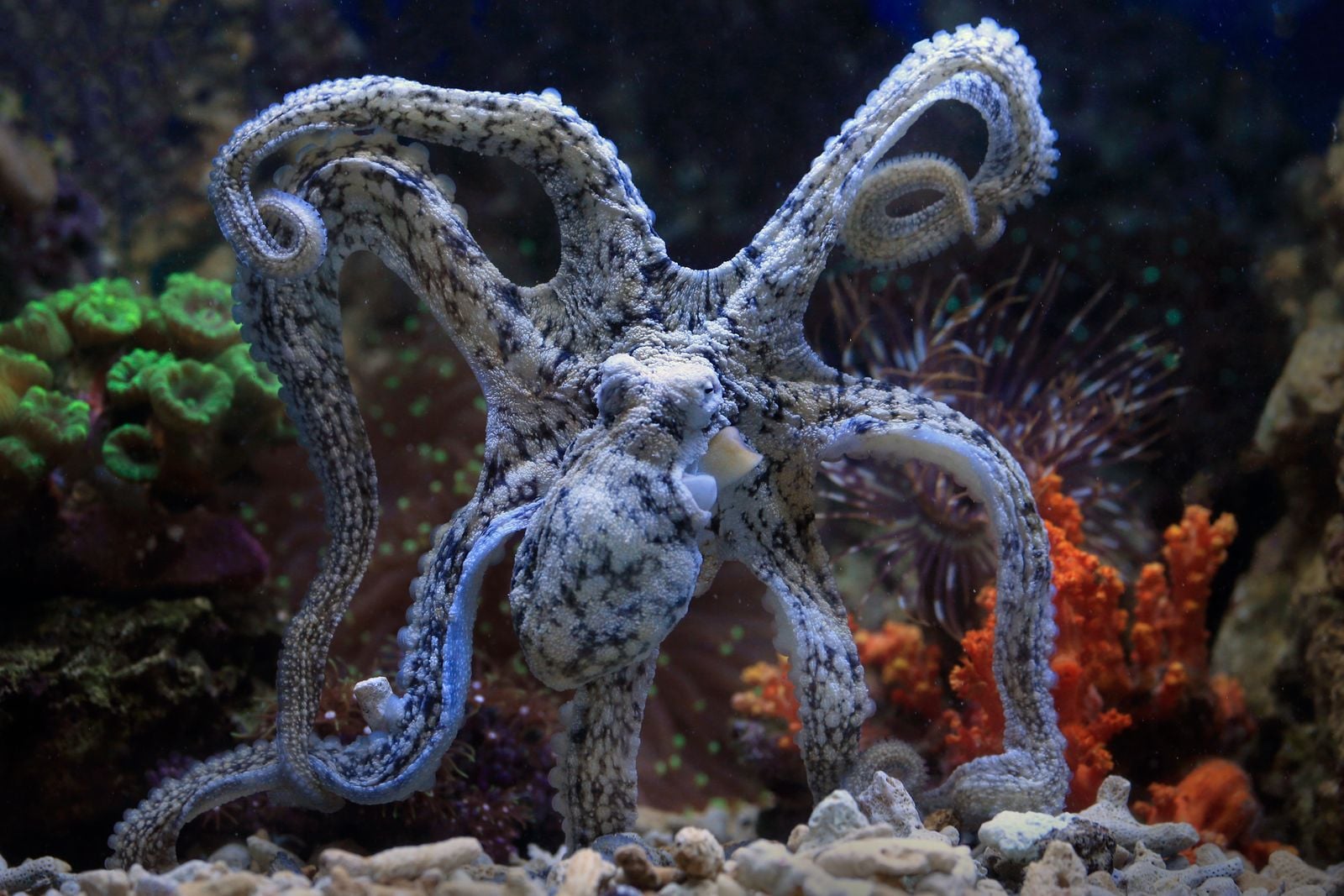
The count depends on how strict you want to be about the word brain. The central brain sits between the eyes, threaded around the esophagus in a donut shape — swallow something too big and it bumps the neurons that plan your next move. The central brain and optic lobes contain substantial neural tissue, while the arms hold even more.
Each of the eight arms contains its own axial nerve cord packed with neurons. Taken together, the arms hold more nervous tissue than sits in the head. Marine biologists count nine brains because the arm cords are not just relays. They compute.
An arm can taste. It can decide. It can grip a crab before the central brain has registered the crab is there.
What a severed arm can still do
The strangest evidence for arm autonomy comes from amputation studies. When octopus arms are surgically removed and kept in oxygenated seawater, they continue to respond to stimuli for close to an hour. Poke one with a probe and it withdraws. Touch it with food and the suckers close. Drop acid on it and it flinches away with the same coordinated sequence a living octopus would use.
Working with soft-robotics researchers, scientists filmed amputated arms performing reaching motions that looked identical to arms still attached to a living animal. The wave of muscle contraction that propagates from base to tip — the octopus’s signature reach — is generated locally in the arm’s nerve cord, not commanded from the head.
The central brain, in other words, does not micromanage the limbs. It sends a goal — reach toward that shadow — and the arm figures out the trajectory itself.
Three hearts, one of which stops when the animal swims
An octopus circulates blood through three separate pumps. Two branchial hearts sit at the base of the gills, each squeezing blood through one gill so it can pick up oxygen. A third systemic heart takes the oxygenated blood and pushes it out to the rest of the body.
Here is the odd part. When an octopus swims by jet propulsion, the systemic heart stops beating. Swimming is metabolically expensive for these animals, which is why they mostly crawl. A giant Pacific octopus jetting across open water is essentially holding its cardiovascular breath.
This is one reason octopuses are ambush predators rather than pursuit hunters. The plumbing does not support long chases.
Why the blood is blue
Human blood carries oxygen on hemoglobin, an iron-based protein that turns bright red when it binds O2. Octopus blood uses hemocyanin instead — a copper-based protein that turns blue when oxygenated and nearly colorless when it is not.
Copper is a less efficient oxygen carrier than iron in warm, oxygen-rich conditions. But it works better in the cold, low-oxygen water where many octopus species live, particularly deep-sea species and Antarctic octopuses that survive at temperatures near freezing. This copper chemistry is part of why cephalopods have thrived in ocean environments where iron-based blood would struggle.
An injured octopus does bleed blue. It looks less dramatic than a horror film and more like ink spilled into seawater — a pale, dispersing wash of color.
Distributed cognition, or biological edge computing
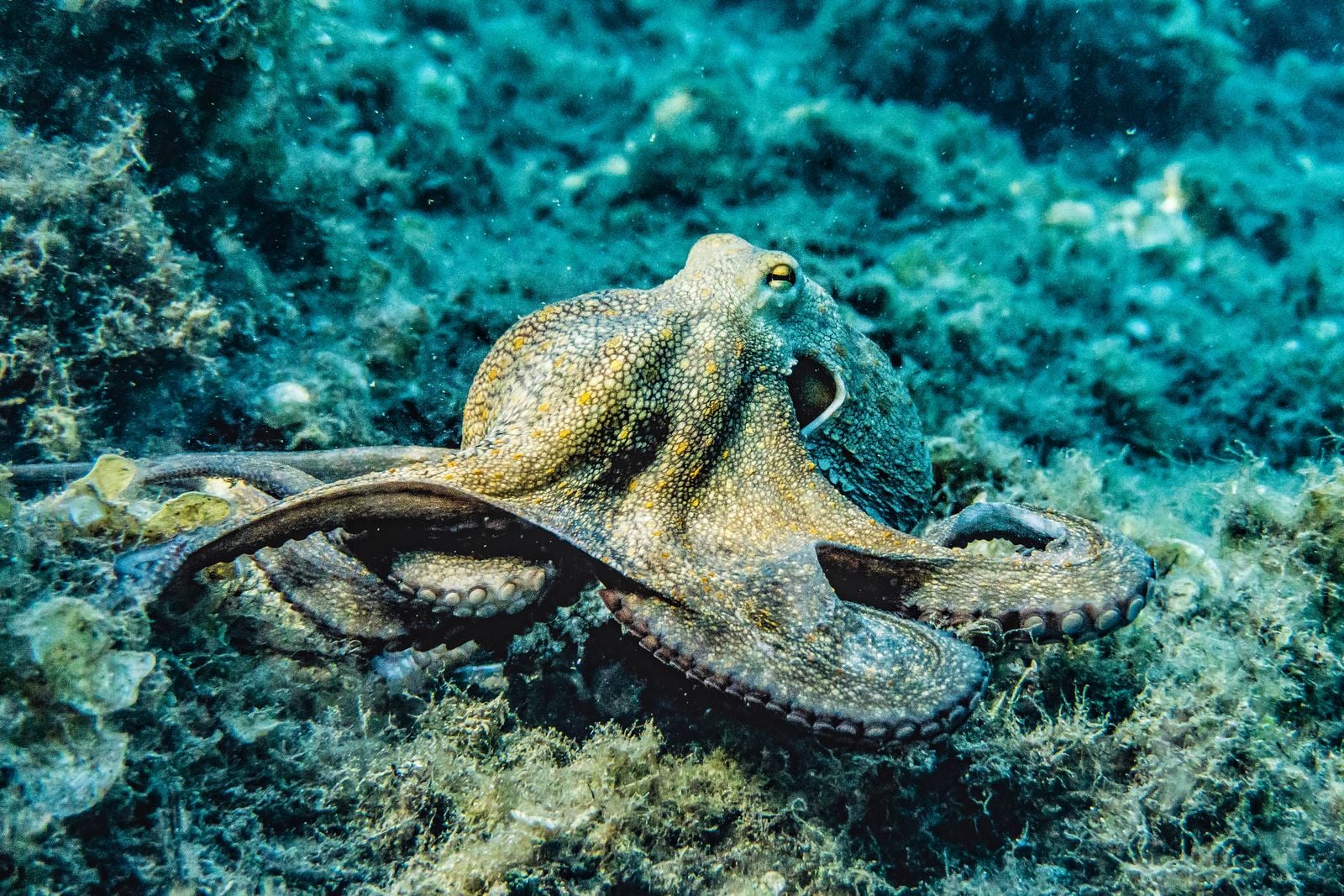
The reason all of this matters — the reason neuroscientists keep coming back to octopuses — is that the animal represents an independent solution to the problem of intelligence. Vertebrates and cephalopods last shared a common ancestor hundreds of millions of years ago, a small worm-like creature with almost no nervous system to speak of. Everything sophisticated in the octopus brain evolved separately from everything sophisticated in yours.
Which means the octopus is, in a real sense, the closest thing on Earth to an alien intelligence. Neuroscientist and astrobiologist Dominic Sivitilli, at the University of Washington, has argued in interviews such as one with NPR that studying octopus cognition may be the best available model for what non-human intelligence could look like elsewhere in the universe. The architecture is genuinely different. There is no clear command-and-control hierarchy. The arms do not wait for permission.
Comparative neuroanatomists treat cephalopod nervous systems as a natural test case for how brains can be organized when the vertebrate blueprint is set aside.
Suckers that taste what they touch
Each octopus arm carries hundreds of suckers, and each sucker is lined with chemoreceptors that let it taste by touch. When an arm slides into a crevice on a reef, it is sampling the chemistry of everything it brushes against — detecting whether a surface is shell, flesh, algae, or rock without any visual information reaching the central brain.
The suckers can also grip with fine control. An octopus can pick up a single grain of sand or peel the lid off a screw-top jar from the inside. Aquarium keepers tell stories about octopuses escaping tanks at night, walking across dry floors, raiding neighboring tanks for fish, and returning home before the morning shift arrives. These are not exaggerations. They are documented behaviors.
Some species have taken tool use further. Coconut octopuses carry discarded shells with them as portable shelters. Others assemble communal aggregations of rocks and shells that researchers have nicknamed Octopolis and Octlantis.
How does an arm avoid tying itself in knots
If two-thirds of the octopus nervous system lives in the arms, and each arm can act independently, why does an octopus not end up tangled? Octopus skin secretes chemical cues its own suckers recognize as self. The suckers reflexively refuse to grip octopus flesh. Cut an arm free and its suckers will grab anything — anything except another arm from the same animal.
This is elegant engineering. The arms do not need a central map of where all the other arms are, which would require an enormous amount of coordination from the head. Instead, each arm carries a simple local rule: do not stick to anything that smells like me.
Regeneration and the shape of the animal
Lose an arm to a shark or a moray eel and an octopus grows it back, complete with its full complement of neurons, suckers, and chemoreceptors. This is a routine biological process for the animal, not a rare feat. Full regeneration takes weeks to months depending on species and water temperature.
The regrown arm is functionally identical to the original. Its neurons rewire into the central nerve ring around the esophagus and pick up their old job of tasting, deciding, and reaching without instruction.
Chromatophores and the language of skin
The skin is its own information system. Octopus skin contains chromatophores — tiny sacs of pigment surrounded by muscle fibers. Contract the muscles and the pigment sac spreads flat, showing its color. Relax them and the color disappears. This happens in milliseconds.
Layered underneath are iridophores and leucophores, which reflect and scatter light to produce blues, silvers, and whites. An octopus can shift its entire skin pattern faster than you can blink, and it can hold a pattern that matches the coral behind it while simultaneously flashing a different pattern on the side facing a rival.
Octopuses are also, as far as anyone can tell, colorblind. Their eyes have only one type of photoreceptor. How they match colors so precisely remains an open question, though some researchers suspect the skin itself contains light-sensitive proteins that detect color independently of the eyes.
What the arms are doing while the brain thinks about something else
The underlying question — how does life organize itself into functional units — is exactly the question the octopus answers differently from us. In humans, the functional unit of decision-making is centralized in the head. In an octopus, it is distributed across nine loci that can act in parallel.
When an octopus is hunting, the central brain may be tracking a fish visually while three arms independently investigate three separate crevices for hiding prey and a fourth arm anchors the animal to a rock. Each arm is running its own search algorithm. When one arm finds something, it grips, and only then does information about the catch propagate back to the central brain.
Roboticists have been trying to copy this for years. Soft robotic arms built to mimic octopus reaching use distributed sensors along their length to grasp underwater objects without requiring a central controller to compute every movement in advance. It works better than centralized designs. The octopus figured it out first, by about 500 million years.
Short lives, dense with information
For all this sophistication, most octopuses live only one to two years. The giant Pacific octopus, the largest species, may reach four or five. Females typically die shortly after their eggs hatch — they stop eating and guard the clutch until they starve.
The nine brains, the three hearts, the copper blood, the tasting suckers, the color-shifting skin — all of it is compressed into a lifespan shorter than a house cat’s kittenhood. An octopus that solves a puzzle-box in an aquarium tank will be dead within eighteen months, taking whatever it learned with it. There is no elder octopus teaching younger ones. Every generation reinvents the trick.
Somewhere on a reef right now, an arm is reaching into a shell it has never seen before, tasting the interior, deciding what lives inside, and pulling — while the animal it belongs to is looking the other way.