In the Almería province of southeastern Spain, a sea of white plastic covers tens of thousands of hectares of former scrubland, visible from orbit as a bright rectangle against the ochre coastline. Underneath those greenhouses, on a strip of coast that receives minimal rainfall each year, growers ship millions of tonnes of tomatoes, peppers, cucumbers, aubergines and courgettes each season, much of it onto supermarket shelves in Germany, the Netherlands and the United Kingdom by the following morning. And the water footprint per kilogram of produce is a fraction of what it was in the 1980s.
The mechanism is not magic. It is a stack of unglamorous engineering choices — drip irrigation, sand-mulch soil beds called enarenado, hydroponic recirculation, brackish groundwater blending, and increasingly, desalinated seawater pumped inland — layered on top of one of the sunniest climates in Europe. Published comparisons of tomato-growing systems, including figures tracked by Cajamar’s agricultural research station in Almería, put the water intensity of a kilogram of open-field greenhouse tomato at roughly 60 litres, falling toward 20 litres or less as growers switch from furrow irrigation to closed-loop hydroponic systems that recapture drainage water.
The white sea, seen from space
The plastic covering in Almería is often called the mar de plástico. The reflectivity is high enough to have measurably cooled the local surface temperature — an accidental albedo experiment on a landscape scale. Under each hectare of polyethylene sits a growing system that has almost nothing in common with open-field farming.
The soil, in most of these houses, is not really soil. Growers lay down a base of imported clay-rich earth, cover it with a thin layer of manure, and top the whole thing with a 10-centimetre blanket of coarse beach sand. The sand acts as a mulch: it breaks capillary rise, so water applied at the root zone stays near the roots instead of wicking to the surface and evaporating into the greenhouse air. That trick, refined by farmers along this stretch of Mediterranean coast over decades before any engineer wrote it down, cuts evaporative loss dramatically compared with bare soil.
Drip lines, hydroponics, and the wider dry-world math
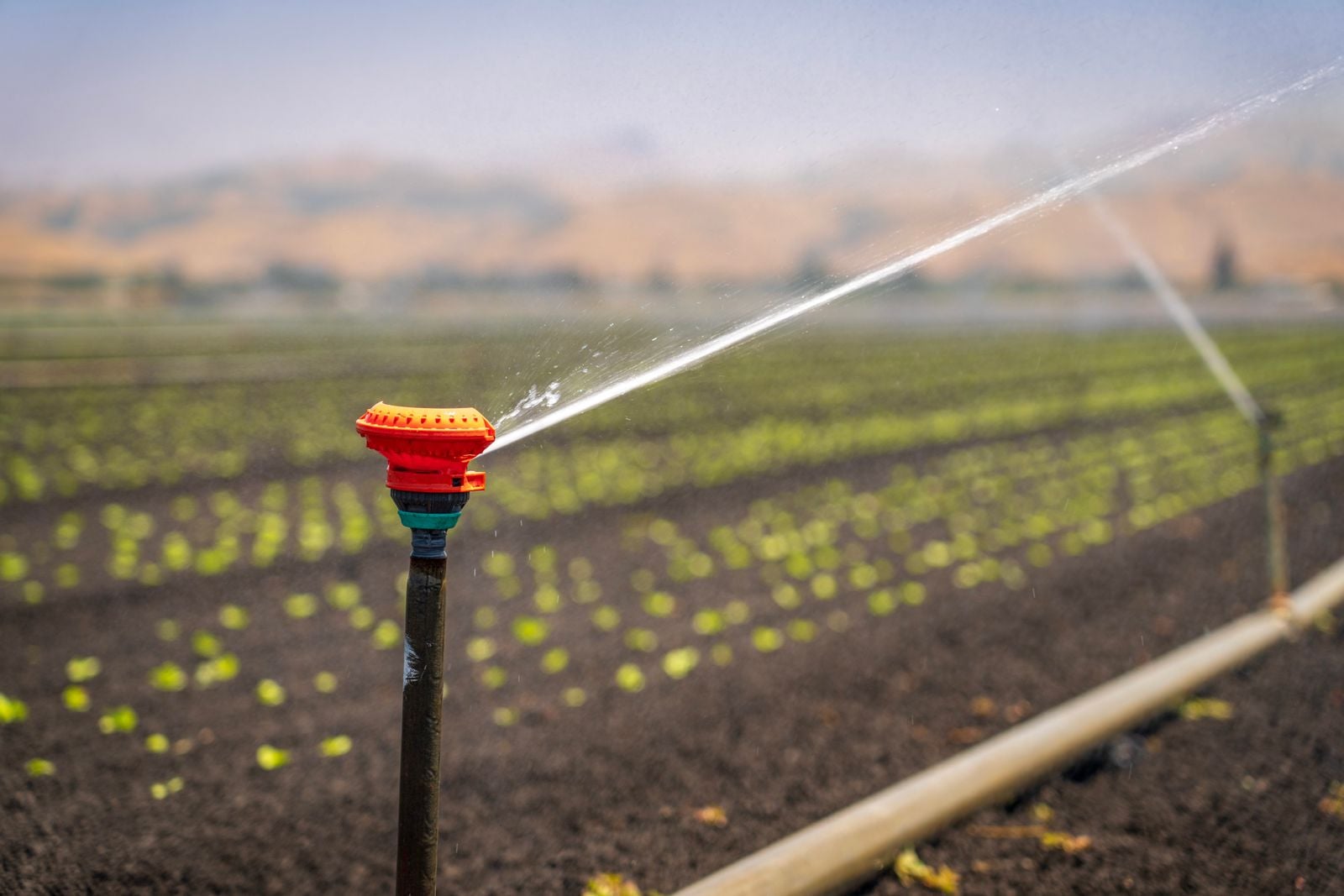
Every plant in a modern Almería greenhouse receives water through a pressure-compensated drip emitter, calibrated to deliver between half a litre and two litres per day depending on the growth stage, fruit load and outside radiation. A climate computer reads solar input every few seconds and adjusts the fertigation schedule accordingly. Spanish irrigation communities elsewhere are running the same arithmetic with solar-powered pumping schedules built around daylight hours, trading nighttime power savings for the water efficiency of drip lines. The result in Almería is that a mature tomato vine, which will produce several kilos of fruit over a season, might receive its total water ration in doses no larger than a shot glass, dozens of times a day.
A tomato is about 95 percent water by weight, so there is a hard floor to how little water a kilogram of fruit can be grown with. Field-grown tomatoes in California or southern Italy typically require significantly more water per kilogram at the farm gate once evaporation and runoff are counted. The closed hydroponic systems now common in Almería’s newer greenhouses recirculate the drainage, capture condensation on the plastic roof, and push the ratio toward a theoretical minimum. Such edge-of-field technologies can also reduce the nitrogen and phosphorus loading that would otherwise leach into groundwater.
Almería is not the only dry place doing this. Drip irrigation technology developed in the Negev in the 1960s and diffused through the Mediterranean, North Africa and parts of the Middle East over the following decades. Jordan, one of the most water-scarce countries on Earth, has adopted the same greenhouse-plus-drip package in the Jordan Valley for its own export crops. Photovoltaics now power a growing share of the pumping stations that lift water up from the Rift Valley aquifers to the highland farms.
The common ingredient in Spain, Israel and Jordan is not rainfall — obviously — but the willingness to treat every drop as an engineering unit. Water is metered, priced, budgeted per plant, and, in the most advanced systems, weighed on the way in and on the way out through the drainage collector.
Where the water comes from
Almería sits on top of a set of coastal aquifers that have been over-pumped for half a century. By the 1990s, seawater intrusion had pushed salinity in some wells above 3 grams per litre — undrinkable, and marginal even for the salt-tolerant tomato varieties growers had bred for the region.
The response, funded partly by the Spanish government and the European Union, was a chain of desalination plants along the Mediterranean coast. The Carboneras plant, run by the state water company Acuamed, has a treatment capacity of 120,000 cubic metres a day and was, at the time it opened in 2005, the largest seawater desalination plant in Europe — a title Barcelona’s El Prat plant took over a few years later. Much of the Carboneras output is piped inland to greenhouse cooperatives.
Desalination is energy-hungry, and the greenhouse belt has become one of the more instructive test cases for pairing that energy demand with photovoltaic generation. Cooperatives have installed rooftop solar on packing houses and, in some cases, translucent solar films on the greenhouse structures themselves — not unlike the logic behind solar-synced desalination systems now being tested elsewhere that ramp output up and down with available sunlight instead of relying on batteries or grid backup. Almería is among the sunniest provinces in Spain, which is why the greenhouses ended up there in the first place and why the electricity to run the pumps can increasingly be produced on site.
The aridity is not a figure of speech. Almería averages somewhere around 200 to 260 millimetres of rain a year, a level climatologists classify as desert, and one of the lowest anywhere in Europe. That is a fraction of what falls on Spain’s own Atlantic coast, where parts of Galicia see well over 1,200 millimetres annually — a reminder that the “desert” description belongs to this particular corner of the country, not to Spain as a whole.
Sand, plastic, and the accidental invention
The Almería story usually gets told as a triumph of Spanish agronomy, but the founding trick really was an accident. The historical record traces the sand-mulch technique back to the 1880s, to farmers on the Granada coast around El Pozuelo and La Rábita. Local accounts credit a farmer there, Manuel Romero Rivas, with noticing that ants digging near one of his tomato plants had thrown up a small mound of sand — and that the tomatoes growing beside that mound came in earlier, bigger and better than the rest of the plot. The practice spread east along the coast into Almería over the following decades.
The state got involved from 1957, when the Instituto Nacional de Colonización began financing sand-mulched plots for the farmers it was resettling on the arid Campo de Dalías. The plastic came a few years later: in 1963, a colonist named Francisco Fuentes Sánchez — known locally as “Paco el Piloto” — built the area’s first plastic-covered plot near Roquetas de Mar as part of a state-backed trial, using cheap polyethylene sheeting to trap humidity and extend the growing season into winter. Academic research on the region’s agrarian transformation traces how that combination of sand mulch and plastic cover, first grown out of peasant observation and then scaled by state colonisation policy, became the template for the entire greenhouse belt.
Over the following decades, greenhouse coverage expanded from a few hundred hectares to tens of thousands of hectares across Almería and neighbouring provinces. Yields per hectare climbed dramatically as growers shifted to modern hydroponic systems. The water bill per kilogram fell in the same period, because the denominator grew faster than the numerator.
The cost side of the ledger
None of this is free of consequences. The aquifers are still over-drafted in dry years. The plastic waste from greenhouse covers, which need replacing every three years, is a chronic disposal problem. And the labour force that picks the tomatoes is largely made up of migrant workers from Morocco and sub-Saharan Africa. Research on migrant labour conditions in Almería’s agroindustrial sector has found that Moroccan and sub-Saharan workers are disproportionately assigned the hardest tasks inside the greenhouses on the most precarious, lowest-paid contracts, and that many live in informal settlements without running water — an irony not lost on the region’s own social scientists.
Fertiliser runoff is another persistent issue. Even closed hydroponic systems leak, and the Mediterranean coastline downstream of the greenhouse belt shows elevated nitrate signals that ecologists have been tracking since the 1990s.
Nanobubbles, biochar, and the Ogallala counterfactual
The frontier is now oxygen and precision. Growers experimenting with nanobubble technology — injecting microscopic oxygen bubbles into irrigation water — are drawing on peer-reviewed trials on nanobubble-enriched irrigation in greenhouse tomato and cucumber crops, which found gains in yield and water-use efficiency alongside improved soil microbial activity. Faster root growth and lower disease pressure translate into fewer replant losses and lower total water use per marketable kilo. Biochar amendments, made from crop residues pyrolysed at low temperature, are being trialled as soil sponges that hold water and nutrients in the root zone for longer.
The connection to solar is direct. A greenhouse cooperative with rooftop photovoltaics can run desalination pumps, climate computers and nutrient dosing systems on its own electricity, decoupling food production from grid gas prices. Perovskite films printed at low temperatures could eventually be laminated onto greenhouse plastic itself, generating power from the same square metre that shelters the crop — the same arid-region logic behind solar-driven water-harvesting materials now being developed for other water-stressed regions.
What makes Almería instructive is the counterfactual. The High Plains of the United States grow corn and cotton on top of the Ogallala Aquifer, one of the largest freshwater reserves on the planet, using centre-pivot irrigation that sprays water into hot, dry air. Reporting from High Plains Public Radio on the Ogallala’s decline describes statewide water levels falling by nearly two feet in a single year and Kansas lawmakers, after decades of inaction, finally passing legislation pushing groundwater districts to cut withdrawals in the hardest-hit areas. A kilo of Kansas corn can use several hundred litres of water; a kilo of Almería tomato uses under 20. The crops are different, the calories are different, and the comparison is not clean — but the philosophical gap is real. One system treated water as effectively free until it wasn’t. The other has treated it as the binding constraint from the first day.
A farmer who started in Almería in 1980 would have grown a few tonnes of tomato on a hectare of sanded soil, watered from a shallow well, and sold the crop into a regional market. The same farmer, still working today, might oversee a hydroponic greenhouse recirculating desalinated seawater, powered partly by rooftop solar, with fruit trucked overnight to a Rotterdam distribution centre and on a Berlin supermarket shelf 36 hours after picking. The plastic sea has grown many times over in that career. The water per tomato has fallen by more than half.
Stand on a hillside above El Ejido at dusk and the greenhouses catch the last light off the Mediterranean, a low-lying grid of white rectangles running to the horizon. Underneath each one, a drip line ticks water out in measured pulses, one shot glass at a time, from a coast that on paper should not be able to feed anyone at all.