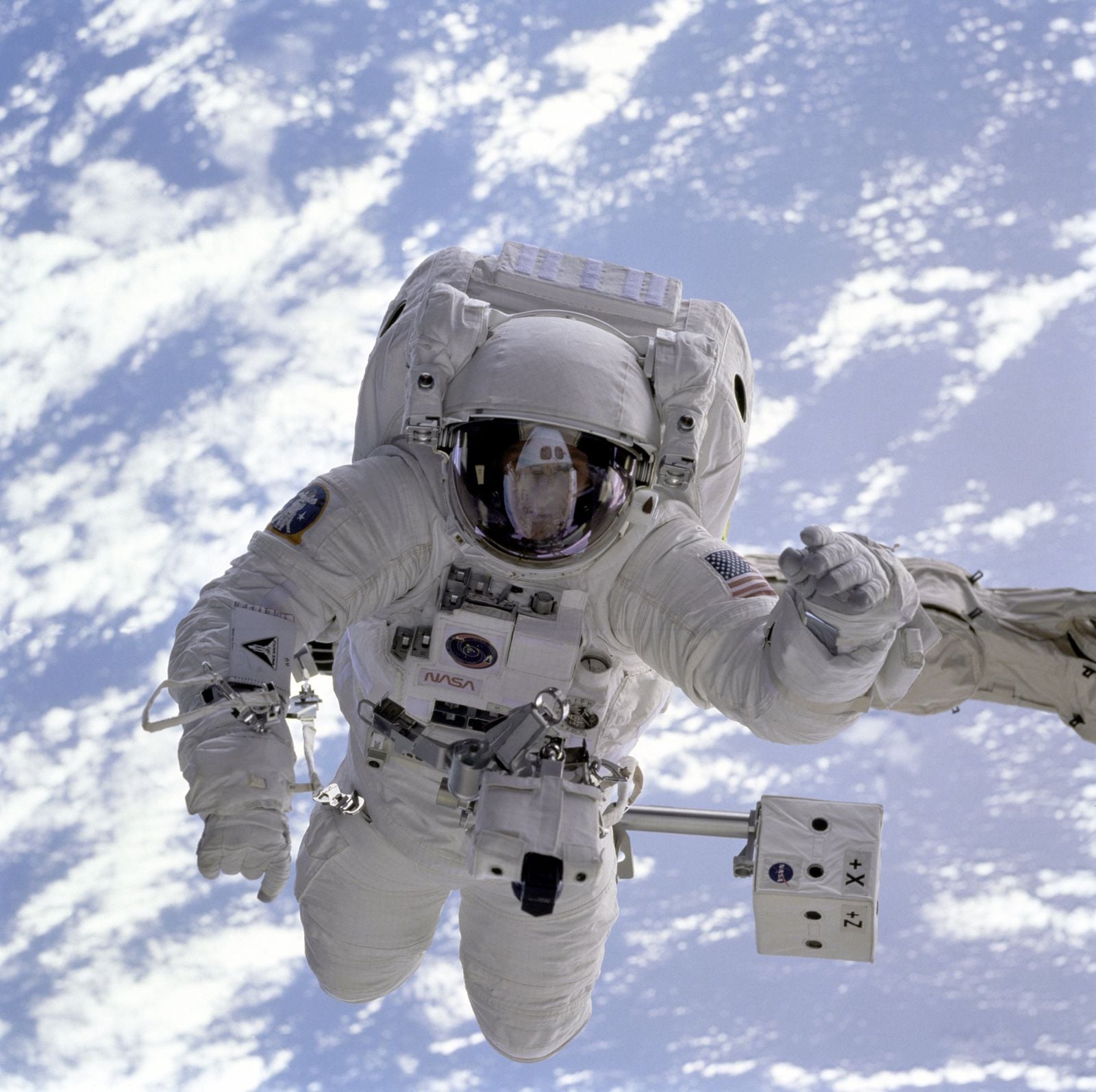
Astronauts stepping off a Soyuz capsule after six months on the International Space Station are, quite literally, not the same size they were when they launched. Flight surgeons have documented crew members returning up to 5 centimetres taller than their pre-flight height, a stretch caused by the absence of gravity pressing down on the spine. The effect is predictable enough that Russia custom-builds each crew member’s Soyuz return seat from a plaster cast taken weeks before launch, engineering the couch to cradle a spine that will come home longer than it left.
The mechanism looks like simple plumbing. Between each of the vertebrae in the human spine sits a disc of fibrocartilage with a gel-like core called the nucleus pulposus. On Earth, standing, sitting and walking squeeze water out of those discs across the day. Lie down for eight hours and the discs rehydrate. Remove gravity for 180 days and, the reasoning goes, the discs keep expanding, uncompressed, until the spine reaches a length it has not held since the astronaut was horizontal in a womb.
The 3 percent stretch
NASA puts the gain at up to 3 percent of standing height. For a 1.75-metre astronaut, that is a little over 5 centimetres — about the length of a matchbook. NASA’s Spinal Ultrasound investigation was set up precisely because the agency could measure the change without being able to explain it, sending crew members to scan each other’s spines at 30, 90 and 150 days into flight.
Most of the stretching is thought to happen in the lumbar region, where the discs are largest and bear the most weight on the ground. In microgravity, the deep spinal stabilising muscles stop firing the way they do against gravity, and the spine’s S-curve flattens toward something closer to a column.
Astronauts describe the sensation as a mild, floating loosening — comfortable at first. The pain comes later.
Why the Soyuz seats are moulded from plaster
Roscosmos figured out decades ago that a return seat built for a pre-flight body would not safely restrain a post-flight one. During re-entry, the Soyuz descent module hits substantial deceleration forces. A spine that has grown several centimetres and a rib cage that has shifted upward need custom foam cradling, or the crew member risks compression injuries at the moment gravity slams back on.
So each crew member lies in wet plaster during pre-flight training. The cast becomes the mould for the Kazbek seat liner — a removable cocoon shaped to one individual’s back, hips and shoulders, dropped into a shock-absorbing frame. It is one of the more quietly astonishing pieces of engineering in human spaceflight: a chair built for a person who does not yet exist.
The painful weeks on the other side
Coming home is worse than going up. Within hours of landing, gravity begins pressing the spine back toward its Earth shape, but the surrounding muscles have weakened, the ligaments have loosened, and the spinal curvature has flattened. A NASA-funded study of six long-duration crew members, led by Douglas Chang at the University of California, San Diego and published in Spine in 2016, found the functional cross-sectional area of the lumbar paraspinal muscles fell by an average of 19 percent between pre-flight and immediate post-flight scans. A month or two later, only about two-thirds of that loss had come back.
The same study complicates the tidy disc explanation. Chang’s team found no consistent change in intervertebral disc height, and said outright that the measurements ran counter to earlier hypotheses about microgravity causing the discs to swell. A 2018 review in Frontiers in Physiology by ESA’s David Green and Jonathan Scott reached the same conclusion: loss of spinal curvature and disc swelling are both plausible contributors to spaceflight elongation, but in-flight ultrasound and pre- and post-flight MRI have not yet detected significant disc changes. The astronauts are unmistakably taller. Exactly how much of that is discs and how much is a straightening spine remains open.
What is not in doubt is the cost. Chang and colleagues reported that NASA crew members carry roughly 4.3 times the risk of herniated intervertebral discs compared with general and military aviator populations, with the highest risk in the first year after a mission.
Astronauts return, in other words, with a spine that is temporarily longer, structurally weaker, and surrounded by muscles that have forgotten how to hold it upright.
What the discs are actually doing
An intervertebral disc is mostly water, with a proportion that declines through life. The outer layer is tough, layered collagen. The inner core behaves like a hydraulic cushion — squeezed under load, swollen when unloaded.
On the ground, a healthy adult is measurably taller in the morning than in the evening, usually by 1 to 2 centimetres, because a night of lying flat lets the discs draw in fluid. Microgravity has been described as a night that never ends. Whether the same osmotic mechanism scales up across 180 days, or whether the flattening of the spinal curve does most of the work, is what the imaging has so far failed to settle.
Scott Kelly came back from his 340-day mission measurably taller than he left. He lost most of it within days. The rest took weeks and hurt.
A body reshaping itself in orbit
The spinal stretch is only one of the anatomical reworkings that happen in microgravity. Fluid shifts upward, puffing the face and thinning the legs. The heart, no longer pumping against gravity, becomes more spherical. Bone density in the hips and lower spine drops significantly without countermeasures.
Even digestion gets stranger. In August 2026, Space.com reported on a University of Copenhagen and NASA study of 52 astronauts finding that microgravity appears to slow the movement of food through the intestines. The researchers did not measure transit directly; they inferred it from blood metabolites showing gut bacteria fermenting more protein than usual, a signature of food lingering longer in the colon.
Metabolism shifts too. The ENERGY study of eleven male ISS crew members, published in npj Microgravity in March 2024, found that three months in space left fasting energy expenditure essentially unchanged, but tipped fuel selection sharply toward carbohydrate: carbohydrates supplied 65 percent of fasting energy expenditure in orbit against 44 percent on the ground. The authors’ own conclusion is the interesting part — the shift tracked the inflight diet more closely than it tracked microgravity. Average body mass still fell by about 1.2 kilograms.
The taller, thinner, puffier astronaut who floats through the ISS cupola looking down at Earth is a body being rewritten by absence — the absence of the single force that has shaped every vertebrate spine since spines existed.
Body size as mission cost
The height gain matters beyond seat moulds. A 2020 study in Scientific Reports by Jonathan Scott and colleagues at ESA’s European Astronaut Centre and KBR modelled how crew body size drives life-support demand across missions of 30 to 1,080 days. Stepping a theoretical four-person male crew from 1.50 metres to 1.90 metres raised 24-hour total energy expenditure by 44 percent, oxygen consumption and carbon dioxide production by 60 percent each, and water needed for hydration by 19 percent. In absolute terms, the difference ran to an extra 996 megajoules of energy and 183.6 litres of water every month. For a Mars mission, where every kilogram sent to the surface costs enormous propellant, crew anthropometry becomes a design variable.
The spinal stretch also complicates spacesuit fit. Green and Scott note that stature increases can leave astronauts unable to fit their EVA suits, which are assembled to a tolerance of roughly 2.5 centimetres — less than half the height an astronaut can gain over six months. The person who launches and the person who spacewalks four months later are not the same dimensions.
How they measure it
Crews are measured before launch using standard stadiometers at the Johnson Space Center and the Gagarin Cosmonaut Training Centre. In orbit, height is harder to pin down because there is no floor to stand on and no reliable postural baseline; developing repeatable in-flight stature measurement has itself been a research problem.
NASA has submerged astronauts since the earliest days of space training to simulate moving in microgravity, from Buzz Aldrin’s 1966 Gemini pool runs to the NEEMO missions in the Aquarius habitat 62 feet down off Key Largo. What the seafloor cannot reproduce is the spinal effect — water pressure loads the body in ways orbit does not, so aquanauts do not come up taller.
Post-flight, height is measured again within hours of landing, then during the initial rehabilitation window and periodically for months. The curve back to baseline is not linear. Most of the loss happens fast. The final centimetre or so takes weeks and is often accompanied by the disc pain and lower-back stiffness astronauts complain about most.
The pain nobody photographs
The images of returning crews — smiling, wrapped in blankets, held upright by flight surgeons on the Kazakh steppe — do not show what happens over the following month. A spine that has spent half a year unloaded now sits in a body whose supporting muscles have shrunk by a fifth. Every step compresses it at an unfamiliar angle, against the elevated herniation risk Chang’s team documented.
Rehabilitation programmes at the Johnson Space Center focus heavily on reactivating the deep spinal stabilisers — the multifidus above all, the muscle Green and Scott single out as the one whose atrophy may precipitate the loss of lumbar curvature. Physical therapists work with returning crew for weeks, sometimes months, before the spine settles back to its pre-flight length and function.
The oldest force on the body
Gravity has pressed on vertebrate spines since the first fish hauled itself onto Devonian mud roughly 375 million years ago. Every design compromise of the human back — the S-curve, the wedge-shaped lumbar vertebrae, the shock-absorbing discs — is an answer to that constant downward pull. Take the pull away, and the spine simply keeps unfolding, obedient to a physics it has never encountered before.
The astronauts who float through the ISS cupola at 400 kilometres above Earth, watching sunrise every 90 minutes, are the first humans in the species’ history to find out what a spine does when nothing is pushing on it. We still cannot fully explain what we are measuring. They come home taller for a few weeks, and then the planet takes it back, one painful millimetre at a time, until they are again the height they were when they left.