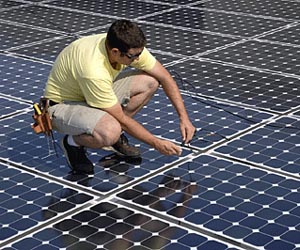
Homes and businesses joining the solar revolution will be getting a power boost, thanks to state-of-the-art technology that not only will increase solar panel efficiency but also make it easier to install, monitor and service the energy systems.
Microinverters, now being used by Premier Power Renewable Energy in the San Francisco, Sacramento and Los Angeles areas, provide a new and far more efficient way of converting the sun's power into electricity that can run a home or business.
Tests show that the small units, which connect directly to individual solar panels, can increase energy harvest by as much as 25 percent over the traditional bulky inverters.
That added power is money in the pocket for solar system owners who will see their utility bills plummet as more energy is produced and sold back to their local power company.
Inverters are an essential part of any solar system, since they convert the DC current coming out of the panels into the standard AC power used on the electrical grid.
But traditional systems link every solar panel to the same, single inverter, which means if something goes wrong with one panel, the only way to troubleshoot the problem is to check each panel individually, a slow, tedious and often expensive process.
But since each microinverter services just one solar panel, it pinpoints any problem, whether it is a serious technical issue or something as simple as too much dust. The faster a low-performing panel can be identified and fixed, the sooner the system is back at full capacity, turning sunlight into energy – and dollars.
With the individually operating microinverters, there's no longer any single point of failure that can crash the entire system. And unlike the single inverter systems, which can only work as well as the worst performing panel in the link, each microinverter panel keeps producing at full capacity, regardless of what's happening to neighboring solar panels.
As an added bonus, installation of the microinverters is fast and easy, since they don't need the extra high-voltage DC wiring and clunky central box of the single inverter system. Since each panel is an individual unit, it's easy to add more solar panels to an existing system as energy needs or finances dictate.
Share This Article With Planet Earth