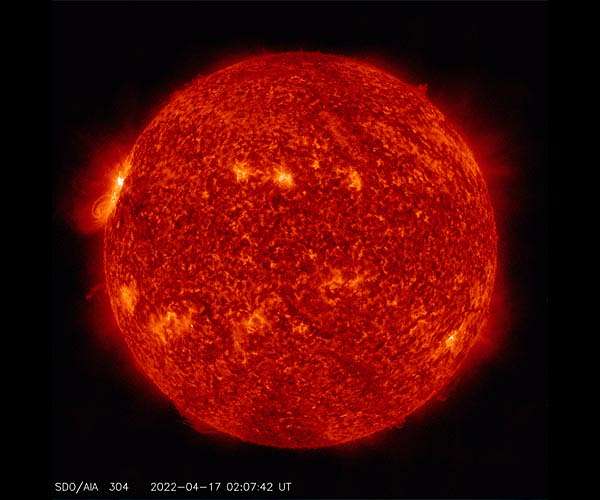
An unusual magnetic storm from the sun will aim at the Earth soon, possibly beginning Thursday, and experts say it has the potential to cause some noticeable damage here on our planet.
Scientists say that the solar activity — called a geomagnetic storm — will produce a magnetic discharge and send it in the direction toward Earth. In other words, essentially, that means that increased activity on the sun will eject significant amounts of Coronal Mass Ejection with high-intensity energy toward the Earth and other inner planets.
Coronal Mass Ejections are expulsions of plasma and magnetic field from the sun's corona — the bright, shiny outer crown of the star at the center of our solar system — into space. And when they are ejected toward the Earth, they can interfere with the planet's magnetic surface in an exchange of energy and cause certain damage.
NASA and the National Oceanic and Atmospheric Administration have been tracking emissions of Coronal Mass Ejections, which see billions of tons of plasma from the sun and its embedded magnetic field arrive on earth.
Solar activity has intensified over the past several weeks as the sun approaches the Solar Maxima, the period of greatest activity during the sun's 11-year cycle. File Photo by NASA/UPI
NOAA describes a geomagnetic storm as a "major disturbance of Earth's magnetosphere that occurs when there is a very efficient exchange of energy from the solar wind into space environment surrounding earth."
The storms are caused by magnetic activity on the outermost portion of the sun, which causes it to burst regularly, creating Coronal Mass Ejections that collide with Earth's magnetic field. Some models project that the activity will affect the Earth as soon as Thursday.
Coronal Mass Ejections toward the Earth have happened many times before, but significant damage from them is pretty rare. Some scientists believe that the new solar activity, however, has the potential to cause some damage — largely in the form of regional power blackouts in higher elevations and disruptions to radio signals. Mid-altitude areas will likely experience less damage but could still see power disruptions, NOAA said.
The Center of Excellence in Space Sciences India said in a tweet that its model indicates "a very high probability of Earth impact" on Thursday with solar energy speeds ranging from 266 to 357 mph.
Coronal Mass Ejections are a regular occurrence and they often are ejected in the direction toward Earth, but noticeable damage to our planet caused by the activity is rare. File Photo by John Angelillo/UPI
"Low to moderate geomagnetic perturbations are expected," the center said. "Currently, solar wind and near-Earth space environmental conditions are returning to nominal levels."
NASA has predicted that an extremely rapid solar wind stream may cause the storm to intensify after it strikes Earth.
"During storms, the currents in the ionosphere, as well as the energetic particles that precipitate into the ionosphere add energy in the form of heat that can increase the density and distribution of density in the upper atmosphere, causing extra drag on satellites in low-earth orbit," the NOAA says.
"While the storms create beautiful aurora, they also can disrupt navigation systems such as the Global Navigation Satellite System and create harmful geomagnetic induced currents in the power grid and pipelines."
Sun Releases Significant Solar Flare
Greenbelt MD (SPX) Apr 19, 2022 –
The Sun emitted a significant solar flare on April 16, 2022, peaking at 11:34 p.m. EST. NASA's Solar Dynamics Observatory, which watches the Sun constantly, captured an image of the event.
Solar flares are powerful bursts of energy. Flares and solar eruptions can impact radio communications, electric power grids, navigation signals, and pose risks to spacecraft and astronauts.
This flare is classified as an X-Class flare. X-class denotes the most intense flares, while the number provides more information about its strength. More info on how flares are classified can be found here.
To see how space weather may affect Earth, please visit NOAA's Space Weather Prediction Center, the U.S. government's official source for space weather forecasts, watches, warnings, and alerts. NASA works as a research arm of the nation's space weather effort. NASA observes the Sun and our space environment constantly with a fleet of spacecraft that study everything from the Sun's activity to the solar atmosphere, and to the particles and magnetic fields in the space surrounding Earth.