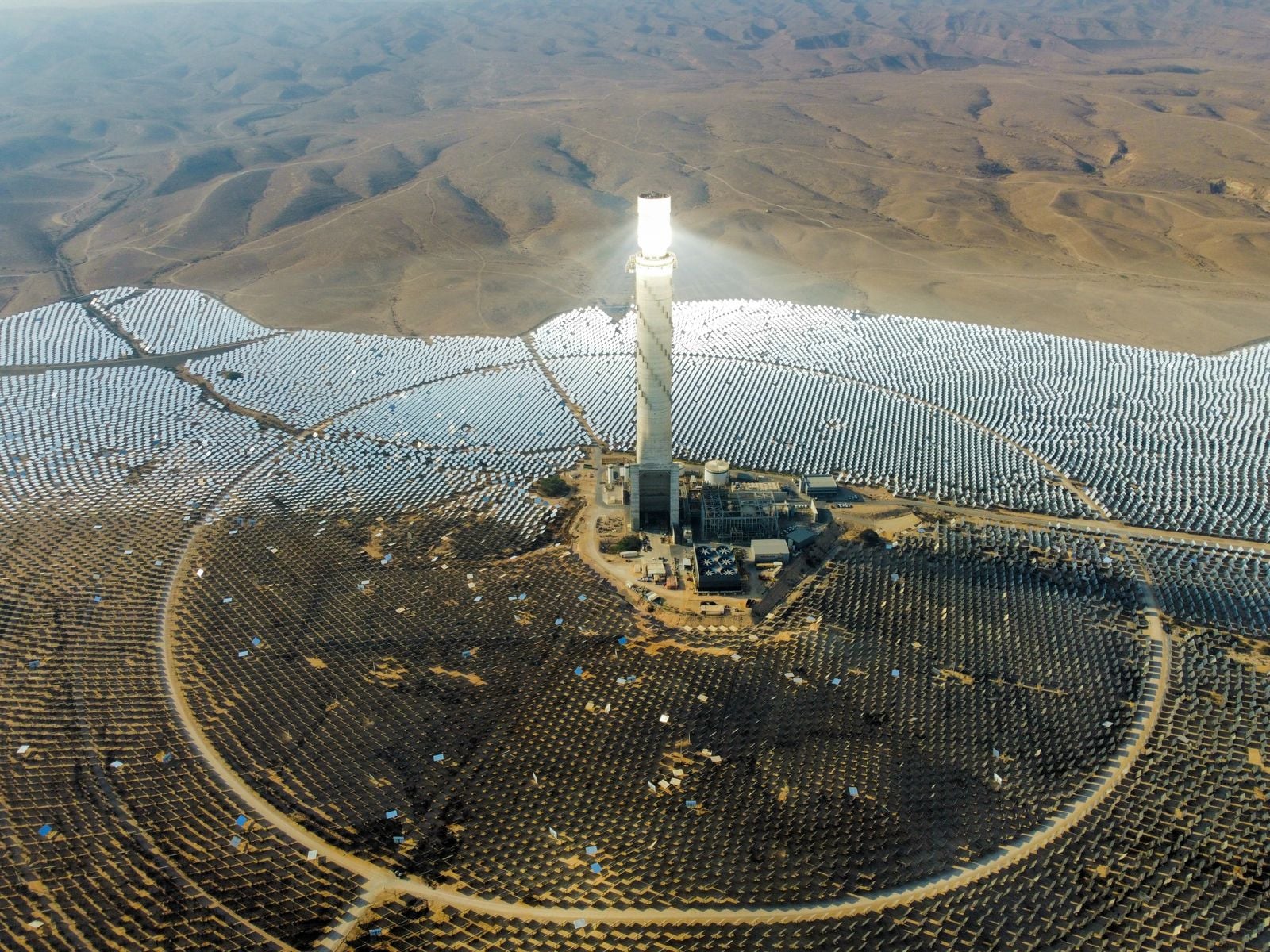
Across more than 3,200 acres of California’s Mojave Desert, 173,500 movable heliostats track the sun and redirect its light toward boilers mounted on three towers approximately 140 metres tall. Each heliostat carries two mirror panels, bringing the total number of reflective surfaces to nearly 347,000. NASA describes the heliostats as steerable pairs of mirrors, while Engineering News-Record documents the exact count and three-tower configuration.
The plant is called the Ivanpah Solar Electric Generating System. It became the world’s largest concentrating solar power facility when it entered commercial operation in early 2014 and remains the largest plant of its kind built in the United States. Ivanpah was expected to begin shutting down in 2026, but California regulators blocked the agreements behind that plan.
In December 2025, the California Public Utilities Commission rejected PG&E’s proposed contract terminations without prejudice. Instead of becoming a straightforward story about a failed technology being dismantled, Ivanpah became something stranger: a plant that utilities and federal officials wanted to close, but that state regulators determined the grid could not yet afford to lose.
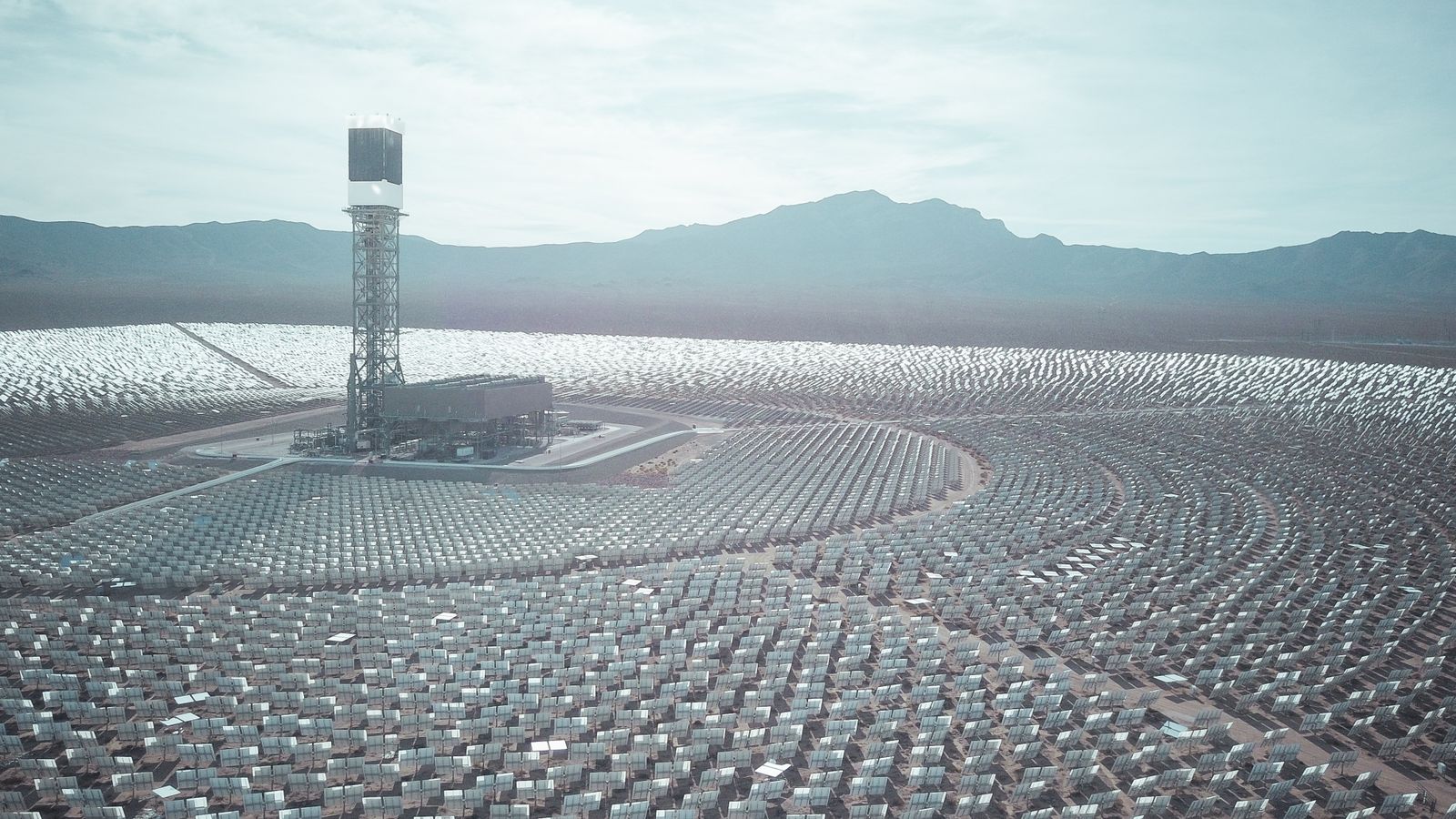
The mechanics of a mirror farm
A heliostat is a mirror assembly mounted on a motorized base that can move on two axes. Software continuously adjusts its angle so that sunlight lands on a fixed target as the sun crosses the sky. At Ivanpah, the heliostats are divided among three enormous fields, with each field directing light toward the receiver on its own tower.
Water pumped into tubes inside the receivers absorbs the concentrated solar energy and becomes high-pressure, superheated steam at approximately 540 to 550 degrees Celsius. That steam travels down the towers to conventional turbines, where it spins generators in much the same way steam from a coal, gas or nuclear plant would.
Ivanpah does not store that heat for later use. Its original design is a direct-steam system, meaning electricity production depends largely on the sunlight available at that moment. The plant also uses natural gas to warm its boilers during startup and to support steam production when clouds interrupt the concentrated sunlight, so it is inaccurate to describe the facility as operating without burning any fuel.
The three units have a combined nameplate capacity of roughly 390 megawatts, although published figures vary slightly according to whether gross, contracted or turbine capacity is being counted. The Department of Energy originally projected that Ivanpah would generate 940,000 megawatt-hours annually and prevent approximately 500,000 metric tons of carbon dioxide emissions each year. Those figures were project estimates, not a statement that the plant consistently achieved that result in every year of operation.
Why anyone built it in the first place
Concentrating solar power predates the modern photovoltaic boom. Italy built the first CSP plant in 1968, and California installed the first commercial-scale array in 1981, according to an ABC Science history of the technology. Early systems offered a way to turn sunlight into the familiar combination of heat, steam and rotating machinery already understood by the electricity industry.
When Ivanpah was planned in the late 2000s, photovoltaic modules were considerably more expensive than they are today. A utility-scale field of mirrors feeding standard steam turbines appeared to offer a credible route to large amounts of solar electricity, particularly in a desert with intense sunlight and hundreds of clear days each year.
Construction began in 2010, with Bechtel serving as the engineering, procurement and construction contractor. The completed project cost approximately $2.2 billion and received $1.6 billion in federal loan guarantees. NRG Energy, BrightSource Energy and Google were among its owners or investors, and commercial operations began in January 2014.
At that moment, Ivanpah represented a serious bet on the future of solar power. Its vast mirror fields and glowing towers were not simply visual theatre. They were an attempt to prove that solar energy could be delivered through the same steam-driven machinery that had powered electrical grids for generations.
The technology that overtook it
The economic assumptions behind Ivanpah changed rapidly once it was built. The International Renewable Energy Agency reported that wholesale photovoltaic module prices fell by 93 percent between 2010 and 2020. Over the same decade, the global average installed cost of utility-scale PV declined by 81 percent.
A field of photovoltaic panels could increasingly produce electricity more cheaply than a field of heliostats feeding towers, boilers, steam pipes and turbines. Falling battery prices also allowed photovoltaic projects to shift part of their output into the evening without constructing a solar-thermal power block.
Photovoltaic plants are not literally fields of glass with no moving components. Many utility projects use motorized trackers, and all require inverters, transformers and other electrical equipment. They are nevertheless mechanically simpler than a direct-steam plant containing thousands of tracking assemblies, high-pressure piping, valves, boilers and turbine machinery.
That difference translated into lower construction and operating costs. PG&E eventually identified its Ivanpah contracts as a possible source of customer savings, while the plant’s owners argued that improvements in photovoltaic generation and battery storage had produced more efficient and flexible alternatives.
The problems that dogged it
Ivanpah generated electricity, but its early performance did not consistently match the expectations built into its contracts. The plant encountered periods of lower-than-expected solar availability, and operators sought permission in 2014 to increase the amount of natural gas that could be burned in its boilers from 328 million to 525 million cubic feet per year.
The gas helped warm the system in the morning and maintain suitable steam conditions when cloud cover interrupted the solar input. That did not turn Ivanpah into a conventional gas plant, but it complicated the clean visual story of mirrors converting desert sunlight directly into electricity.
The plant also became associated with bird deaths. A 2015 report prepared for California by H.T. Harvey & Associates estimated that approximately 3,500 birds died at the site during its first year. Insects congregated near the bright towers, birds followed the insects, and some animals passing through areas of concentrated solar flux suffered damaged or singed feathers.
Those impacts existed alongside the project’s broader land footprint. Ivanpah occupied thousands of acres of federal desert habitat and became a lasting example of the trade-offs that can emerge when renewable infrastructure is built at exceptional scale.
The shutdown California blocked
PG&E had contracts to purchase electricity from Ivanpah Units I and III until January 2039. The utility and plant owners negotiated agreements that would terminate those contracts early, allowing the two units to close and begin decommissioning. Southern California Edison holds the separate contract for Unit II.
The proposed shutdown appeared settled enough that early reports described Ivanpah as a plant entering its final year. The CPUC reached a different conclusion in December 2025, rejecting the two PG&E termination agreements after examining their value to ratepayers and the possible effect of removing the generation from California’s electricity portfolio.
The Los Angeles Times reported in January 2026 that the decision would effectively require two of Ivanpah’s three units to remain running instead of shutting down that year. Regulators cited grid reliability, rising demand and the value of keeping existing clean generation available.
The rejection was issued without prejudice, so PG&E or the plant owners may return with a revised proposal. For now, however, the contracts remain in place and the planned closure did not proceed under the rejected agreements. Suggestions that the 3,200-acre site could later be redeveloped with photovoltaic panels remain a possible future use rather than an active replacement project.
The strange second life of concentrated solar
Ivanpah’s economic difficulties do not mean every form of concentrating solar power has reached the end of the road. Its direct-steam design has no substantial thermal-storage system, but other CSP plants use molten salt or another heat-transfer medium that can remain hot inside insulated tanks for hours. The stored heat can then produce steam after sunset.
That capability gives modern CSP a different role from the one Ivanpah was built to perform. Instead of competing directly with photovoltaic panels for the cheapest daytime electricity, a storage-equipped CSP plant can support a grid during the evening or through longer periods when solar panels and short-duration batteries are less useful.
Australia’s CSIRO Renewable Energy Storage Roadmap projected that CSP could eventually become a competitive option for storing energy over periods of eight to 24 hours. Vast Solar, later known as Vast Renewables, proposed a modular 30-megawatt project in Port Augusta using liquid sodium and molten salt rather than Ivanpah’s three giant direct-steam towers.
That project’s future is now uncertain. KPMG says Vast Renewables and its Australian subsidiaries entered voluntary administration in November 2025. The company’s modular design remains an example of the direction developers were pursuing, but it should not be presented as a straightforward commercial project moving ahead on its original timetable.
The clearest current expansion is taking place in China, where CSP is increasingly being combined with wind, photovoltaic generation and thermal storage inside large renewable-energy parks. SolarPACES counted 43 Chinese CSP projects operating or under construction by the middle of 2026, including 26 online facilities and 17 being built.
What the numbers actually mean
Ivanpah’s scale can be difficult to grasp from the ground. Its 173,500 heliostats contain nearly 347,000 mirror panels, and its three towers rise approximately 140 metres above the desert. Together, the units can produce roughly 390 megawatts under their published nameplate ratings.
The sunlight striking those mirrors has travelled from the Sun to Earth in approximately eight minutes and 20 seconds. The energy may have spent an immense period moving through the Sun’s dense interior before reaching its surface, but the photons reaching Ivanpah did not leave the solar surface thousands of years ago. They began the final journey to the Mojave only minutes before hitting the mirrors.
At the receivers, that light is concentrated strongly enough to turn pressurized water into superheated steam at temperatures approaching 550 degrees Celsius. The transformation from sunlight to turbine power happens quickly, but it depends on a sprawling and mechanically demanding system that photovoltaic technology has largely undercut on price.
A monument that is still operating
Ivanpah was built as a bet that utility-scale solar would look like an enormous field of mirrors surrounding steam towers. Photovoltaic panels and batteries changed that future, becoming cheaper and easier to deploy while Ivanpah struggled with costs, fuel use, environmental impacts and disappointing production.
Yet the plant has not reached the ending that seemed inevitable in early 2025. California regulators decided that an expensive and technologically overtaken source of electricity could still be valuable when the grid was facing rapidly growing demand. Ivanpah therefore remains both an engineering monument and an unresolved policy argument.
Its mirrors continue turning through the Mojave sunlight, directing almost 350,000 reflected images of the sky toward three towers. Whether they operate until the contracts expire in 2039 or face another attempt at early closure, Ivanpah’s next chapter will say as much about California’s need for dependable electricity as it does about the solar technology that replaced it.