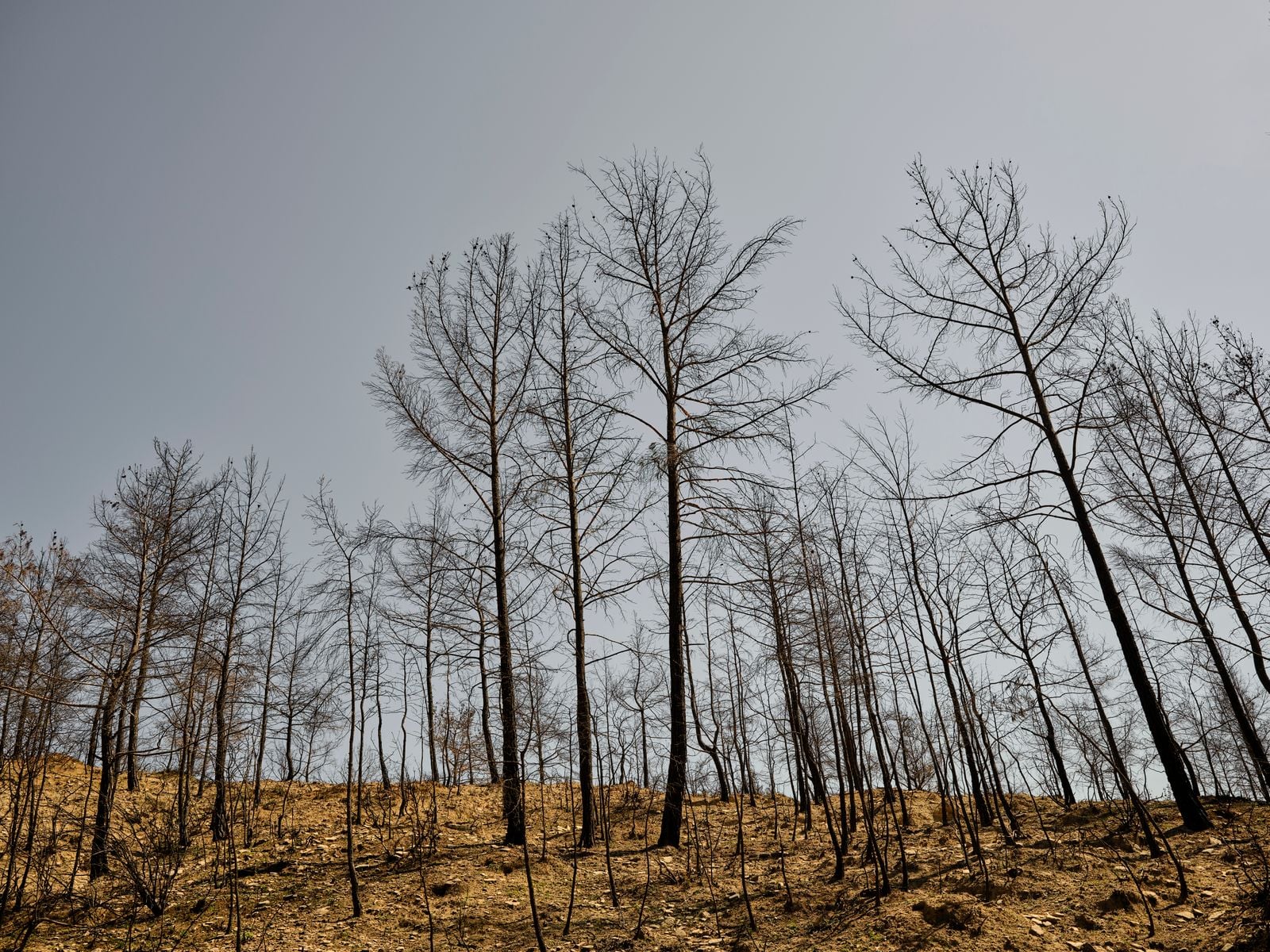
South Korea’s mountains were, by the early 1950s, largely bald. Photographs from that period show ridgelines scraped down to mineral soil, hillsides gullied by rain, villages ringed by stumps. Three years of war had shattered the forest cover that centuries of firewood cutting had already thinned. By the time the armistice was signed at Panmunjom in July 1953, more than half of the peninsula’s forest land was classed as degraded or unstocked. Within a single lifetime — under seventy years — that reversed. Today forest covers roughly 63 to 64 percent of South Korea’s land area, one of the highest ratios in the OECD. The turn came from an unglamorous sequence the Korea Forest Service ran in a deliberate order: cut household demand for firewood first, then plant on a massive scale and enforce a no-cut rule — a sequence China’s far larger northern shelterbelt never fully matched.
The turnaround was not accidental. It was engineered by the Korea Forest Service, launched in 1967, and driven by a pair of ten-year National Forest Plans that began in 1973. The mechanism was blunt: fast-growing pines and larches planted in dense monoculture, village-level fuel substitution from firewood to briquette coal and later kerosene, and legal protection of hillsides backed by criminal penalties for cutting. The comparison worth drawing is with China’s much larger Three-North Shelter Forest Program, which began a few years later, in 1978, and has produced a more uneven ledger of results.
The starting point: a peninsula scraped to soil
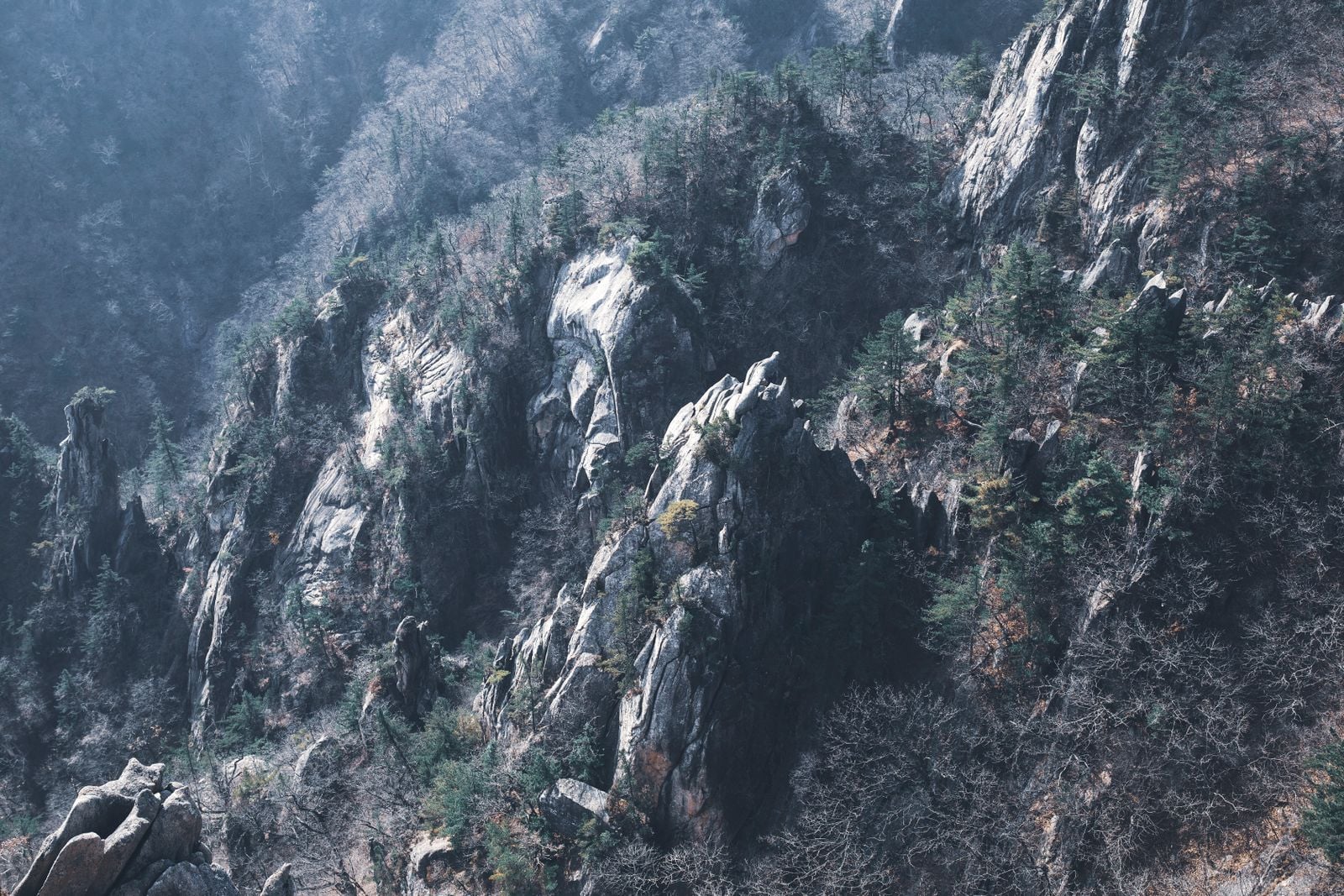
The condition of Korea’s forests in 1953 was the compounded result of Japanese colonial extraction between 1910 and 1945, the fuel demands of a rural population that cooked and heated almost entirely with wood and charcoal, and then the artillery, defoliation, and fires of the Korean War itself. Aerial photographs held by the Korea Forest Service show entire watersheds reduced to what foresters call "red mountains" — hillsides where the topsoil had washed off and the underlying decomposed granite gave the slopes a rust colour visible from kilometres away.
The rural population kept cutting because there was nothing else to burn. A household in a village outside Daegu in 1955 might consume two to three tonnes of firewood a year. Multiply that by roughly four million rural households and the arithmetic of denudation writes itself.
The first attempts at replanting, in the late 1950s and early 1960s, largely failed. Seedlings were planted and then dug up for fuel or grazed off by goats within weeks. The forests could not grow back while the demand curve for wood stayed where it was.
The mechanism: fuel substitution first, trees second
What distinguished the Korean effort from most reforestation programmes of the era was the order of operations. Under the First National Forest Plan of 1973, the government did not simply plant trees and hope. It first cut the demand for firewood at the household level by subsidising anthracite coal briquettes — the yeontan that would define Korean winter for the next two decades — and by electrifying rural villages under the Saemaul Undong movement. Only then did the planting begin in earnest.
Between 1973 and 1987, across the two ten-year plans, foresters planted roughly 12 billion trees on about 2.2 million hectares. The species mix was pragmatic rather than ecological: Japanese larch, pitch pine, black locust, and Korean pine, chosen for fast growth on poor soils rather than for biodiversity. Village forestry associations, tied to the Saemaul framework, took on the maintenance and patrolling. Cutting a live tree without a permit became a criminal offence carried through the courts.
The results are visible from orbit. Inventory and land-cover data compiled by the UN Food and Agriculture Organization show stocked forest land climbing from about 4 million hectares in the early 1960s to 6.3 million by the mid-1990s, with forest cover holding above 60 percent since, even as the country urbanised into one of the densest built environments on Earth.
What the numbers actually say
The often-cited figure — that South Korea went from roughly 35 percent forested and heavily degraded in the mid-1950s to about 64 percent forested by the 2000s — comes from Korea Forest Service inventories. Standing timber volume per hectare rose from around 11 cubic metres in 1960 to over 165 cubic metres by 2020, a fifteen-fold increase in biomass on the same land. That figure matters more than canopy percentage because it tracks the density and age of the forest, not just its presence.
The carbon consequences are large. A hectare of maturing pine-larch forest on the Korean pattern sequesters roughly 5 to 8 tonnes of CO₂ per year during its growth phase. Across 6.3 million hectares, the annual drawdown runs into the tens of millions of tonnes — a rounding error against global emissions but meaningful against South Korea’s own inventory.
Why China’s larger effort has produced uneven results
China’s Three-North Shelter Forest Program, launched in 1978, is the largest afforestation effort in human history. It targets a belt across the country’s arid north stretching from Xinjiang to Heilongjiang, and by 2020 official figures put planted area at over 30 million hectares. On paper it dwarfs the Korean programme by more than an order of magnitude. In practice, the outcomes have been more contested.
A 40-year assessment of the Three-North programme found that much of the planted forest carries low silvicultural preservation rates and poor structural quality, with a high risk of decline — problems concentrated in the arid western reaches of the shelterbelt. Separate remote-sensing work on the sandy-land portions of the project found that vegetation cover barely changed over four decades, because low seedling survival meant many plantings never established; in the driest zones, survival for fast-growing species has been reported as low as the mid-teens.
The reasons are structural rather than technical. Much of the Three-North zone sits on land that was never densely forested in the Holocene — it is steppe and semi-desert where annual rainfall drops below 400 millimetres, the rough threshold for closed-canopy forest. Korean foresters were replanting land that had held forest within living memory and that received 1,000 to 1,400 millimetres of rain a year. The Korean project was restoration on a substrate that wanted to be forest. Much of the Chinese project is afforestation on a substrate that does not.
The other difference is fuel substitution. Korea’s programme was preceded and accompanied by a national shift out of biomass burning. China’s shelterbelt regions, particularly in rural Inner Mongolia and Gansu, continued to see grazing pressure and fuel-gathering that undercut the plantings. Trees went in; goats and stoves took them back out.
The role of the state, and its limits
Korea’s reforestation ran under an authoritarian government for its first two decades. Park Chung-hee’s administration could compel village participation, criminalise firewood cutting, and reroute state credit toward briquette manufacturers in a way that later democratic governments could not have. That fact is uncomfortable but relevant. The programme’s speed was tied to the political system that ran it.
What survived the transition to democracy in the late 1980s was the institutional apparatus: the Korea Forest Service, the village forestry cooperatives, the seedling nurseries, and the legal framework protecting standing forest. Later governments layered on ecological priorities — mixed-species planting, native broadleaf reintroduction, urban forest programmes — without dismantling the base.
The comparison with reforestation efforts elsewhere in Asia is instructive. A systematic review of mangrove restoration across Southeast Asia found that large-scale planting programmes frequently failed to establish viable forests, with long-term seedling survival often in the 10 to 20 percent range, because site selection and local livelihood pressures went unaddressed alongside the planting itself. The pattern is consistent: trees planted without changing the underlying demand on the land tend to disappear.
The vulnerabilities the Korean forest now carries
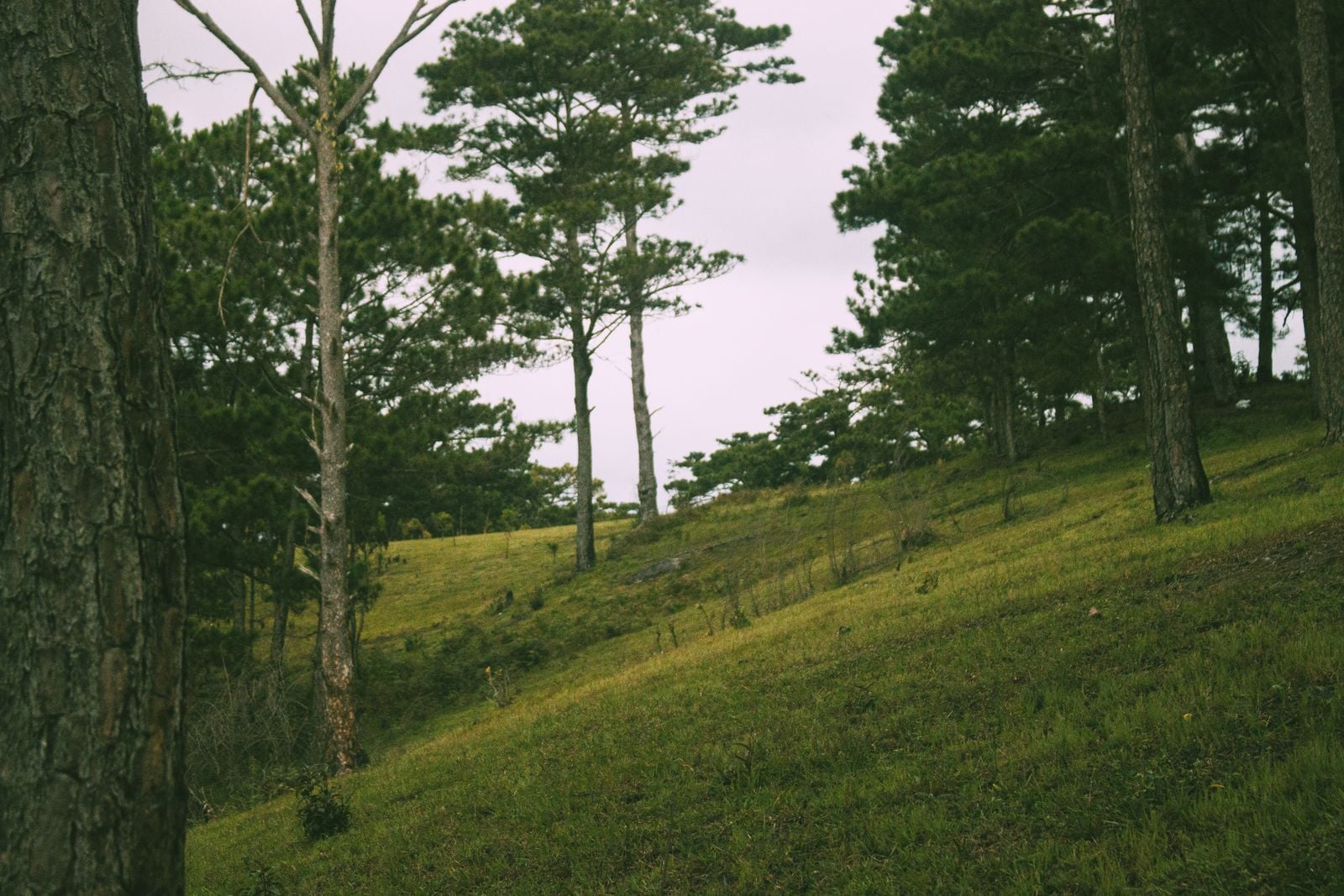
The forest that grew back is not the forest that was lost. A large share of South Korea’s standing timber is red pine, pitch pine, and Japanese larch — species that took hold on eroded soils but were never chosen for resilience. The result is a landscape that is dense, uniform in age, and increasingly flammable.
Pine wilt disease, caused by the pinewood nematode, has spread across southern Korea since first being detected in Busan in 1988 and has killed millions of trees. Fire seasons have lengthened. The Uljin-Samcheok fire of March 2022 burned over 20,000 hectares and reached the perimeter of the Hanul nuclear power plant, a reminder that a monoculture pine forest carries fire like a fuse.
The pattern is not unique. Wildfires across Europe this summer, including the blazes that forced roughly 330,000 people to evacuate in France and Spain, have followed the same script: dense, uniform-aged forest planted or regrown in the mid-twentieth century, now drying under a warmer climate. Spain’s own 2025 season was its worst since 1994, with around 380,000 hectares burned by late August, roughly four and a half times its two-decade average. The Canadian 2023 fire season, in which wildfires burned about 18.5 million hectares (an area larger than Florida), released roughly three billion tonnes of carbon dioxide — many times what Spain emits in a year.
What the Korean case does and does not prove
The peninsula’s forest recovery is often cited as proof that dense reforestation at national scale is possible. It is. It is less often cited as proof of what it actually required: a decade of household energy substitution before planting, criminal enforcement of no-cut rules, an authoritarian administrative reach through village cooperatives, and a substrate of adequate rainfall on land that had held forest within living memory. Strip out any one of those and the outcome likely looks more like the drier portions of the Three-North belt.
Solar Daily has written before about the coupling between climate adaptation and coastal defence, including Bangladesh’s post-1991 mangrove green belt, where similar lessons about pairing physical planting with policy hold. And research from the Smithsonian Environmental Research Center on the emergence of ghost forests along flooded coastlines underscores that even mature forests can unravel quickly when the underlying conditions change.
A visitor walking a ridge north of Seoul today looks out at continuous canopy where a photograph from 1953 would show bare rock and washed gullies. The trees are seventy years old. Many of them stand on soil that had to be rebuilt by decades of leaf fall from pines specifically chosen because nothing else would grow. The next seventy years will test whether that forest, planted in a colder and wetter climate than the one now arriving, can hold the ground its planters gave it.