Voyager 1 still sends data from more than 25 billion kilometres away because three plutonium-powered generators keep its essential electronics alive, a 3.7-metre dish focuses roughly 22 watts of radio output toward Earth, and NASA’s Deep Space Network uses giant antennas and extremely sensitive receivers to recover the whisper. The radio crossing now takes almost a day each way. The answer is not one indestructible component, but a chain in which power generation, pointing, coding and ground reception all have to keep working.
The spacecraft launched from Cape Canaveral on September 5, 1977, when the first Star Wars film was still in cinemas. Its primary mission was a roughly five-year tour of Jupiter and Saturn, not an open-ended experiment in surviving for almost half a century.
Voyager has endured component failures, fading power and periods when useful telemetry disappeared. It remains reachable because engineers built in redundancy and autonomous fault protection, then spent decades switching off loads, rewriting software and protecting the few systems that still matter.
The nuclear generators losing four watts a year
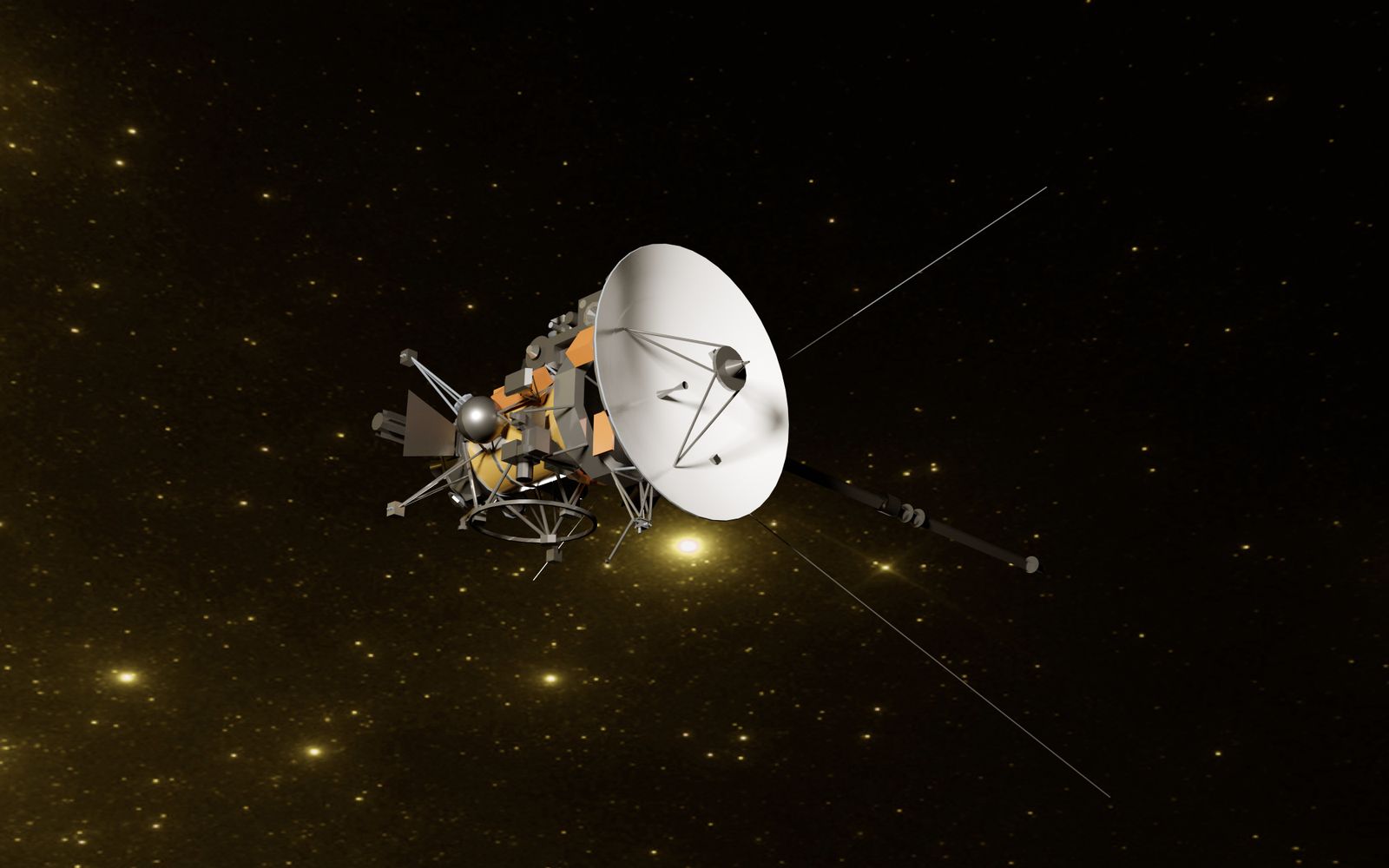
Voyager 1 has no solar panels. Its three multi-hundred-watt radioisotope thermoelectric generators, or RTGs, contain plutonium-238 oxide that releases heat as it decays, while thermocouples turn part of that heat into electricity without moving parts. RTGs are also among the real NASA technologies depicted in The Martian, although Voyager’s units predate the film’s Mars hardware by decades.
At launch, the three units produced about 470 watts between them. NASA’s spacecraft specifications listed Voyager 1 at 225 watts in stable operation in November 2023, while an April 2026 mission update said each Voyager loses about four watts of electrical power every year. The decline comes from both the slow decay of the fuel and the ageing of the thermoelectric system.
That shrinking total has to run the computers, communications equipment, attitude control, heaters and science instruments. Since April 2026, Voyager 1 has had two operating science instruments left: a magnetometer that measures magnetic fields and a plasma wave subsystem that detects electrical oscillations in the surrounding plasma.
The power problem is therefore a problem of temperature and pointing as much as science. Hydrazine lines must not become too cold for the small thrusters that keep the high-gain antenna aimed at Earth, so turning off a heater can threaten communications while leaving it on can consume power needed elsewhere.
How 22 watts crosses interstellar distance
Voyager 1’s main X-band transmitter radiates around 22 watts, a figure documented when radio telescopes imaged its carrier signal. That is the radio-frequency output sent into the antenna, not the total electrical power consumed by the spacecraft or even by the communications system.
The 3.7-metre high-gain antenna concentrates that output into a narrow beam instead of spraying it equally in every direction. The beam still spreads enormously on the journey home, and by the time it reaches Earth its received power is only a fraction of a billion-billionth of a watt.
NASA says Voyager science data normally return at 160 bits per second, with each spacecraft receiving an average of six to eight hours of real-time tracking per day. At that raw rate, one megabyte would take nearly 14 hours to send before allowing for framing and other overhead.
The cameras are long inactive, so Voyager is no longer sending pictures. What arrives now is a thin stream of engineering telemetry and measurements from its two remaining science instruments, organised and encoded so the ground system can distinguish data from noise.
The ground network built to hear the whisper
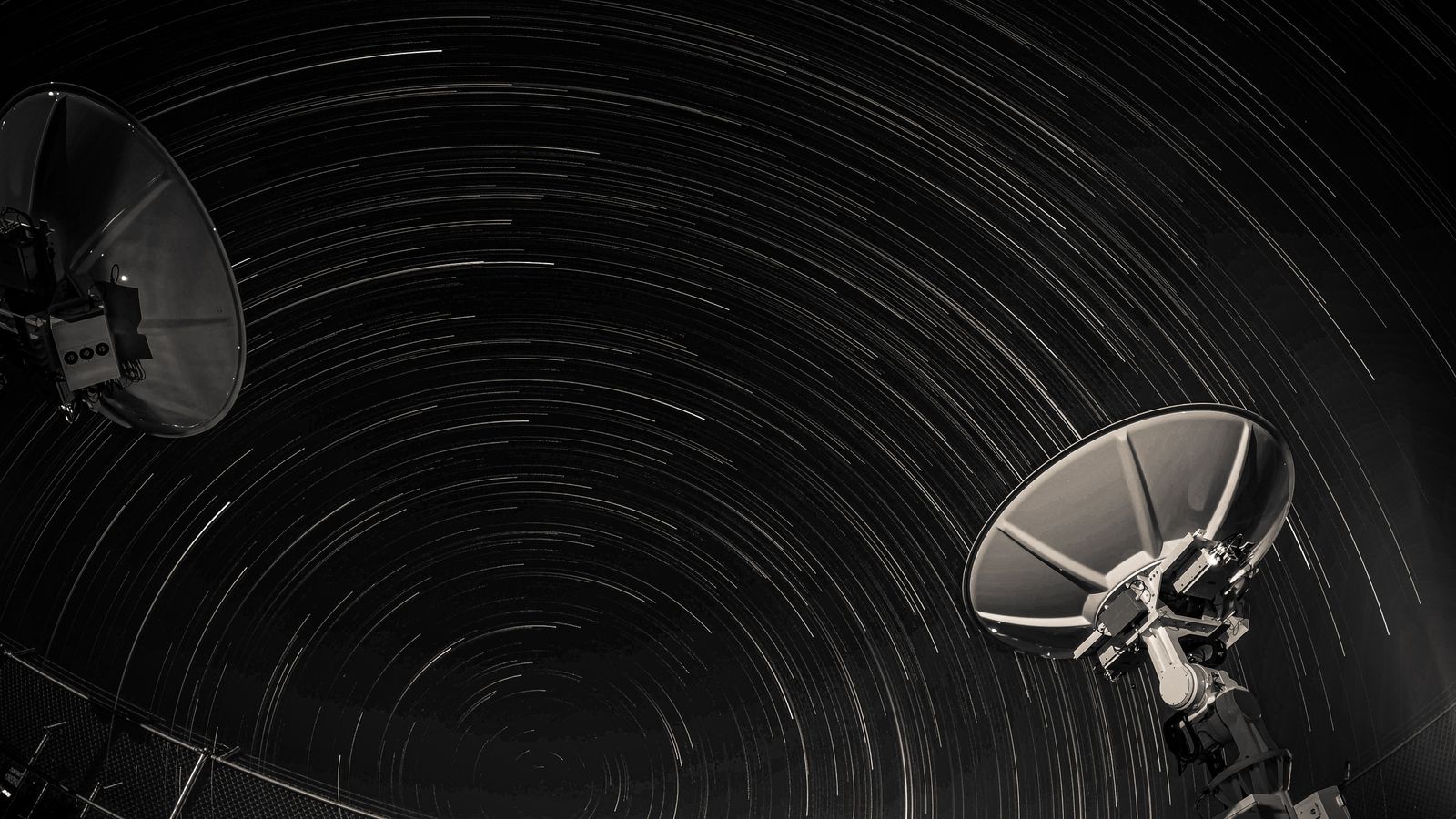
The Deep Space Network is not a trio of dishes but three antenna complexes spaced about 120 degrees apart: Goldstone in California, Madrid in Spain and Canberra in Australia. Each site contains several antennas, including one 70-metre dish, and the separation lets another complex take over as Earth rotates.
The 70-metre antennas are the network’s largest and most sensitive. Their vast reflecting surfaces feed ultra-sensitive receiving systems designed to add as little noise as possible to an already vanishingly weak signal.
The geometry makes continuous coverage possible, but Voyager does not have a dish listening to it every second. The network is shared among many missions, so Voyager receives scheduled tracking passes rather than monopolising a 70-metre antenna, and the Deep Space Network collects its slow telemetry stream during those windows.
When the receiver locks onto Voyager 1, the carrier appears as a narrow peak near 8.4 gigahertz, only slightly above the noise floor. The ground system knows where to look, tracks tiny frequency shifts caused by motion, integrates the signal and then extracts the telemetry carried on it.
A conversation that takes two days
The one-way light time is now close to 24 hours. NASA calculates that on November 18, 2026, at 2:16:07 a.m. Pacific Standard Time, Voyager 1 will be 25,902,068,356 kilometres from Earth, exactly one light-day away.
At that distance, a command sent on Monday cannot arrive until Tuesday, and an immediate reply cannot return until Wednesday. There is no live joystick control, so commands are assembled into carefully checked sequences that the spacecraft can execute on its own.
Voyager’s memory is also smaller than many modern photographs. NASA puts the total across its six onboard computers at about 68 kilobytes, rather than 70 kilobytes in a single computer. The craft therefore relies on compact routines and autonomous fault protection instead of the software layers found in modern devices.
That constraint became visible after Voyager 1 stopped returning readable science and engineering data in November 2023. Engineers traced the problem to a failed memory chip and relocated pieces of the affected flight-data code into other parts of memory, restoring engineering telemetry in April 2024. Every diagnostic command and reply took roughly 45 hours to complete the round trip, which turned each test into a multi-day operation.
The shrinking margin between science and silence
On April 17, 2026, the mission team shut down Voyager 1’s low-energy charged particles experiment to protect the spacecraft’s power margin. NASA said the change should provide about a year of breathing room, while the magnetometer and plasma wave subsystem continue returning unique measurements.
NASA’s 2025 power-conservation plan said the probes might retain at least one science instrument into the 2030s, although unforeseen failures could shorten that timeline. Engineering data could continue after science collection ends if enough power remains to transmit. That is a possibility, not a guarantee.
Voyager also needs a more careful solar comparison than the claim that sunlight becomes useless beyond Jupiter. Juno proved that a spacecraft can run on solar power at Jupiter, and Europa Clipper carries enormous arrays for the same region. At Neptune’s distance, however, sunlight is about one nine-hundredth as intense as at Earth, which helps explain why Voyager’s 1970s designers chose compact, dependable radioisotope power for an outer-planet mission.
When the transmitter finally falls silent, Voyager 1 will not stop. It is moving at about 17 kilometres per second relative to the Sun, and interstellar space offers almost nothing that can slow it appreciably, so the spacecraft will continue through the galaxy long after its last radio contact.
What the signal still carries
Voyager 1 crossed the heliopause on August 25, 2012, becoming the first spacecraft to operate in interstellar space. Its magnetometer now samples the magnetic field beyond the Sun’s plasma bubble, while the plasma wave subsystem can use naturally occurring oscillations to infer conditions such as electron density.
The spacecraft also carries a gold-plated copper phonograph record intended for any future finder. Its contents include 115 images, greetings in 55 languages, natural sounds and music from several cultures and eras, sealed beneath a protective cover with instructions for playback.
On a Deep Space Network display, the surviving carrier is still only a thin spike above the background. Yet it has crossed more than 25 billion kilometres from a transmitter with the output of familiar household lighting, and on November 18 its radio wave will require exactly 24 hours to reach Earth. The remarkable part is not that 22 watts fills the void, but that machinery built in 1977 and receivers on Earth can still complete the same fragile conversation.