
The sunlight warming a rooftop panel this afternoon left the Sun’s surface roughly 500 seconds ago — 8 minutes and 20 seconds, give or take, at the speed of light across 93 million miles of vacuum. But the energy carried in those photons is far older than the trip suggests. Before any of it escaped the Sun’s surface, it spent something on the order of 100,000 years ricocheting through a plasma so dense that a single quantum of light could travel only a fraction of a millimetre before slamming into another particle and being absorbed all over again.
Every kilowatt-hour a silicon panel converts today began its journey when mammoths still walked northern Europe.
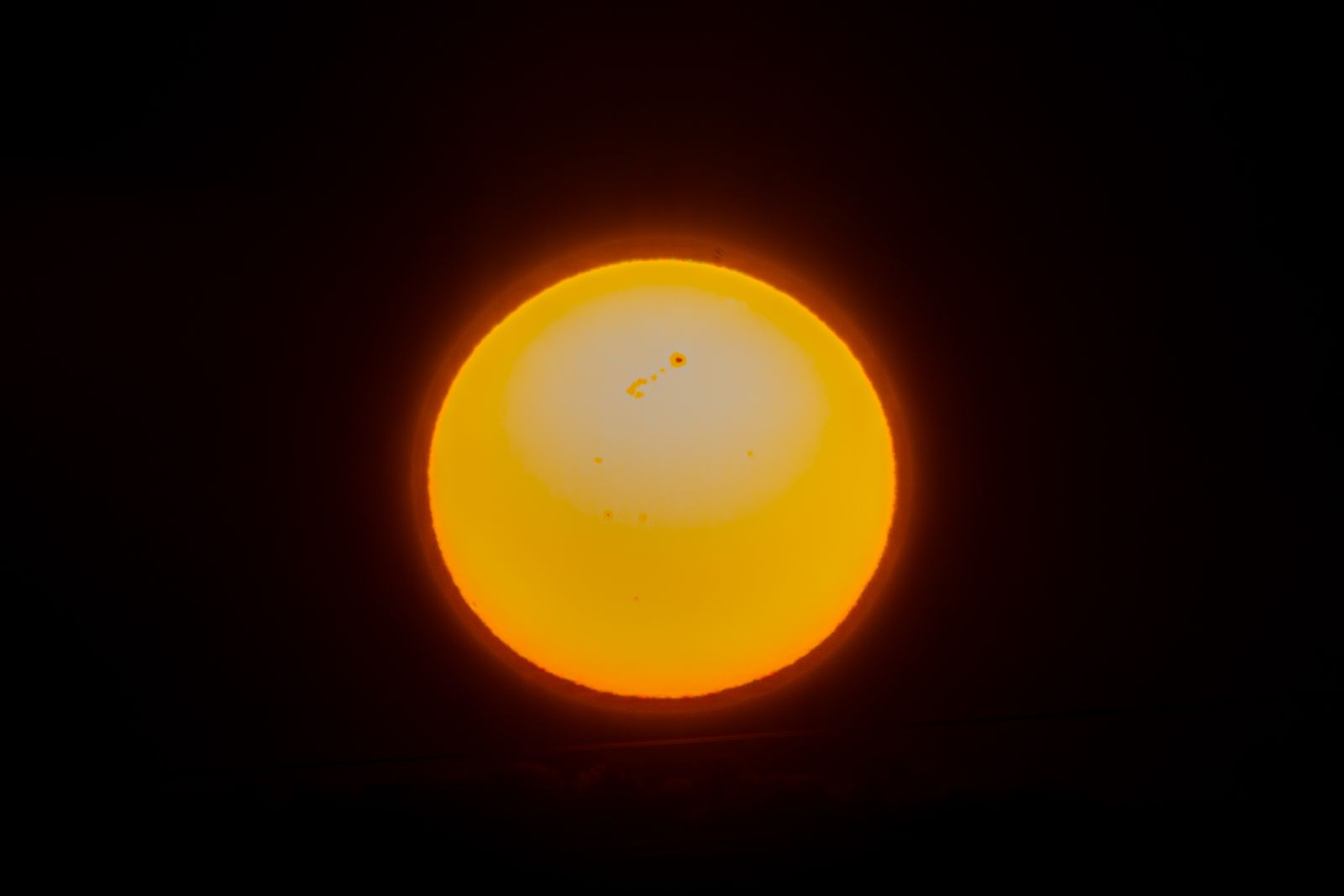
The 8-minute part is the easy bit
The outer leg is straightforward physics. Light moves at just under 300,000 kilometres per second in vacuum, and the Earth sits, on average, 149.6 million kilometres from the Sun. Divide one by the other and you get about 499 seconds — the figure astronomers usually round to eight minutes and twenty seconds.
That number is why the Sun you see setting has, in a strict sense, already set. If the star vanished at noon, nobody on Earth would notice until 12:08.
Light-travel time is the metronome of astronomy. A light-year is the distance light covers in a year, and NASA uses it to describe how the James Webb Space Telescope studies rocky exoplanets like LHS 3844 b, 50 light-years away — meaning the infrared photons Webb collects left that planet’s surface around the mid-1970s. The same principle applies inside the solar system, just on a much shorter clock. When Voyager 1 reaches one full light-day from Earth on November 13, 2026, it will be the first human-made object whose signals take 24 hours to reach us.
The Sun, by comparison, is close. Eight minutes is nothing. The interesting number is the one hidden inside the star.
Inside the core, light barely moves
The Sun’s energy is manufactured in its core, where temperatures reach about 15 million kelvin and pressures crush hydrogen nuclei together hard enough to fuse them into helium. Each fusion event releases a burst of gamma-ray photons — extremely energetic, extremely short-wavelength light.
Those gamma rays do not sail outward. They cannot. The plasma around them is so dense — roughly 150 grams per cubic centimetre in the core, denser than lead — that a photon travels only a tiny fraction of a millimetre before being absorbed by an ion. The ion then re-emits a photon in a random direction. That new photon travels another minuscule step, gets absorbed, gets re-emitted, and so on.
Physicists call this a random walk. It is the same maths that describes a drunk trying to cross a field: each step is short, and the direction is arbitrary, so net progress is agonisingly slow. To cover the 700,000 kilometres from the core to the surface, a packet of energy has to take an astronomical number of these steps.
The commonly cited estimate is that the journey through the radiative zone takes somewhere between 10,000 and 170,000 years, with 100,000 years the figure most textbooks settle on. Some models push it much higher. The exact number depends on how you handle the opacity of the plasma at each depth, but the order of magnitude is not in dispute.

The photon that hits your panel is not the one that was born
There is a subtlety worth pausing on. The gamma-ray photon created in the core does not survive the trip. Every absorption and re-emission event shifts energy around. By the time the packet reaches the Sun’s surface — the photosphere — the original gamma ray has been transformed, through countless intermediate steps, into a huge shower of lower-energy visible-light and infrared photons.
The energy is conserved. The identity of any single photon is not. What arrives at a rooftop panel is a descendant of the original fusion event, carrying the same energy budget spread across many more, less energetic particles.
Once that light finally reaches the photosphere, it escapes almost immediately. The density drops off a cliff. Beyond the visible surface lies the chromosphere and then the corona — the tenuous outer atmosphere that stretches millions of kilometres into space and that missions like ESA’s Proba-3 have been designed to observe by flying two spacecraft in precise formation to create an artificial eclipse. From the photosphere outward, a photon covers the distance to Earth in that famous 8 minutes and 20 seconds. The bottleneck is entirely on the inside.
What 100,000 years actually means
To make the number concrete: if the energy in the sunlight striking a solar farm this July was released by fusion around 98,000 BCE, then it left the core when Neanderthals still shared Europe with early Homo sapiens, before the last glacial maximum, before agriculture, before writing, before every empire in human memory.
By the time it broke free of the photosphere in July 2026, the human species had built cities, mapped the genome, and covered rooftops with the crystalline silicon needed to catch it.
The 8-minute leg — the part everyone learns in school — is the last 0.008 percent of the journey.
How anyone knows this
Solar interior physics cannot be observed directly. The photosphere is opaque; visible light cannot reach us from any depth beneath it. So the 100,000-year figure is a model result, built from three convergent lines of evidence.
The first is helioseismology. The Sun rings like a bell. Pressure waves propagate through its interior and cause the surface to oscillate at measurable frequencies. By tracking those oscillations — a technique pioneered in earnest by the SOHO spacecraft, which has been observing the Sun for three decades — physicists can infer the density and temperature profile of the interior with remarkable precision.
The second is neutrino detection. Unlike photons, neutrinos produced in the core barely interact with matter and escape the Sun in about two seconds. Underground detectors in Japan, Canada and Italy have been counting them for decades, and the flux matches predictions from standard solar models to within a few percent.
The third is opacity calculations. Laboratory measurements and quantum-mechanical models tell physicists how likely a photon of a given energy is to be absorbed by the ions in a given plasma. Feed those numbers into a simulation of the Sun’s density profile, run the random walk, and out drops a diffusion time somewhere in the tens to hundreds of thousands of years.
None of those methods gives a single sharp number. All of them agree that “immediate” is wrong by roughly five orders of magnitude.
Why it matters for the panels on the roof
The random walk is not an astronomical curiosity. It is the reason the Sun burns steadily for ten billion years instead of ten million.
If gamma rays produced in the core could escape freely, the Sun would radiate its fuel away far faster than fusion could replenish it. The star would flare and collapse. The radiative zone acts as a thermal blanket, trapping energy long enough for the core to sustain a stable equilibrium between gravity pulling inward and radiation pressure pushing outward. That equilibrium is what keeps the solar constant — the amount of sunlight striking the top of Earth’s atmosphere — pegged at about 1,361 watts per square metre, year after year, with variations of less than 0.1 percent across the 11-year solar cycle.
Every photovoltaic array on Earth is designed around that constant. Panel efficiency ratings, capacity factors, financial models for solar farms — all of them assume the Sun will deliver roughly the same power tomorrow as it did yesterday. That reliability is a direct consequence of the 100,000-year lag. A star with a leakier interior would be an unusable power source.
The lag going the other way
The 8-minute delay has practical consequences too. Space-weather forecasters watching for solar flares and coronal mass ejections have exactly that much lead time between seeing a flare erupt and the first burst of X-rays and radio noise arriving. The slower particles in a coronal mass ejection can take one to three days to reach Earth, which is what makes solar-storm warnings possible at all.
The Deep Space Climate Observatory (DSCOVR), parked at the L1 Lagrange point about 1.5 million kilometres upstream of Earth, buys grid operators a little extra warning — perhaps 15 to 60 minutes — before a plasma cloud hits the magnetosphere and starts inducing currents in high-voltage transmission lines. That margin exists only because the intervening space is empty and light-speed rules apply. Inside the Sun, no such shortcut exists.
A different way to look at a sunset
The next time a rooftop panel clicks over another kilowatt-hour, consider the accounting. The final leg took 8 minutes and 20 seconds across a vacuum wide enough to fit 11,700 Earths end to end. The leg before that took a thousand centuries through a plasma dense enough to stop light in its tracks. And the visible colour of what arrives — the yellow-white glow filtered through atmosphere into the warmer tones of afternoon — is itself a trick of the sky, as Solar Daily has explored in a recent piece on why the Sun looks yellow from the ground but white from orbit.
Astronomers describe telescopes as time machines because the light they gather is always old. The light from the Andromeda galaxy is 2.5 million years old. The light from the cosmic microwave background is 13.8 billion. On that scale the Sun feels close. But the photons hitting a silicon cell carry a memory that stretches back before agriculture, before cave paintings, before the last ice sheet retreated from northern Europe — a slow-cooked payload of energy that finally, on a bright afternoon, becomes a few extra amps in a household circuit.