On 13 October 2022, a four-month-old bar-tailed godwit tagged B6 lifted off from the Kuskokwim Delta in western Alaska and did not touch land again for eleven days. When it finally dropped out of the sky over Ansons Bay in Tasmania on 24 October, the satellite transmitter glued to its rump had logged 8,425 miles — roughly 13,560 kilometres — of continuous flight over the open Pacific, the longest documented non-stop flight by any animal, according to the U.S. Geological Survey’s Alaska Science Center.
B6 was about the size of a large pigeon. It had never made the trip before. Nobody taught it the route.
And somewhere over the empty water between Hawaii and Fiji, its internal organs began to disappear.
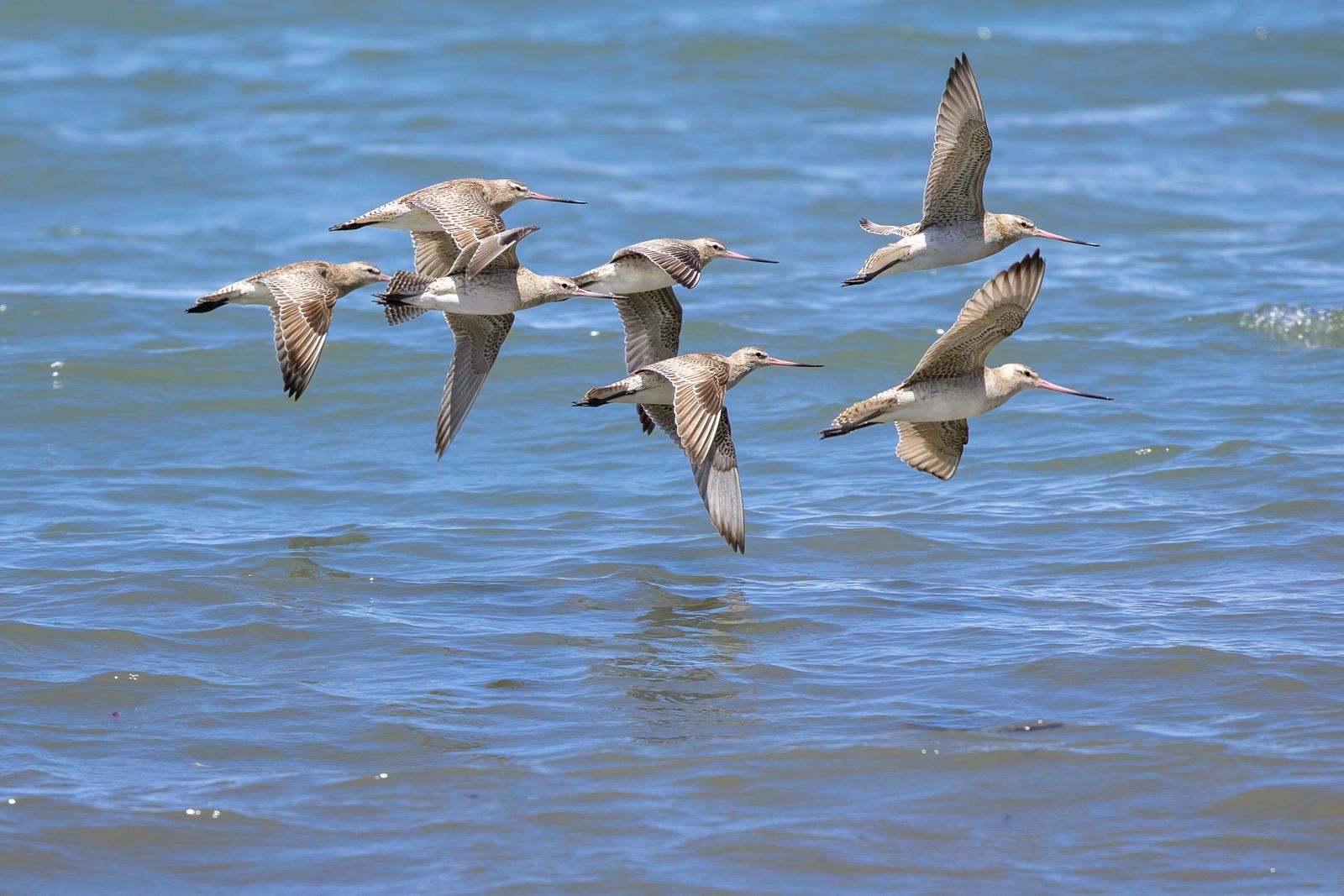
The flight, in numbers that don’t quite compute
Eleven days and one hour. No food. No fresh water. No sleep in any way a human would recognise. No rest on a wave, because bar-tailed godwits cannot swim — their feet are not webbed, and a landing on the Pacific would be a death sentence. The bird beat its wings, or held them in a glide, for roughly 265 hours in a row.
To picture the distance, imagine flying from London to Sydney and then continuing on past Sydney by another thousand kilometres, without the plane ever refuelling and without you ever getting up from the seat. B6 did that on stored body fat and a set of physiological tricks that biologists are still working out.
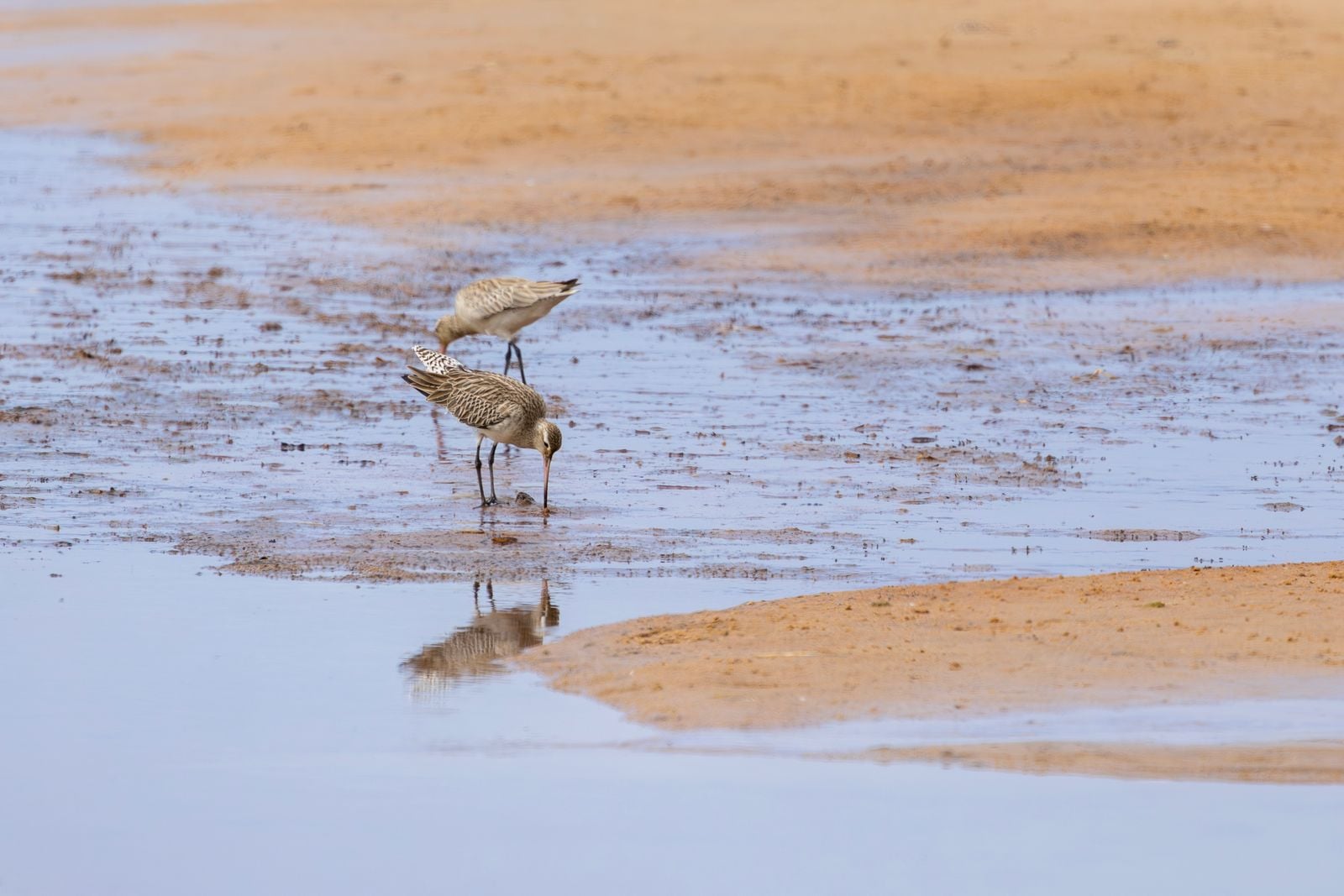
The bird belongs to the subspecies Limosa lapponica baueri, which breeds in western Alaska and winters in New Zealand and southeast Australia. Adults weigh a few hundred grams, with females noticeably larger than males. Before the southbound trip they close to double that weight, gorging on clams and marine worms in the tidal mudflats until they look like feathered tennis balls with beaks.
How a bird was clocked across the Pacific
The record was not a lucky sighting. A team from the U.S. Geological Survey, the Max Planck Institute, and the U.S. Fish and Wildlife Service had spent the summer of 2022 near Nome, Alaska, catching juvenile godwits at their breeding sites and fitting them with 5-gram solar-powered satellite transmitters glued to the base of the tail. Each bird also carried a metal USGS band and a coloured alphanumeric leg flag so ground observers could ID it if it ever landed somewhere with binoculars pointed at it.
The transmitter on B6 pinged its position every few hours as the bird crossed the North Pacific, angled past Hawaii, kept going past Fiji, past New Caledonia, and finally slid down the eastern side of Australia into Tasmania. The track is a nearly straight diagonal line across a quarter of the planet.
What makes B6’s flight extraordinary even by godwit standards is that the bird was a juvenile, hatched in Alaska in the northern summer of 2022. Four months later it was crossing an ocean by itself, without an adult to follow. The navigation system it was using came pre-installed.
Why the liver has to go
A bird of a few hundred grams cannot carry eleven days of fuel and also carry a full-sized digestive system it isn’t using. So it doesn’t.
In the weeks before departure, godwits do something almost no other vertebrate is known to do at this scale: they remodel their own bodies. The pectoral muscles that drive the wings grow larger. Fat is packed under the skin and around the organs until it makes up more than half the bird’s body weight. At the same time the organs that are no longer needed begin to shrink, a process that starts before takeoff and continues aloft as the bird burns through lean tissue as well as fat. When Theunis Piersma and Robert Gill dissected Alaskan godwits that died just after departing on a trans-Pacific flight, the gizzards, livers, kidneys and guts were tiny compared with birds that had not yet started the journey. Their 1998 paper in The Auk carried the title Guts don’t fly.
The same paper describes the other half of the trick: long-distance migrants dispense with parts of the metabolic machinery they do not need in the air, then rebuild those organs on arrival. When the godwit finally touches down on a New Zealand mudflat or a Tasmanian estuary, the digestive organs regrow within days as the bird starts feeding again. The liver comes back. The intestine comes back. The gizzard, which grinds up shellfish, plumps up. It is the closest thing in the animal kingdom to a body that reconfigures itself for a specific task and then puts itself back together on the other side.
Sleeping on the wing, maybe
How the birds sleep during an eleven-day flight is still an open question. A project involving the ornithologist Jesse Conklin and the avian sleep researchers Bart Kempenaers, Mihai Valcu and Niels Rattenborg, of the Max Planck Institute for Biological Intelligence in Germany, has been trying to work it out. Their working hypothesis, described on RNZ’s Our Changing World, is that godwits snatch microsleeps by dropping into a glide for a few seconds at a time and accumulating rest that way. In spring 2023 the team fitted 45 godwits at the Motueka sandspit with 4.5-gram solar smart tags that log altitude and acceleration, which should reveal whether those glides are happening.
The comparison cases are suggestive. The same lab has used EEG tags to show that chinstrap penguins take thousands of one-to-five-second microsleeps a day, usually one brain hemisphere at a time, and that frigatebirds — which, like godwits, cannot land on water — sleep one hemisphere at a time while circling on thermals, getting by on 40 minutes to an hour a day at sea.
There is no direct EEG recording of a godwit mid-Pacific; the logistics are, for now, impossible. But everything about the bird’s alertness on arrival suggests it has not been in continuous wakefulness for a week and a half. Something in there is resting, even as the wings keep beating.
Why fly this route at all
The obvious question is why any bird would evolve a migration this brutal when shorter, staged routes exist. The answer appears to be wind, and what the open ocean does not contain.
Bar-tailed godwits time their departure from Alaska to catch strong following winds off the North Pacific storm systems, riding them south. When Robert Gill and colleagues published the first satellite tracks of the crossing in Proceedings of the Royal Society B in 2009, they proposed that the Pacific works for godwits as a corridor rather than a barrier — a wind-assisted passage relatively free of pathogens and predators. Landing to refuel on the Asian coast would mean sharing crowded mudflats; going straight over deep water means eleven days of empty sky.
The timing is not improvised, either. Tracking work by Jesse Conklin, Phil Battley, Murray Potter and James Fox, published in Nature Communications in 2010, found that individual godwits leaving a single New Zealand site departed on a schedule strongly correlated with the specific latitude in Alaska where they would breed — and that the same individuals returned south in roughly the order they had left. The calendar appears to be largely internal.
The northbound trip, by contrast, is staged. Godwits leave New Zealand in March and, as RNZ reports, take seven or eight days to cover the 10,000-odd kilometres to the tidal mudflats of China, Taiwan and Korea, where they feed for four to six weeks before a second leg carries them to Alaska in time for the brief Arctic breeding window. It is only the southbound crossing that is done in one shot.
The tag that made it visible
None of this was known in detail until miniaturised transmitters got small enough to fit on a shorebird. Gill’s 2009 study tracked seven female godwits flying non-stop between 8,117 and 11,680 kilometres, over six to nine days. B6’s journey represents the current documented record.
The broader field of migration tracking has changed just as dramatically. As Smithsonian Magazine reported in 2023, the Cornell Lab of Ornithology’s BirdCast project now uses weather radar and machine-learning models to forecast bird movements at the county level up to three days ahead. The old joke among nineteenth-century naturalists — that swallows spent winter buried in pond mud, because nobody could imagine them going further — has been replaced by the ability to watch a four-month-old shorebird cross a quarter of the planet on a laptop screen.
What the whole population is doing
B6 is one bird. At the last full count, in 2020, roughly 126,000 godwits were spending the southern summer in Australasia, about 78,000 of them in New Zealand, and they all make some version of this crossing every year. In late September and October, the Kuskokwim Delta empties out as flocks lift off in waves. Weeks later, New Zealand’s Pūkorokoro Miranda mudflats and the Firth of Thames fill up with the same birds, thinner by half.
Māori tradition in New Zealand marks the godwit’s arrival — the kuaka — as a signal of the changing season, and the birds’ return each September is celebrated at coastal sites around the country. BirdLife International’s Global Bird Weekend, held on the second Saturday of October, falls close to the peak of the southward crossing, and lists the bar-tailed godwit as a species to watch at the Yellow Sea and on the New Zealand coast.
What could break the route
The northbound leg depends on a specific set of Yellow Sea mudflats that have been shrinking for decades. Half a century ago the region held some 2.7 million acres of tidal flats; roughly two-thirds of them have since been destroyed, mostly by reclamation for ports, aquaculture and industrial zones, according to the Cornell Lab of Ornithology’s Living Bird. A godwit that can fly 13,560 kilometres non-stop cannot compensate for a missing refuelling stop on the way back north.
The population consequences are measurable. Analysing twenty years of survey data across ten shorebird taxa, Studds and colleagues found in Nature Communications in 2017 that how heavily a species depends on Yellow Sea stopover habitat predicts how steeply it has declined; seven of the ten were falling, some by as much as 8 per cent a year.
The story of B6’s crossing is a story about what the animal is physically capable of. The story of whether godwits will still be doing this in fifty years is about what the coasts they need at either end will look like.
The bird that ate its own liver over the Pacific
On the morning of 24 October 2022, in a bay on the northeast coast of Tasmania, a four-month-old shorebird landed on a mudflat it had never seen before. It had flown for eleven days and one hour. It had crossed the equator. It had lost roughly half its body weight, and much of its digestive tract, along the way.
Within a week the organs had grown back and B6 was probing the mud for worms alongside adult godwits that had made the same trip dozens of times.
The cycle it had just entered runs on a fixed calendar. Each September the flocks arrive in New Zealand and southeast Australia and spend the southern summer packing on fat in the shallows. Each March they lift off for the Yellow Sea and, weeks later, for Alaska. Then, in October, the whole thing reverses, and a new cohort of four-month-old birds that have never seen the ocean point themselves south with the route already loaded in their heads — livers, for the moment, still full size.