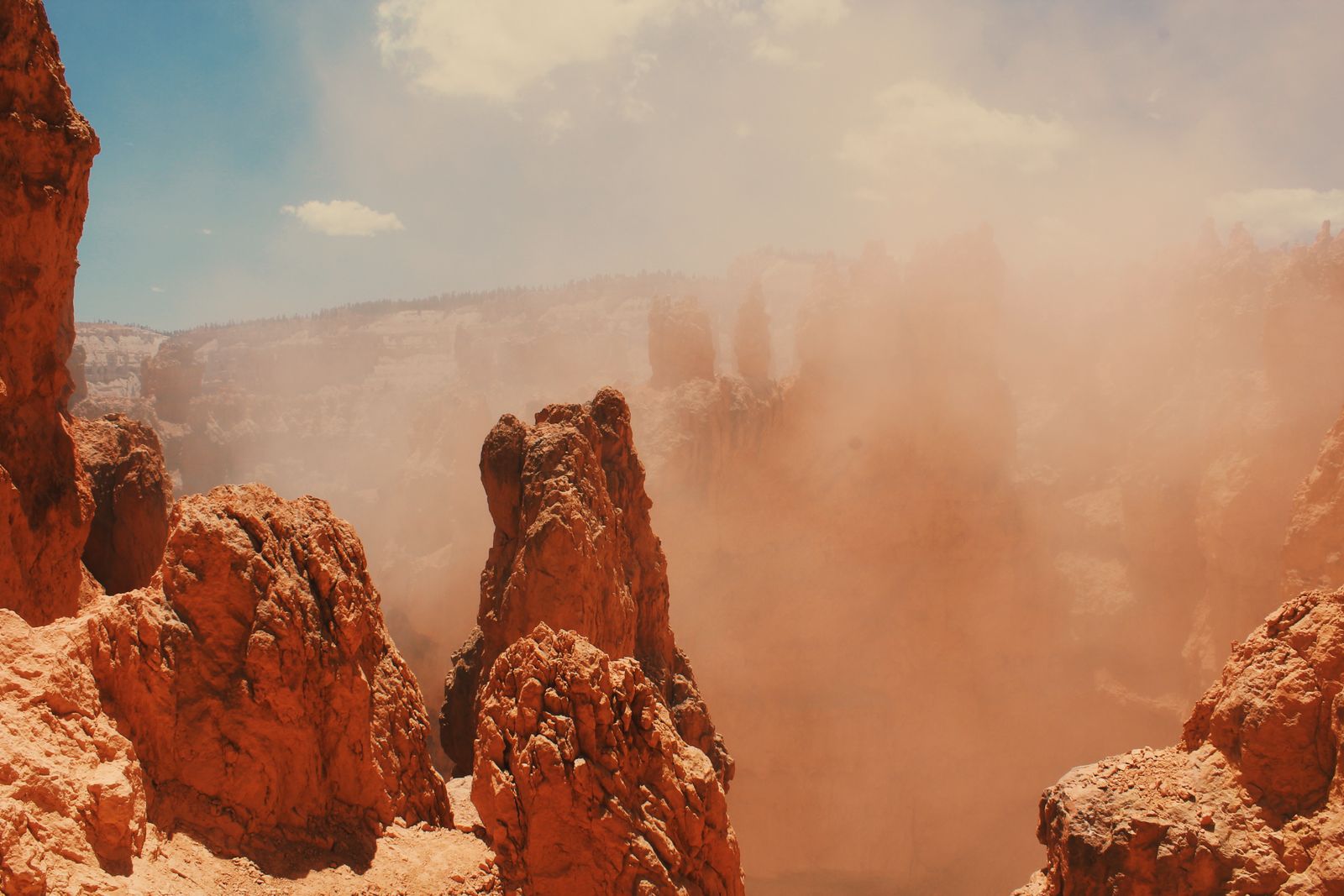
Every year, enormous quantities of Saharan dust rise from western Africa and travel across the Atlantic toward South America. A 2015 study led by Hongbin Yu used seven years of CALIPSO satellite observations to estimate that roughly 28 million tonnes of African dust are deposited over the Amazon basin in an average year.
Mixed into that dust is phosphorus, a nutrient that Amazonian ecosystems continually lose through rainfall and river runoff. The remarkable part is not that desert dust reaches a rainforest. It is that the amount of phosphorus arriving with it appears to be on roughly the same scale as the Amazon’s long-term hydrological phosphorus losses.
A desert feeding a forest
Amazonian soils are old, intensely weathered and heavily leached by rainfall. Much of the ecosystem’s usable nutrient supply is therefore held and rapidly recycled in living vegetation and decomposing organic matter rather than sitting freely in the soil.
Phosphorus is especially important because plants need it for basic cellular processes, yet some of it continually leaves the basin in water. NASA’s account of the CALIPSO findings estimates that Saharan dust supplies about 22,000 tonnes of phosphorus per year, approximately comparable with the amount lost through rain and flooding.
That does not mean Saharan dust is the Amazon’s only source of phosphorus. Internal recycling is much larger, and smoke and biological particles also contribute atmospheric phosphorus. The important point is narrower: the African dust represents an outside input that can help replace phosphorus that would otherwise be steadily removed from the basin.
The Bodélé connection
A particularly important dust source lies in northern Chad. The Bodélé Depression contains highly erodible sediments associated with ancient Mega-Lake Chad, including extensive diatom-rich deposits left behind during wetter periods in the region’s past.
Its importance is wildly disproportionate to its size. NASA Earth Observatory has described earlier satellite and modelling work indicating that more than half of the mineral dust fertilising Amazon soil could originate from this single Saharan depression.
The topography helps explain why. Northeasterly Harmattan winds are funnelled through a gap between the Tibesti and Ennedi Mountains, concentrating strong winds over the easily eroded Bodélé surface. Once lofted, fine mineral particles can continue westward on the broader easterly circulation toward the Atlantic.
What CALIPSO added
Between 2007 and 2013, CALIPSO’s lidar instrument repeatedly profiled aerosols through the atmosphere. That three-dimensional view allowed researchers to estimate the amount of dust moving through different parts of the trans-Atlantic corridor rather than relying only on what reached individual ground stations.
The resulting averages were striking. About 182 million tonnes of dust were estimated to pass the western edge of the Sahara each year, with roughly 132 million tonnes still airborne near the eastern coast of South America. Around 27.7 million tonnes were estimated to settle over the Amazon basin, while another large fraction travelled farther into the Caribbean.
This was not the first evidence that African dust reached and fertilised the Amazon. Earlier ground measurements, satellite estimates and models had already established the connection. What the CALIPSO work provided was the first multiyear satellite-based estimate using three-dimensional aerosol observations across a seven-year record.
The study also found meaningful year-to-year variation. Dust deposition varied by up to about 29% and was negatively correlated with rainfall in the Sahel during the previous year, showing how rainfall patterns in Africa can influence the amount of mineral material transported toward South America later on.
The phosphorus arithmetic
Researchers estimated that the dust deposited over the Amazon carries about 22,000 tonnes of phosphorus annually. The scientific significance comes from comparing that input with the phosphorus that leaves the basin through rivers and other hydrological pathways.
The 2015 analysis found those quantities to be broadly comparable. Its authors concluded that African dust may therefore play an important role in preventing gradual phosphorus depletion over decades to centuries.
That conclusion is more cautious than saying the rainforest would immediately fail without Saharan dust. The same paper notes that researchers still do not know exactly how much dust-derived phosphorus is required to maintain Amazon productivity, because the basin’s phosphorus cycle also includes enormous internal recycling and other atmospheric inputs.
How the dust gets airborne
The process begins with strong winds moving across a dry, loose surface. Larger grains bouncing along the ground can knock finer material into the air through a process known as saltation, allowing much smaller particles to remain suspended and travel far beyond the source region.
In the Bodélé, the surrounding terrain intensifies this process by funnelling winds across the depression. Once dust has risen high enough to join the larger-scale westward flow, it can travel thousands of kilometres across the Atlantic before rain or gravity removes it from the atmosphere.
The consequences are visible far beyond Africa. Saharan dust regularly reaches the Caribbean and the southeastern United States, producing hazier skies and affecting temperatures, rainfall and air quality.
The dry, dusty air can also interfere with tropical development. WUFT’s Florida weather coverage notes that Saharan dust can suppress weaker tropical systems, while also carrying nutrients across both terrestrial and marine ecosystems.
Two ecosystems, one long-distance exchange
The geographical contrast is what makes the story so compelling. Material eroded from one of the driest landscapes on Earth can cross an ocean and fall onto one of its wettest, most biologically productive regions.
Some dust reaches South America directly, while some continues across the Caribbean. The transport is not a single uninterrupted ribbon, and individual plumes differ enormously in strength, altitude and destination.
Once deposited in the Amazon, phosphorus-bearing minerals become part of a much larger soil and biological cycle. Weathering, microbial activity and plant uptake determine how much of that phosphorus eventually becomes biologically available.
Why Amazon soils lose phosphorus
Tropical forests can support extraordinary biomass even though many of their soils contain relatively small reserves of readily available nutrients. Warm temperatures, intense weathering and heavy rainfall have acted on Amazonian soils over geological time, while the living forest continuously recycles nutrients through leaves, roots, wood and decomposing organic matter.
That recycling is efficient but not perfectly closed. Some phosphorus is transported out of the system in dissolved and particulate material carried by rivers.
This is why the Saharan contribution matters even though it is much smaller than internal nutrient recycling. It represents phosphorus arriving from outside the basin, helping compensate for a persistent external loss.
The 2023 drought and a stressed carbon cycle
The nutrient story sits inside a broader question about how resilient the Amazon will remain as heat and drought intensify. Research published in 2026 found that the extreme conditions of 2023 substantially weakened the forest’s carbon uptake.
A report on that study put the estimated carbon release between September and November 2023 at roughly 10 to 170 million tonnes. The underlying research attributed the weak carbon-source conditions mainly to reduced vegetation uptake rather than an exceptional increase in fire emissions.
Warmer Atlantic and Pacific waters were linked with reduced moisture transport and unusually dry atmospheric conditions across the region. The drought therefore affected the Amazon not simply by increasing heat stress, but by reducing the vegetation’s ability to take up carbon through photosynthesis.
That does not establish a simple one-to-one relationship between drought and Saharan phosphorus. It does show why understanding every major input and loss in the Amazon’s nutrient and carbon cycles has become increasingly important.
The satellites that made the budget clearer
Scientists had measured African dust in and around the Amazon long before CALIPSO. What satellites added was the ability to observe the plume repeatedly over enormous distances and, with lidar, measure how aerosols were distributed vertically through the atmosphere.
The method also reflects a broader principle in Earth observation: satellite estimates become more useful when checked against measurements on the ground. NASA’s Terra education site illustrates this with TRMM rainfall estimates compared with rain gauges and radar observations.
For Saharan dust, CALIPSO provided a comparable advantage by adding three-dimensional atmospheric information to existing surface measurements and model estimates. The result was a much clearer multiyear picture of how much material crosses the Atlantic and where part of it is deposited.
What the plume looks like closer to home
By the time Saharan dust reaches Florida, its effects can be easier to see than its nutrient chemistry. Summer plumes can produce hazier skies while reducing the chances of afternoon rain and allowing temperatures to climb.
During a July 2026 event, WUFT reported that Saharan dust was expected to reach Central Florida while reducing rain chances. The same report noted the familiar combination of haze, higher temperatures and potential respiratory irritation when particles descend closer to the surface.
Those effects illustrate the strange dual nature of desert dust. It can worsen air quality in one place, interfere with tropical weather in another and deliver useful minerals to ecosystems thousands of kilometres from its source.
The connection across an ocean
The Sahara and the Amazon look like ecological opposites. One is dominated by extreme aridity, the other by extraordinary rainfall and biological productivity.
Yet the atmosphere connects them. Winds lift mineral particles from North Africa, carry them across the Atlantic and deposit part of that material into a rainforest whose soils continually lose phosphorus through water.
The CALIPSO measurements put numbers around that connection: roughly 28 million tonnes of dust deposited over the Amazon in an average year, carrying an estimated 22,000 tonnes of phosphorus. The figures come with substantial uncertainty, and the Amazon’s full nutrient budget is far more complicated than one desert feeding one forest.
But the underlying connection is real. Sediment left in a dry basin in Chad can become airborne over Africa, cross an ocean and eventually join the nutrient cycle of a tropical forest in South America. Few examples make the interconnectedness of Earth’s atmosphere, geology and living ecosystems quite so visible.