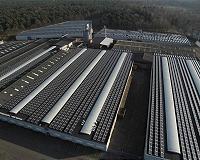
Japan Tobacco International (JTI) formally unveiled its new manufacturing plant in Batangas, Philippines this 2018. Atop its roof, a solar power system designed and installed by Solenergy Systems Inc. is running at 4.77MW peak energy generation. This self-consumption rooftop solar PV system is the largest in South-East Asia, and one of the largest in the world.
The system is composed of 17,040 solar panels from Canadian Solar Inc., covering a roof area of over 27,000sqm. The panels are then connected to 213 Fronius International GmbH grid-tied inverters, which dynamically convert the yielded solar power to usable AC electricity. The system was designed for self-consumption to directly offset JTI's power demands.
To achieve this, Solenergy deployed their proprietary curtailment control system, which dynamically regulates the power generated to match the client's needs.
Annually, the solar PV system is expected to generate close to 6.5 Gigawatt hours of energy, which is enough to power 4,300 homes. Furthermore, the system will offset as much as 4 million kg of CO2 emissions that would otherwise have been produced by grid-sourced power.
Solenergy's participation in the project began months before the ground-breaking of the facility began. Since pre-construction phase, close coordination with JTI had been key to streamlining the architectural and electrical designs of such a large project. One notable challenge was finding a cost effective and structurally sound mounting solution for the plant's membrane roof system.
Discussions eventually led to a custom bracketing system designed by Solenergy that achieved these objectives while maintaining the roof's watertight seal. Advanced features of the Fronius inverters were also critical to the project's success, as they are being used to help regulate and optimise the client's power factor.
In addition, the lightweight, low maintenance nature of the Fronius inverters make them ideal for industrial applications. Solenergy is also the only Service Partner Plus for Fronius in the Philippines, thus enabling them to also perform all warranty and service requirements on-site.
Self-consumption of solar power is becoming more and more popular in the Philippines, with industrial and commercial facilities seeing the benefit in offsetting daily power demands. Along with green incentives and global directives to source clean energy, companies such as JTI continue to play a critical part in identifying, understanding, and ultimately reducing the environmental impact of large scale manufacturing in the Philippines.