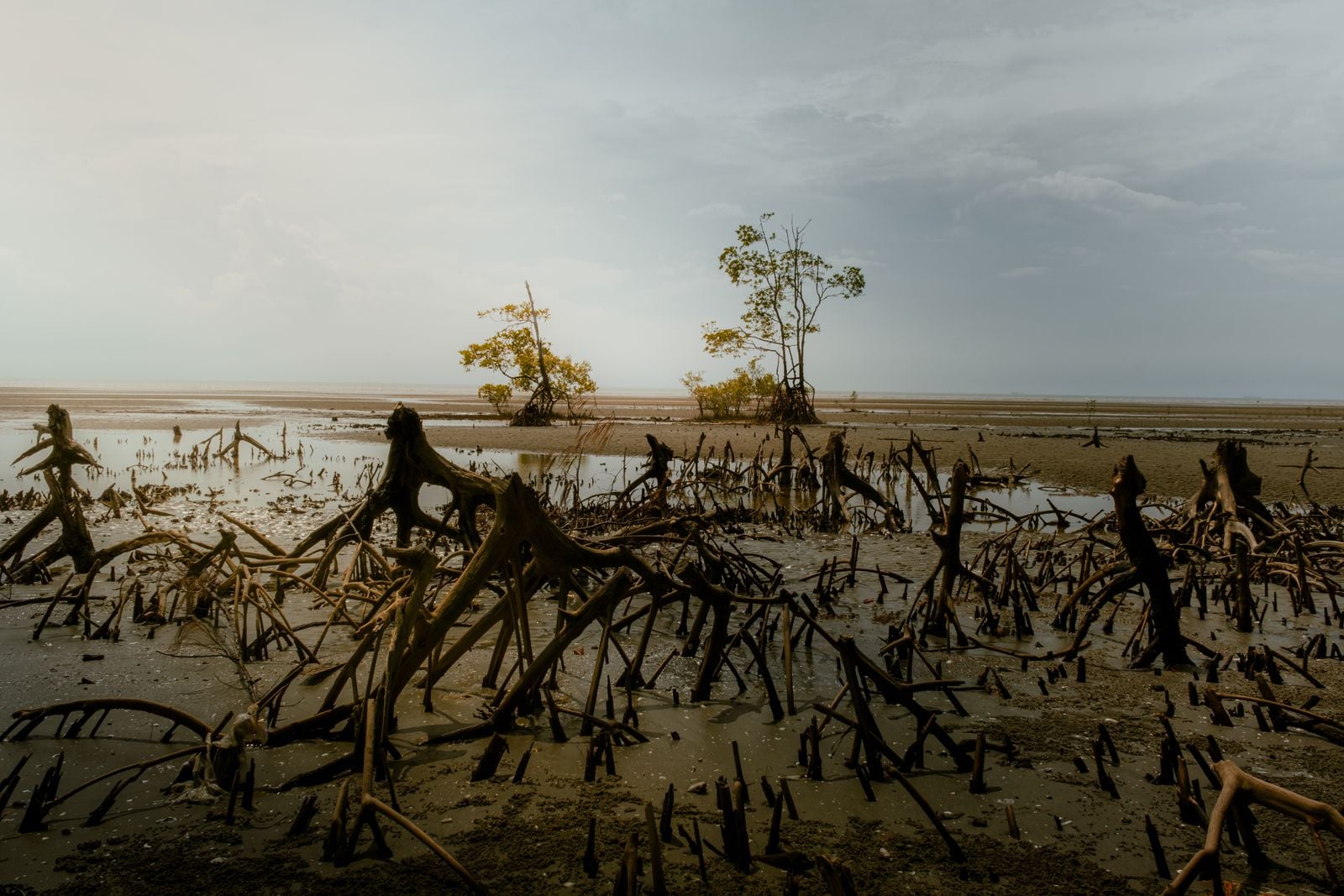
A mangrove is a tree that drinks salt water. It grows in tidal mud along tropical coasts, breathes through knee-shaped roots that stick up out of the sediment, and locks carbon into waterlogged soil so oxygen-poor that leaves and roots take centuries to rot. That trapped, anaerobic soil is the whole trick. A hectare of mangrove holds several times more carbon than a hectare of tropical rainforest, which stores between 60 and 230 tonnes of carbon per hectare, and most of the mangrove total sits below the waterline rather than standing in the trunks.
The failure rate is the other half of the story. In parts of Southeast Asia and Latin America, research suggests roughly 70 percent of restoration projects struggle to establish healthy forest, usually because the wrong species went into the wrong tidal elevation on the wrong stretch of coast. The carbon math is spectacular. The reforestation record is grim. Both facts are true at once.
Where the carbon actually sits
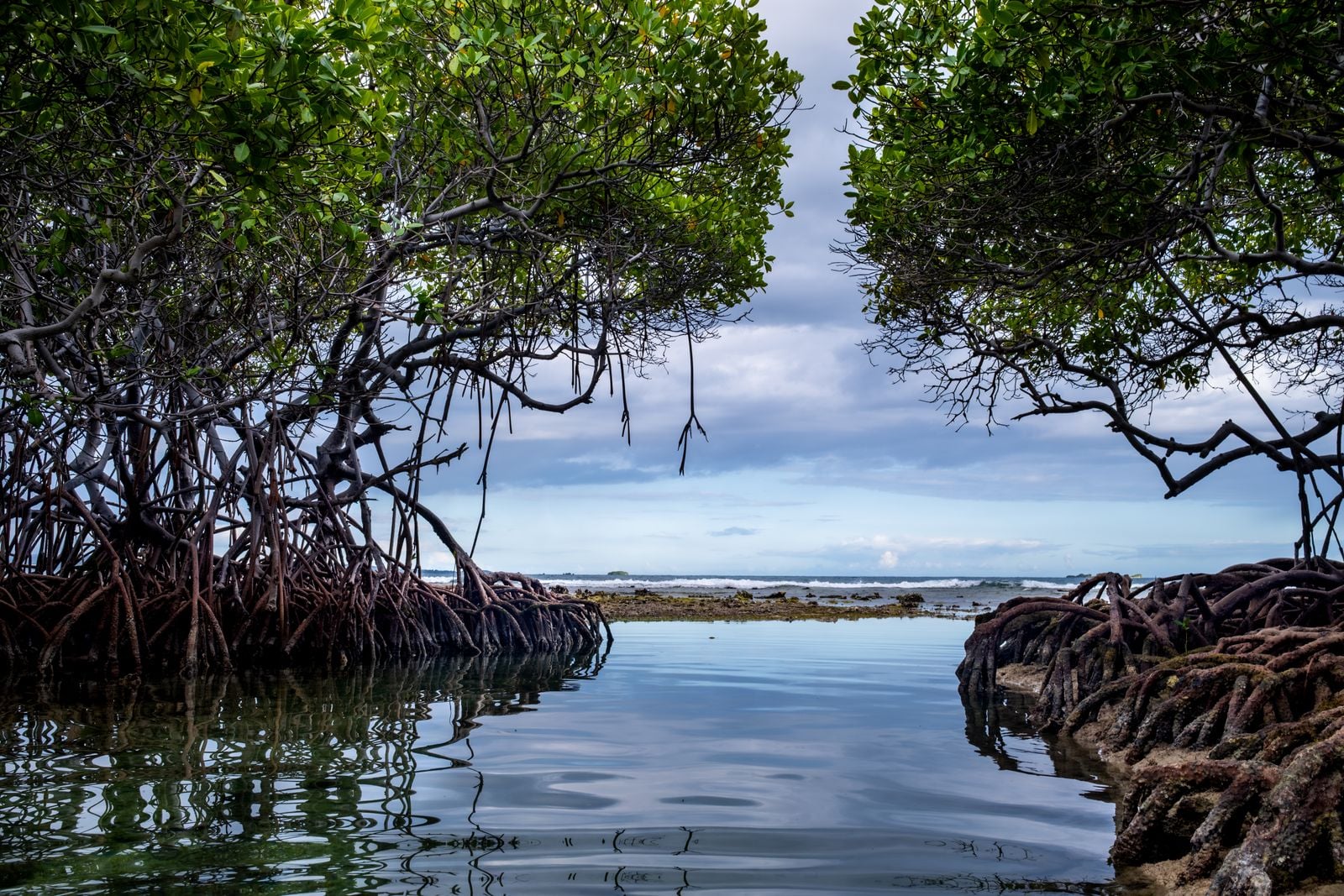
Look at a mangrove and you see the trees. The carbon is somewhere else. A tropical rainforest holds most of its carbon in living wood and in leaf litter that decomposes on a warm, oxygenated forest floor. Mangroves invert that ratio. The trunks and canopy hold a modest amount. The soil holds the rest, averaging around 430 tonnes of carbon per hectare and reaching 1,000 tonnes or more in mature, well-preserved stands, in peat-like layers that can run several metres deep.
The reason is chemistry. Mangrove soil is flooded by the tide, so oxygen cannot reach the organic matter that falls into it. Microbes that would normally break down dead roots and leaves stall out. Carbon accumulates instead of respiring back to the atmosphere. A leaf that lands in an Amazon clearing is gone in months. A leaf that sinks into mangrove mud can still be there when the next century starts.
The global totals are large enough to matter to national carbon accounts. Mangrove soils hold more than 6.4 billion tonnes of carbon in their top metre alone, and inventories that follow the soil profile deeper than one metre put total ecosystem storage at roughly 11.7 billion tonnes, of which about 10.2 billion tonnes is below ground. The choice of soil depth changes the answer more than climate, salinity or forest structure do.
The soot layer nobody counted
Inside that soil carbon is a fraction almost nobody was measuring. Black carbon, the soot-like residue of wildfires and fossil fuel combustion, washes down rivers and settles into tidal mud. A survey of mangrove soils in the Zhangjiang Estuary in China found black carbon at 0.95 to 1.67 grams per kilogram of soil, between 3.5 and 17.4 percent of total organic carbon, with the dissolved fraction ranging up to 12.18 milligrams per kilogram.
Black carbon is unusual because its condensed aromatic structure resists decomposition for centuries. In the Zhangjiang cores, concentrations fell with depth, but the proportion of the remaining carbon that was black carbon rose, and the material grew more aromatically condensed the deeper it sat. The most stubborn fraction settles deepest, where it is least likely to ever move.
That matters for climate budgeting because it means a mangrove is not only storing this year’s leaf fall. Part of what it holds is soot from fires that burned decades ago and combustion products that travelled downriver from cities upstream, in a form that is close to permanent on human timescales. It is one estuary, not a global census, and the accounting has barely begun.
Methane is the asterisk
The blue-carbon case is not clean. Mangrove tree stems emit methane, and until recently that flux was ignored. A global assessment published in Nature Geoscience in November 2025 by researchers at the South China Botanical Garden found that stems release roughly 730 gigagrams of methane a year, offsetting about 16.9 percent of the carbon buried in mangrove sediments. Add soil emissions and the total offset reaches about 27.5 percent. Methane traps roughly 80 times more heat than CO2 over a 20-year period, so the trunks bite into the net gain from the buried carbon.
Roughly three-quarters of the sequestration survives that deduction, so the ledger still favours mangroves by a wide margin. But it is a smaller margin than the raw soil-carbon figure implies, and the authors are explicit that judging blue carbon on sediment burial alone substantially overstates the climate benefit. The stems turn out to be conduits: methane made by anaerobic microbes in the mud travels up through aerenchyma tissue and vents highest near the base of the trunk.
Why the plantings die
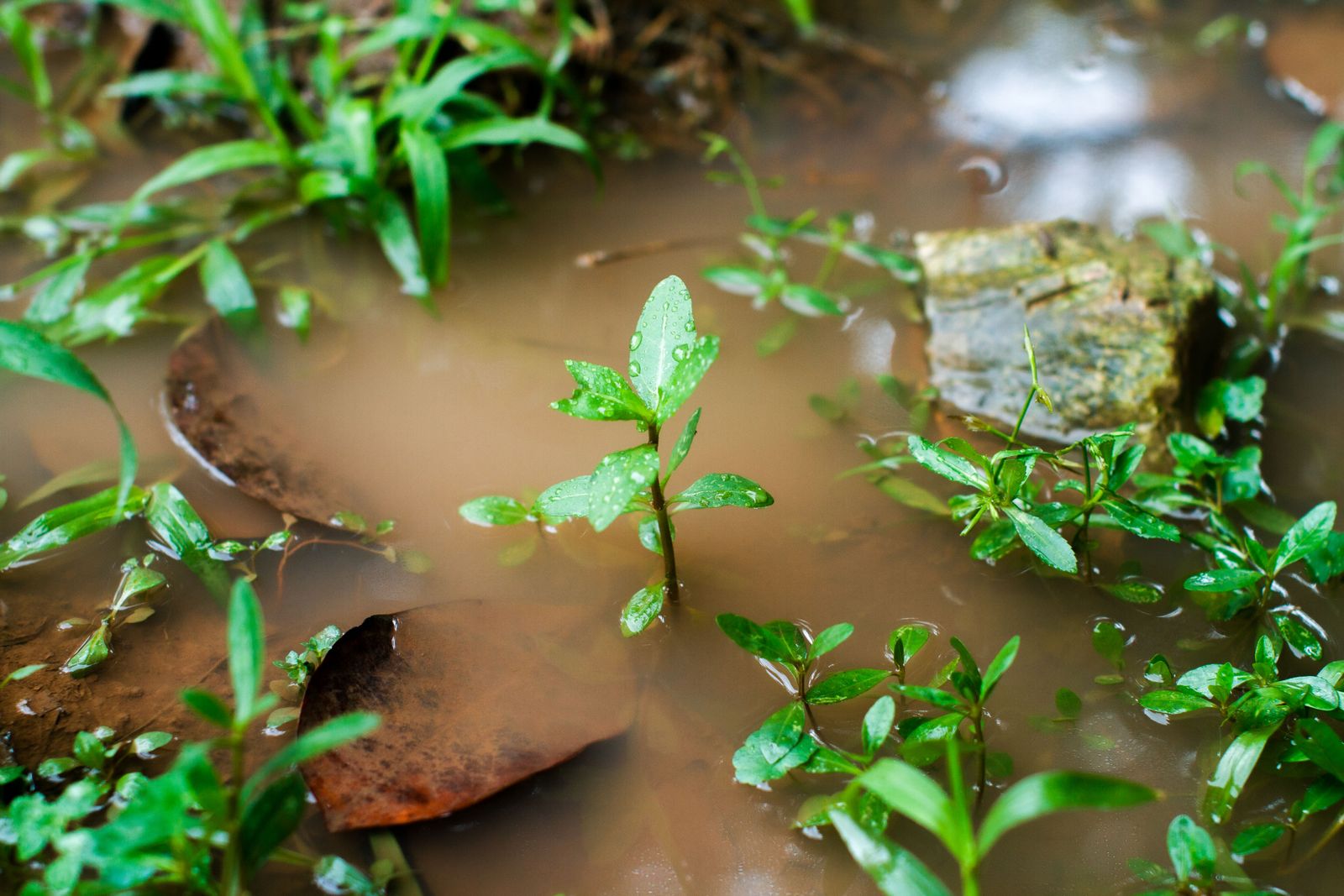
The failure pattern is predictable enough that it has a name in the restoration literature: monospecific planting at the wrong elevation. A well-meaning project shows up on a stretch of degraded coast, buys thousands of Rhizophora propagules, the pencil-shaped seedlings that look like a mangrove is supposed to look, and pushes them into mudflats or seagrass beds that were never mangrove habitat to begin with.
Mangroves are picky about tidal elevation. Each species, Rhizophora, Avicennia, Sonneratia, Bruguiera, occupies a narrow band of the intertidal zone defined by how many hours per day its roots sit underwater. Plant Rhizophora too low and the seedlings drown. Plant them too high and they desiccate. In the Philippines, where long-term survival has run at just 10 to 20 percent, Jurgenne Primavera and Jon Esteban traced the poor results to two causes: unsuitable species and unsuitable sites. Planters favoured Rhizophora on exposed sandy coastlines where the natural colonisers are Avicennia and Sonneratia, and they planted low in the intertidal because the mid and upper zones had long since been converted to fishponds.
That points at the larger problem, which is that plantings often go into the wrong ecosystem entirely. Mudflats and seagrass meadows are not degraded mangrove forests. They are their own habitats with their own carbon budgets, and covering a seagrass bed with mangrove seedlings can destroy one blue-carbon system to build a failed version of another. A systematic review of 335 mangrove restoration studies across Southeast Asia found direct planting used in 74 percent of projects and hydrological rehabilitation in only 9 percent, with national programmes still putting Rhizophora into non-mangrove zones.
What works: hydrology before seedlings
The projects that hit high survival rates share a pattern. They fix the water first. Blocked tidal creeks are reopened, aquaculture pond walls are breached, upstream sediment supply is restored. Then, in many cases, the mangroves return on their own from waterborne propagules, with no planting required. Where planting is used, it fills gaps rather than substituting for natural recruitment. The same review found that smaller projects sited in the mid to upper intertidal succeed far more often than mass plantings along lower coastal fringes.
Nigeria’s Hydrocarbon Pollution Remediation Project has been running a case study in this approach across ten communities in Ogoniland, where mangroves were devastated by decades of oil pollution, working with the University of Portsmouth, the Mangrove Action Project, Rivers State University and the University of Colorado Boulder. According to the Commonwealth’s account of the work, the project supported restoration of more than 3,000 hectares of oil-degraded mangroves, identified 21,723 restorable hectares, and estimated up to $49 billion in carbon credit revenues over 40 years under best-case scenarios.
The community piece is not decorative. Of the 1,757 respondents surveyed across those ten communities, more than half of households drew significant income from mangrove resources. Plantings that ignore local livelihoods get cut for firewood or cleared for aquaculture within a few seasons. Plantings that pay households to protect them tend to survive.
The stakes are not only carbon. A belt of mature mangroves absorbs storm surge the way a shock absorber takes a pothole. Bangladesh lost about 138,000 people to the cyclone of April 1991 and recorded 3,406 deaths when Cyclone Sidr struck in November 2007, an improvement we have examined in detail. Warnings, evacuation and shelters carry most of the explanation. The coastal greenbelt, begun in 1966, is one layer in a system, and the public record does not support handing it the credit.
Coastal restoration and terrestrial reforestation also run on different clocks. The South Korean reforestation story we looked at earlier this year turned on decades of consistent state policy and village-level fuelwood substitution. Mangrove restoration has to work at the tidal cycle. Hours matter, not just decades.
Why the sector overpromises
The failure statistic keeps recurring because the incentive structures reward planting counts rather than survival counts. A donor writes a cheque for 100,000 seedlings. A contractor plants 100,000 seedlings. Photos are taken. The contract closes before anyone comes back to see how many are alive at year three, let alone year five.
Monitoring is the weak joint. The Southeast Asia review found that the usual markers of success are survival rate and area planted, that monitoring data are missing from most projects, and that where reports exist they cover spans too short to judge whether ecosystem function returned. Natural recolonisation alone takes an estimated 10 to 25 years to produce developed forest. Its authors argue plainly that long-term recovery deserves more weight than the hype around carbon offsets. When credited sequestration never materialises, the credits may already have been sold.
Carbon-market rules are tightening in response. Newer methodologies require multi-year monitoring, species-appropriate site selection, and hydrological restoration before planting counts toward credits. Older projects are being retired or downgraded when survival audits come in.
How much mangrove has actually been lost is itself contested, and the answer depends on where you start counting. Estimates built from historic baselines put the loss at roughly a third of global mangrove area over the past half-century, and that figure still circulates widely. The satellite record is narrower. An analysis of four decades of Landsat imagery, published in June 2026 by researchers at Tulane University, found gains beginning to counterbalance losses around 2010, leaving a cumulative net decline of about 1 percent since the 1980s, with closed-canopy forest rising from roughly half of the total to about 58 percent. Most of that gain came from mangroves expanding into new ground rather than damaged forests recovering, and the authors are careful to say deforestation continues in many local regions.
The tree that grows in salt water is doing something no rainforest can do: burying carbon in mud that will not let it go. The math works because the mud is anaerobic, because the tides keep depositing new sediment on top, and because leaf litter that falls in never fully rots. Break any of those conditions, drain the soil, cut the tidal connection, plant the wrong species at the wrong elevation, and the whole system stops working.
At high tide on a healthy mangrove coast, the trunks stand in a metre of brown water and the crabs disappear into their burrows. At low tide, the roots reappear like a forest of bent knees, and the mud between them smells faintly of sulphur. That smell is the carbon staying put. It has been staying put, in some places, since before the pyramids.